PG-13 (for violence, sensuality and language including sexual references)
Directed By
F. Gary Gray
Run Time
1 hour 58 minutes
Cast
John Travolta, Uma Thurman, Dwayne Johnson
Theatre Release
March 04, 2005 by MGM
Be Cool, directed by F. Gary Gray (The Italian Job), tries to strike the cocky pose of its 1995 predecessor, Barry Sonnenfeld's Get Shorty, and other show-biz satires like The Player. But above all, it alludes to Quentin Tarantino's Pulp Fiction, with its dimwitted gangsters, glamorous ne'er-do-wells, gunslinging face-offs, painful ironies, and its centerpiece John Travolta/Uma Thurman dance floor flourish.
So, let's borrow a note from Pulp Fiction and begin with a definition:
cool, adj.
Neither warm nor very cold
Giving relief from heat
Characterized by calm self-control
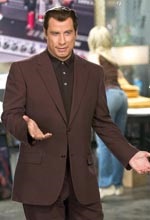
John Travolta returns in his role as Chili Palmer
All of these definitions can apply to Be Cool, but one is especially appropriate.
Chili Palmer, the thug who smooth-talked his way into a job as a film producer in Get Shorty, continues to be the perfect role for John Travolta. Palmer's big, square-shouldered, cigarette-slinging machismo, ice-blue stare, and self-control in the midst of Mexican standoffs are the epitome of Definition No. 3.
Regarding Definition No. 2, Be Cool's release date means it's too early to offer us any relief from summertime heat. But it does offer two hours of climate-controlled reprieve from our troubles … even if it replaces them with new ones. Further, it's quite a change from the "heat" of the recent, self-important, serious, and sometimes scandalous Oscar contenders.
But Be Cool is best described by Definition No. 1. Like Get Shorty, it has all of the talents it needs to bring things to a rapid boil. But Gray and screenwriter Peter Steinfeld can't take this tepid material to anything more than a simmer.
Gray seems unfocused and uninspired, and since his style lacks energy, he fails to muster any in us. The central conflict never convinces us to care. It's a flimsy story drawn from Elmore Leonard's novel about a girl-group pop singer who wants to break free and release her inner diva.
Chili Palmer, restless in the movie business, wants to switch industries. When he discovers the young and talented Linda Moon (Christina Milian), he sees that he can help her find a better future. Furthermore, she can be his ticket to a new career, and provide the lift necessary for a sinking record company managed by his leggy friend Edie Athens (Uma Thurman). But first, Edie and Chili must liberate Linda from a five-year contract. To do that, they'll have to out-talk, outmaneuver, and outwit a heartless management kingpin (Harvey Keitel) and a sleazy manager (Vince Vaughn).
It's easy to imagine how much fun Tarantino, the Coen Brothers, Steven Soderbergh, or even Guy Ritchie would have had with the caper that follows, as slimy businessmen, producers, and even the Russian mafia wrestle for Linda's contract. But Grey's approach is to move so lazily and half-heartedly along that a viewer's mind is likely to wander into questions like these:
With so many stars involved, how much money did this forgettable picture cost to make?
Mel Gibson took flack for earning millions from The Passion of the Christ—his very passionate and personal project. So why isn't anybody questioning the dollars that exchanged hands for this empty, misguided, superstar-packed waste of time? (The film's production budget is not listed online.)
Couldn't they find something more interesting for Uma Thurman to do than show off her bikini-ready figure and play such a half-baked character?
This is Thurman's first role since her Oscar-worthy, acrobatic Kill Bill exhibitions, where she careened between furious action-hero stunts, slapstick comedy, melodrama, and moments of grief, terror, and tragedy. Perhaps she used this film as a time to relax and recover. If so, it shows.
And when Thurman's much-anticipated dance-floor rematch with Travolta finally arrives, it's completely underwhelming. Gray chooses a sleazy soundtrack by the Black Eyed Peas and Sergio Mendes, and then moves the camera around so much we have a hard time seeing the dance.
Does Elmore Leonard's novel really include spectacle scenes at the Viper Room, a Laker game, and an Aerosmith concert?
These scenes seem suspiciously calculated to distract us from the film's lack of a compelling storyline, the way Anger Management collapsed into a major league baseball game. They also feel like ideas produced by "a committee," one of the Hollywood dynamics criticized in the film.
Vince Vaughn is irresistably funny in his role as a sleazy manager
Why couldn't they develop Linda Moon, whose career plight is the crux of the matter, into a character we care about? And if she's supposed to be a rare and extraordinary talent, why not find some songs she can perform that prove it?
Therein lies Be Cool's most serious flaw. The characters knowingly wink at Hollywood and Top 40 superficiality. And there are plenty of smirking references to this movie's status as a "product" of the machine. (Chili spends one scene despising unnecessary, mediocre sequels. Aerosmith's Steven Tyler, comfortably playing himself, announces, "I'm not one of those singers who appears in movies." Unapologetic product placement is everywhere.)
But when we're supposed to believe that Chili has found an alternative to artificiality—something "pure" and "genuine"—this exemplar of integrity starts dancing and singing like just another industry product. Pop star Christina Milian certainly knows how to strut her stuff, but if these performances are representative of her work, in a few years we won't be able to tell her apart from the other Janet Jackson/J-Lo clones who line up for American Idol (which the film deftly skewers).
Article continues below
Some will argue that Be Cool doesn't deserve much serious analysis. And they're right. It doesn't deserve much attention at all. Gray and Company are uninterested in anything more than mild-mannered entertainment. As far as that goes, it has its memorable moments. The end-credits montage, which gives each cast member a chance to bust-a-move, is as much fun … and substantial … as anything that precedes it. And a few of the supporting actors score points along the way.
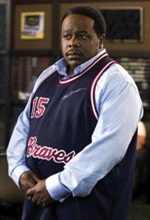
Cedric the Entertainer seizes the film's potential for inspired lunacy. His character—Sin, a successful hip-hop producer who hides his Wharton education in order to keep his "street cred"—is followed around by a group of muscle-bound gunslingers called the Dub-MDs. Whenever they arrive in their parade of glitzy black Hummers, the film's heart gets a jump start.
We get another jolt from Vince Vaughn, who is, perhaps for the very first time, irresistibly funny. As Raji, an ants-in-his-pants music-biz manager and the greatest poser of them all, he goes over-the-top with "gangsta" talk and hyperactive body language. When he learns that he can't get away with gay-bashing around his enormous, unmistakably homosexual bodyguard (Dwayne "The Rock" Johnson in a surprisingly amusing, self-effacing turn), he has to dodge the disgruntled giant's Herculean punches even as he smooth-talks him out of the tantrum. His frenetic rhyming manages to save his skin more than once: "Stop hatin'—start participatin'!" Vaughn seems to be working twice as hard as anyone else in the picture.
Cedric the Entertainer, playing a hip-hop producer, gives the film a rare jump start
But these characters are much more exaggerated than those in Get Shorty. Their behavior is so outrageous that the dramatic turns of the plot—especially those scenes in which characters kill each other—seem jarringly dissonant.
The Pulp Fiction references only emphasize Be Cool's inferiority. Tarantino's characters made you fear them even as they bewildered you, made you laugh, and made you care. Every scene was saturated with searingly memorable style and dialogue that snap-crackle-popped. It boasted career-peak performances by most of its actors. Contrarily, there's nothing distinctive about Be Cool's style. Its comedy engine idles, revving only occasionally. Screenwriter Steinfeld's dialogue strikes few sparks. And some cast members are surprisingly disappointing, perhaps miscast. Thurman's Edie, Keitel's Nick, and James Woods' Tommy are lousy replacements for the memorable fools of Shorty played by Rene Russo, Gene Hackman, and James Gandolfini. Keitel and Woods, usually reliable, look like they got the call and did their scenes the same day, without a moment's preparation.
Article continues below
If these actors and storytellers did want to impress any kind of message on us, it's this tired old refrain: Everyone in showbiz is a hustler. But then it concludes, "Hey, who cares when there's so much fun to be had?" The answer to that is—we care. After all, the actors are clearly having more fun than we are, walking away from this mess with big paychecks, while we're wondering how we got swindled out of another hard-earned ten bucks.
Talk About It
Discussion starters
What do you think of Chili's relationship with Edie? Do you think Edie really loved her husband? Do you think her relationship with Chili is likely to last longer or be stronger?
Are any of these characters particularly admirable? Is anyone here behaving generously or selflessly?
Do you think Get Shorty and Be Cool are a truthful representation of show business? What kind of people does show business typically reward? Why do so many mediocre talents become so popular?
What are your goals in using your talents? How are you pursuing those goals? How important is fame to you? Would you change your goals if someone offered you enough money? When you use your gifts, who do you strive to impress? Whose opinions are important to you?
Talk about a time when you presented yourself as something you weren't? Why do we sometimes feel pressured to be "posers"? How can we overcome that?
The Family Corner
For parents to consider
Be Cool is rated PG-13 for profanity, violence, and sexual references. There's nothing much worthwhile here for younger viewers … or adults, for that matter.
Chili Palmer, the thug who smooth-talked his way into a job as a film producer in Get Shorty, continues to be the perfect character for John Travolta. Palmer's big, square-shouldered, cigarette-slinging machismo, ice-blue stare, and self-control in the midst of Mexican standoffs are the epitome of "cool." And in the sequel, director F. Gary Gray's Be Cool, he even gets to dance.
Article continues below
But Be Cool is best described as "lukewarm." Like Get Shorty, it has all of the talents it needs to bring things to a rapid boil. But Gray and screenwriter Peter Steinfeld can't take this tepid material to anything more than a simmer. Gray seems unfocused and uninspired, and since his style lacks energy, he fails to muster any in us. The central conflict never convinces us to care.
It's a flimsy story drawn from Elmore Leonard's novel about a girl-group pop singer (Christina Milian) who wants to break free and release her inner diva. Chili Palmer, restless in the movie business, wants to help her find a better future. Furthermore, she can be his ticket to a new career, and provide the lift necessary for a sinking record company managed by his leggy friend Edie Athens (Uma Thurman). But first, Edie and Chili must liberate Linda from a five-year contract. To do that, they'll have to out-talk, outmaneuver, and outwit a heartless management kingpin (Harvey Keitel) and a sleazy manager (Vince Vaughn).
It's easy to imagine how much fun Tarantino, the Coen Brothers, Steven Soderbergh, or even Guy Ritchie would have had with the caper that follows, as slimy businessmen, producers, and even the Russian mafia wrestle for the contract of this promising pop singer. But Gray's approach is to move so lazily and half-heartedly along that a viewer's mind is likely to wander.
Michael Elliott (Movie Parables) had a good time. "No one should go to Be Cool expecting much depth or consistency in the story line. The fun of this film is in watching the individual components. Elmore Leonard has peopled his novel with a cornucopia of unusual characters which Hollywood, true to form, delights in bringing to life. No one seems to be delighting more than The Rock, who is hysterical."
But Christopher Lyon (Plugged In) did not have a good time. "After 10 years, you've got to wonder who was asking for this sequel. After two hours, viewers will be wondering why they asked for a ticket. Be Cool is the perfect triple threat: stupid, boring and offensive. It's the whole package."
Annabelle Robertson (Crosswalk) says, "The main message in the film is that the music industry is full of gangsters—like that's a revelation. Everyone is pursuing their dream, and they aren't afraid to shoot someone else—or sleep with their best friend's widow—to get it. Pretty sordid stuff, especially when you add the overwhelming number of profanities and obscenities and a lot of shoot-em-dead violence."
Article continues below
Frederica Matthewes-Green (The National Review) is a fan of Get Shorty, but not its sequel. "Every once in awhile a comedy comes along that is bright and quirky enough that it lingers companionably in the mind a long time after. Get Shorty was one of those movies; the first time I saw it, I spent the ending credits wearing a big grin, thinking back over delicious scenes and wishing I could see more of those characters. Be Cool is a sequel that took ten years in coming, and now the reverse seems to be true: The characters are brassy, loud, and shallow, and there is a lot more of them on display than you really want to see."
Andrew Coffin (World) says, "Chili begins the film talking about the artistic sacrifices involved in making a sequel, something to which his character has just acquiesced. For a movie so concerned with the calamitous plight of such bottom-line-driven projects, Be Cool is remarkably bad. Or is that part of the joke? That doesn't make the film any funnier, but for the sake of everyone involved, I hope it's true."
The Grammy-winning artist was found dead at her home in Nashville at age 47.
Diana Chandler - Baptist Press
Be Cool
1 of 4
John Travolta returns in his role as Chili PalmerUma Thurman plays record company exec Edie AthensVince Vaughn is irresistably funny in his role as a sleazy managerCedric the Entertainer, playing a hip-hop producer, gives the film a rare jump start















 While we pray for peace, we need moral clarity about this war.
 We’ve got little information on Jesus’ appearance and personality. But that’s the way God designed it.españolFrançais
 The Grammy-winning artist was found dead at her home in Nashville at age 47.