You'd be hard-pressed to find an adventure film that uses as much Christian terminology and symbolism as Constantine. You'd have a tougher time finding one that's makes a bigger mess of it.
Director Francis Lawrence's stylish, adrenaline-fueled adaptation of the comic book Hellblazer will probably win some enthusiastic fans among Christian moviegoers keen on pop culture. After all, this hero seeks redemption, fights Satan, entertains angels, and blasts demons with weapons that bear the mark of the Cross (from the blessed brass knuckles to a golden crucifix-Tommy gun). But if you're looking for profound spiritual exploration, this isn't your movie. Nor is it a fun hodgepodge of magical fairy tales like Harry Potter. It's an R-rated immersion in the vocabulary of demon possession and the occult. Compared with Constantine, The Exorcist seems like an after-school special.
John Constantine (Keanu Reeves) is a suit-and-tie exorcist and a chain smoker. He's been to hell and back—literally. Committing suicide, he plunged himself into Satan's clutches, only to be resuscitated back to the land of the living. Why suicide? John grew up with the "gift" of seeing spiritual warfare around him: screaming demons, angels with enormous wings, and "half-breeds"—agents clad in human flesh who act as influence peddlers serving to nudge people either heavenward or to the abyss. You'd think his taste of brimstone would have convinced him to repent. But no—John's too proud, too resentful. Instead he'll try to earn salvation as a volunteer demon hunter on the streets of Los Angeles.
It's a bad time to be a soldier in the spirit wars. In a sequence that recalls The Return of the King's prologue, a talisman called the Spear of Destiny corrupts and transforms the man who discovers it. This menacing villain marches toward L.A., desolation in his wake, preparing to unleash a new devil that will upset "the balance" in the struggle of heaven versus hell.
When John discovers that demons are breaking the rules of engagement and coming through into the physical world, his colleagues don't believe him: "We're finger puppets to them, not doorways." But John knows better. He sets out on a quest with three purposes: to help a police investigator (Rachel Weisz as Angela Dodson) unravel the mystery of her sister's murder; to avert the coming apocalypse; and to stop the spread of his terminal lung cancer. (In The Matrix, Keanu knew kung fu. Here, he has coughing fits.)
Rachel Weisz is a police investigator trying to solve her sister's murder
John gets help from a cocky apprentice named Chas (Shia LeBeouf from Holes) who wants to "get off the bench" and into the game of spiritual warfare; an alcoholic priest (Pruitt Taylor Vince) who scans spiritual wavelengths for psychic murmurings; and a relic collector (Max Baker) who lives in a bowling alley. But other colleagues confuse matters. A nightclub manager called Midnite (Djimon Hounsou) claims to be neutral, but he happily gives hell-spawn a place to party. Gabriel, an androgynous, "half-breed" angel (Tilda Swinton), is less than angelic.
And yet Gabriel alone has some grasp of the exorcist's theological blind spots. He (she?) reminds John that salvation cannot be earned through good works. When John asks what God expects, Gabriel replies, "The usual. Self-sacrifice. Belief." John knows the value of repentance; he lectures a demon (rock star Gavin Rossdale) on the subject. But his grudge against the Almighty is too strong. "God's just a child with an anthill," he declares. "He has no plan."
Constantine touches on many truths: the battle between forces seeking to save or to ruin souls, the reality of possession, the responsibility that comes with God-given gifts. Lawrence and his screenwriters Kevin Brodbin and Frank Cappello do not identify themselves as particularly religious (although Cappello says he has a Lutheran background). They score some points for trying. But they'd have avoided embarrassing errors if they'd consulted with some Bible readers. First Corinthians has chapters, not "acts." Jesus died as a result of crucifixion, not because a Roman soldier thrust a spear into his side. A Catholic could have told them that Roman Catholicism does not consign suicide victims to eternity in hell.
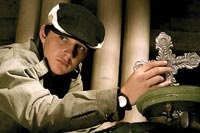
Chas (Shia LaBeouf) is dying to join John in the fight against demons
But the film's preoccupation with jarring violence and distortions of Christian symbolism are truly troubling. A character undergoes a reverse baptism, awakening to horror. Demons try shoving their way through one woman's throat and another woman's womb. The Cross is everywhere, but the Savior who died on it goes unmentioned. Constantine's premise makes Jesus' existence impossible—God and Satan have apparently made a bargain not to intervene on the plane of human existence, using only the power of suggestion instead. What was Christ, if not God's most significant intervention into human history?
This question is easily forgotten in the onslaught of frenzied, CGI-generated apocalyptic imagery. Horror movie buffs will enthusiastically absorb the relentless shocks, the showdowns, and the expletive-laced ultimatums. Lawrence's approach to holding our attention consists of frequent, hushed pauses, followed by explosive assaults to our senses. The camera is at the receiving end of gunfire, punches, blowtorch blasts, and falling bodies. Every few minutes, someone smashes through a mirror, a window, a wall, or a watery surface. One hero half-drowns another. Holy water acts like acid, burning human flesh off demons in disguise. The relentless violence is wearying. By the time Peter Stormare appears in the last act playing the part of Lucifer (Constantine calls him "Lu"), the story has become so convoluted and ridiculous that we can't take the movie seriously anymore. (Judging from his campy, over-the-top performance, neither can Stormare.)
Article continues below
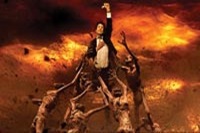
Constantine, trying to escape the grip of those pesky demons
Fortunately, the storytellers know enough to recognize the need for a Christ figure, even if all they have available is an arrogant, resentful con man with the initials "J.C." But the conclusion would have been more resonant if we'd learned not just the wages of sin, but the blessings of obedience. It's a misleading idea that the film presents—good and evil in "balance." Even so, we get gobs of hell and only a glimmer of heaven.
Constantine is likely to blockbust its way to some sequels. Christian moviegoers who see it might enrich post-viewing discussions by pointing out what Scripture actually says about spiritual warfare and the "full armor of God" (Ephesians 6:10-18). They might point to a God who is not remote, not indifferent, but aggressively benevolent. He never signed a cosmic détente with Satan. Instead, he defeated him by taking the sting from death through the sacrifice and resurrection of an obedient, willing hero.
Talk About It
Discussion starters
What is the difference between Constantine's understanding of redemption and the way Scripture describes it? What is truly required of us for forgiveness of sins and the gift of eternal life?
Are good and evil equal forces that should exist in a balance? Or is one stronger than the other? Upon what do you base your opinion?
If you consider the signs given in Constantine, what can you say about "God" in this comic book world? What kind of God is he?
Does Constantine have a right to be angry with God? Why or why not?
What does Scripture say about demon possession? What examples does it give us? In the Bible, who casts out demons? Is this something anyone can do?
Compare the angel Gabriel of the Bible to the angel Gabriel of Constantine. How are they different?
Article continues below
Why is Chas impressed with Constantine? Do you think it's a healthy admiration? Do you think Constantine is a good role model?
What are Constantine's strengths? What are his weaknesses?
The Family Corner
For parents to consider
Constantine is appropriately rated R for extreme violence, gore, and obscenities. Unlike the Harry Potter stories, in which magical spells are the sort found in fairy-tale make-believe, Constantine fictionalizes the dangerous realities of spiritual warfare in a way that entertains us with sensationalized evil. This is the kind of film that really could provoke immature viewers to develop an unhealthy interest in the occult.
Keanu Reeves has played Buddha (Little Buddha), the messiah figures of Neo (The Matrix) and Johnny Mnemonic, the son of the devil (The Devil's Advocate), and a traveler to hell (Bill and Ted's Bogus Journey).
Now, in Francis Lawrence's action-horror flick Constantine, he's an exorcist who's been to hell and back, and thus he knows how important it is to fight on the right side of the war for human souls. But he's also unwilling to deal with God, except in a begrudging fashion as a smart-mouth and a bargainer. He'll cast out as many demons as is necessary to "earn" his way back into God's good graces, but he's not in any kind of mood to ask for forgiveness. Meanwhile, the forces of evil are threatening to overwhelm the world now that one of their zombie-like minions has gained hold of a magical talisman—the spear that killed Christ.
Wait a minute … the what?
Constantine throws more Christian terminology and religious iconography at moviegoers than any film we've seen in the past few years, including The Passion of the Christ. But that has not turned every Christian film critic into a fan of the movie. For all of its talk of heaven versus hell, Constantine is preoccupied with entertaining us with the powers of darkness instead of visions of hope, redemption, or light. Its few nods towards Christ are vague and confused. The visual spectacle earns some points, the cast gets a few compliments, and its presentation of heaven as the preferable side of spiritual warfare is commendable. But the story? The "spirituality"? They leave a lot to be desired.
Steven D. Greydanus (Decent Films) is troubled by Constantine's glorification of evil. "The contrast between the masculine demons and the androgynous Gabriel subtly reinforces the film's overall depiction of the forces of darkness as more forceful and virile than the forces of light." He describes the movie as "a relentless action movie with more ideas than both Matrix sequels put together."
Article continues below
Michael Elliott (Movie Parables) says, "The film is steeped in religious iconography but is so devoid of spiritual truth that for people of faith it may border on being offensively sacrilegious."
Christopher Lyon (Plugged In) calls it "a slick, tightly written, but grotesque and deceptive horror flick. What kind of God makes a wager with the devil for human souls? Certainly, a weaker, less caring God than the one presented in the Bible."
"There's been a lot of talk about this film representing good and evil," says Annabelle Robertson (Crosswalk). "What I [saw] was a bizarre portrayal of demonic and the occult, with virtually no representation of God or anything good. Despite a massive marketing campaign to the Christian media … Constantine offers no spiritual or moral value. Unfortunately, it has little cinematic value, either. It's convoluted, dark and disingenuous. It's also extremely violent—gratuitously so. Moreover, by attempting to make evil so fascinating, it may tempt many to dabble in the occult."
Barbara Nicolosi (Church of the Masses), the screenwriting guru of Act One, blogs, "It has the story of a video game. Bad, bad acting. Stupid script. Indecipherable theme. Some theological errors."
Some religious press reviewers view the film differently, defending it as good fodder for discussion.
"The film is not based on a series of Bible studies, but on a series of comic books," argues Dr. Mark T. Newman (Agape Press). "Some of the theological talk is close to the mark; but much of it is cobbled together from a variety of schools of thought."
But Newman insists that the film provides some good opportunities for Christians to engage in fruitful dialogue. "Spiritual films are just discussion starters, not substitutes for searching the Scriptures. Sprinkled among the audiences for films like Constantine are people who will think about the [spiritual themes], and Christians should be there to provide some answers. Christians need to put less effort into complaining when bad theology hits the screen, and follow the Apostle Paul's example in Acts 17. Constantine is filled with explicit Christian references, while Paul had to use pagan religious symbols to reach out to the Athenians. Surely with this kind of advantage mature Christians who are willing to talk about Constantine can find a way to bring up Jesus and thoughtfully engage the spiritual seekers in our culture." You can access Newman's discussion materials on the film through MovieMinistry.com.
Article continues below
Cliff Vaughn (EthicsDaily) writes, "Even though an off-the-wall theology underpins Constantine … [it] offers some food for thought in the way of demons on earth being 'influence peddlers.'"
Roberto Rivera (BreakPoint) says, "Yes, parts of the plot are silly and differ greatly from the Christian tradition. But you could say the same about The Omega Code and Left Behind, and do I have to tell you which is the infinitely better use of your entertainment dollar? What makes Constantine worthwhile, aside from its considerable entertainment value, is its particular window into our cultural 'moods.'" He goes on to explain what he means by that.
Kevin Miller (Film Forum) says, "While the theology of this film is far from orthodox, the themes and questions it raises are a different story. Few Christian films have done a better job of depicting the difference between works and grace. And few mainstream films offer such a strong affirmation of the spiritual dimension of life, showing it to be every bit as real and consequential as the physical. Constantine also addresses a number of spiritual questions that seem particularly pressing at this point in time, questions like 'Is God good?' 'Does he have a plan for me?' 'Is he out to get me?' 'Is he even there?' and 'What must I do to be saved?'"
Steve Beard (Thunderstruck) concludes, "The film is a mind-bending, theology-probing, fear-stirring journey through the graphic and relentless underworld battles between angels and demons. In the midst of this R-rated film, it is not difficult to be reminded of St. Paul's tutorial on spiritual warfare: 'For our struggle is not against flesh and blood, but against the rulers, against the authorities, against the powers of this dark world and against the spiritual forces of evil in the heavenly realms' (Ephesians 6:12)."
Kevin Miller (Relevant) says, "While I hope viewers won't blindly accept the deistic, dualistic portrayal of good and evil in this film, I do hope it inspires them to think more seriously about the above questions and the spiritual dimension of life as a whole. Not quite The Matrix but infinitely better than Van Helsing, Constantine is a rare supernatural thriller that isn't afraid to make you think. I'm already looking forward to the sequel."
Article continues below
For Andrew Coffin (World), all of this "thought-provoking" isn't enough to earn Constantine approval. "Constantine … is full of biblical imagery. But a smoothie is also full of fruit, which doesn't mean that the final product bears much resemblance to its ingredients. Constantine is a similarly muddled jumble of supernatural spirituality that doesn't have the benefit of tasting like a dessert or containing a modicum of nutritional value. That's not to say that [it] is completely lacking in intriguing ideas—just that none are fleshed out or coherent enough to make the film's explicit imagery especially palatable."
Greg Wright (Hollywood Jesus) says, "Constantine often plays like eschatology-as-theme-park-ride. And when it's all said and done, you may find yourself tired of the—ahem—constantinanity."














 While we pray for peace, we need moral clarity about this war.
 We’ve got little information on Jesus’ appearance and personality. But that’s the way God designed it.españolFrançais
 As Haiti is uprooted by violence, church leaders treat gunshot wounds, give up homes for strangers, and rescue dignitaries.Français





