PG-13 (for violence, some disturbing images, thematic material and language)
Directed By
Clint Eastwood
Run Time
2 hours 12 minutes
Cast
Hilary Swank, Clint Eastwood, Morgan Freeman
Theatre Release
January 28, 2005 by Warner Bros.
Editor's note: Many published reviews for this film—though not this one—reveal the surprising turn that the story takes in the third act, so, consumer beware. Knowing where the story is headed won't ruin the film for you, but it will significantly alter your experience.
Some people live lives in which their prayers are answered, their dreams fulfilled, their needs met, and their lives richly blessed. Others live lives of frustration, longing to hear God's voice, carrying excruciating burdens and struggling to maintain their belief that their Creator cares … or that he exists at all.
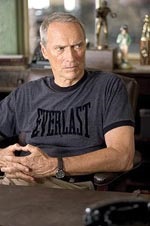
Million Dollar Baby looks like a boxing movie, but at its heart, it is the story of a spiritually frustrated man. Frankie Dunn (Clint Eastwood) is a boxing trainer and "cut man." When a fighter is wounded, Frankie steps into the ring, wipes up the blood, resets broken bones, and gauges how much more they can take.
Clint Eastwood plays Frankie Dunn, a man in search of meaning—and of God
He may be good at patching up others' wounds, but Frankie can't stop his own cuts from bleeding. At night, he kneels, weighed down by the burden of regrets, and asks God to heal his wounds. He attends daily mass, but instead of voicing his deepest conflict, he harasses an exasperated priest with dogmatic questions about the Trinity and the Immaculate Conception. And while he spends his weeks counseling fighters about how to move their feet, his vocabulary becomes a kind of poetry describing his struggle to "protect himself" in fights he can't win on his own. Ultimately, when Frankie and his partner Scrap-Iron (Morgan Freeman) talk about boxing, they're talking about survival. "Everybody's got a particular number of fights in 'em," says Scrap. "Nobody knows what that number is."
There's no American filmmaker more concerned with mortality that Clint Eastwood. He's preoccupied with the consequences of violence and the forces that motivate men to fight. Here, he's chosen the perfect actor to play the troubled trainer—himself. Those famous Westerns about the "pale rider" who dealt out death and judgment have made Eastwood's visage one of Hollywood's most familiar. As he gets older, he digs deeper into questions of conscience, and his wizened, tightly drawn face seems to become more grim and skull-like, as if morphing into a symbol of his chosen subject.
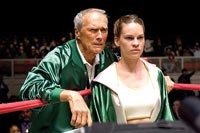
Million Dollar Baby is not a Western, but it's just as primal and bleak as Unforgiven. This is Eastwood's most accomplished film, and he finds in Paul Haggis's screenplay (based on short stories by F.X. Toole) the richest, most complex character he's ever played. It's a familiar plotline—the grizzled old pro being convinced to take a gamble on a longshot. That longshot is Maggie Fitzgerald (Hilary Swank), a young woman from backwoods "Missourah" desperate to escape her "trailer-trash" past by chasing her dream of being a fighter. Frankie thinks girlfights are "the latest freakshow," but the last fighter he trained betrayed him, and that's only added to his feelings of failure as a father figure. There's no suspense in whether he'll take Maggie on; we know they're a perfect match. What we don't know is just how intimately we'll get to know them, and how hard a road they'll travel together.
After initial hesitation, Frankie agrees to train Maggie (Hilary Swank) for the ring
Million Dollar Baby joins Sideways, Eternal Sunshine of the Spotless Mind, and Before Sunset among 2004's finest examples of excellent writing. Haggis develops characters so real and endearing, you'll wish you could invite them out for pie and coffee. Tom Stern—the film's chief lighting technician—frames them in the simple, stark imagery of a bright white boxing ring in a dark arena, and the cold illumination of bare light bulbs in a training gym after hours. While the cinematography tells this bare-bones tale sharply and efficiently, and Eastwood's understated guitar notes gently enhance the drama, it's Freeman's doleful, musical narration that gives Million Dollar Baby its haunting beauty. Great filmmakers show more than they tell, and thus it's fair to ask if Million Dollar Baby might be earning too much praise as a film when most of its power lies in its narration. But in a year when movies heaped indulgent visual spectacle on undernourished scripts, it's hard to complain about a movie with so much exquisite language.
Yet, while the narration gives the film a strong, simple skeleton, the actors put plenty of meat on those bones. They clearly appreciate the lines they're given to speak. Eastwood appears more world-weary and vulnerable than ever before, as if cracking under the pressure of life's beatings even as he teaches boxers how to fight, how to lose, and how to get up and fight again. As we watch him work, we catch hints of the failures he conceals behind clenched teeth. It's his best performance.
Morgan Freeman plays Scrap, Frankie's friend and partner
Freeman, who created a beloved character in Unforgiven, proves a dependable partner again, serving as the play's Greek chorus with a sense of humor as dry as a leather punching bag. Like Frankie the old-timer and Maggie the upstart, Scrap-Iron seems at first like a pulp fiction cliché. He's a retired boxer whose career ended with a blow that cost him his right eye. But he and Eastwood engage in an easy, relaxed banter, exposing layer upon layer of their history, until they become fully developed personalities.
Article continues below
Swank stands apart from almost all celebrity actresses in that, while she's clearly equipped to be a glamorous star, she avoids exploiting her appearance and focuses instead on inhabiting rough-edged, broken characters. She should—and probably will—win another Oscar for the way she transforms Maggie from a scrappy, ambitious, wounded girl into a ferocious, intense, ecstatically victorious fighter. (The bloody punishment she endures in the ring provoked one critic to say she'd been "Caviezel-ed.") Instead of over-acting in the "big scenes" the way Sean Penn did in Mystic River, Swank instead makes the most subtle pauses in the action. When Maggie shares a shy smile with a young girl at gas station, the silent exchange speaks volumes.
Moments like this enable the film to transcend its genre clichés. Each scene resonates on several levels, revealing things about characters' pasts, suggesting their possible futures, and reminding us of challenges we all face. Frankie's letters to his estranged daughter return marked "Return to Sender," paralleling his seemingly one-sided relationship with God. It becomes easier to understand why he's willing to risk his reputation on a "girlie." (After The Life Aquatic with Steve Zissou and In Good Company, this is the third recent film in which characters try to fill the missing pieces of their families by "adopting" others who fit the description. Do you think our culture is coping with regret for devaluing family relationships?)
The lighting and shadows help to set the mood throughout the film
Only a few moments feel false, flat, or manipulative. During the entrance of Maggie's most formidable opponent (Lucia Rijker), the music sounds as though it's going to bust out into a Darth Vader villain-motif. And when Maggie's "hillbilly trash" family shows up to berate and exploit her, they're as mean as the zombies in Dawn of the Dead.
In fact, the film's biggest weakness is the way Haggis's script stacks the deck so unfairly against Maggie and her coach. Frankie's family history is a black hole, and Maggie's is a nightmare. Aside from Scrap-Iron, Frankie's business colleagues are disloyal, exploitative, and opportunistic.
And the church? Eastwood cops out, portraying God's agents on earth as utterly insufficient, suggesting that the path to God is a dead end. In his very first scene, Father Horvak (Brian O'Bryne) lashes out, labeling Frankie as a [insert harsh expletive here] pagan. He repeatedly discourages this doubting soul from attending mass. And in Frankie's darkest hour, he offers not comfort, but a threat that God's forgiveness might soon be out of reach. Eastwood clearly believes that the search for God is an honorable, even essential, pursuit. But by making God's only representative a man who should seek spiritual counsel instead of offering it, he tells us, "You're on your own in this life. Only fleeting glimmers of human kindness will help cushion life's cruel punches until we lose the fight altogether."
Article continues below
Maggie hopes to leave her 'white trash' past behind in her pursuit of boxing glory
At the end, Frankie, Scrap, and Maggie make choices that will prod some viewers to grief and others to outrage. (One man at the screening I attended stood up and stormed out of the theatre in protest during the climactic exchange.) While I do not think the film glorifies the characters, it certainly goes too far in excusing them. We should object when Frankie and Maggie, driven by fear and despair, take matters into their own misguided hands; their decision is as rash as the crime committed by Jimmy Markum (Sean Penn) in Mystic River. And yet, we can feel compassion for these fighters who have been "stripped down to the bare wood." Like the naïve abortionist in Vera Drake, Frankie Dunn makes grave errors of judgment—he is acting out of kindness rather than malevolence, but his vision and compassion are too limited. And his decision does not earn him happiness. This is an honest portrayal of what the world looks like to those whose faith in a benevolent God fails. Million Dollar Baby may not be an inspiring movie, but it is at least honest about the consequences of giving up on God, and about our responsibility to be brave examples of love and grace to those who are suffering and afraid.
The film's closing act does not justify the condemnation that the film is sure to receive from reactionaries. Just because a character commits a sin does not rob a story of all of its virtues, and even a misguided tale can create opportunity for rewarding discussion. Nevertheless, it is important to note that a desirable end does not justify deplorable means. The final actions of Frankie and Maggie, while understandable and in some ways appealing, demonstrate a failure of hope, a lack of faith, a collapse of courage, and the loss of an opportunity for God to work wonders. Frankie would say he just "stepped into the punch," but I say he "threw in the towel."
Article continues below
Fortunately, even when human beings give up on God, he doesn't give up on them. Hopefully, the despair at the end of this story will coax viewers to choose a different path if they ever face similar trials. We can also hope that these storytellers, who seem so disillusioned with God, will stop worrying about "protecting themselves" and instead trust that God will be there to catch them when they fall. Such fatalism fades when we see that Christ has robbed death of its sting.
Spoiler Alert
This film's conclusion includes some disturbing ethical issues that could be of particular concern to Christians. The paragraphs below give away the ending to Million Dollar Baby.
Be warned: THIS ADDITIONAL MATERIAL GIVES AWAY THE ENDING.
The controversial resolution of Million Dollar Baby involves two characters who consent to the ending of another character's life in order to release that character from suffering—in a word: euthanasia. Specifically, when Maggie suffers a literally paralyzing blow in the boxing ring, she eventually comes to believe that she doesn't want to live the rest of her life as a quadriplegic, and she asks Frankie to pull the plug on the machine that's keeping her alive. Frankie refuses at first, but several developments in the story eventually change his mind, and he grants Maggie's wish.
Eastwood and his storytelling colleagues Toole and Haggis manipulate the events to try and win sympathy for their characters in this action. But there are plenty of details in the story that should show viewers the cost of such a decision, and that might even suggest there could have been a more meaningful and fruitful decision than the one made here. As it plays out in the film, the act of euthanasia reduces the victim to the level of a dog, mentioned earlier in the film, that was put out of its misery. That seems, to this reviewer, to be a pessimistic and dispiriting decision on the part of the storytellers, one that leads an otherwise excellent film to an unethical conclusion.
Talk About It
Discussion starters
In the film, the details of boxing become powerful metaphors. Consider some of the narrator's turns of phrase when he describes the sport. How is boxing used in the film to describe the difficulties of life?
Describe Frankie's relationship with God. What do you suppose he is praying for? Is God listening? Is God answering? Why or why not? How have you coped with a time when it felt like God wasn't listening?
Article continues below
Is Father Horvak a good priest? Does his treatment of Frankie reflect wisdom and spiritual discernment? What does he say to Frankie? What does Frankie need to hear from a man of God?
Why is Frankie eventually drawn to work with Maggie? Why is she drawn to him? Why is she drawn to boxing? Why do you suppose Frankie is so passionate about boxing?
Consider the last act of the film and the decisions that Frankie, Maggie, and Scrap-Iron make when facing a difficult ethical dilemma. Do you agree with their decision? Do you sympathize with them? What would you do in that situation?
The Family Corner
For parents to consider
Million Dollar Baby earns its PG-13 rating with some scenes of brutal and bloody violence in the boxing ring, for some wince-inducing scenes of bodily injury, for sexual references, and harsh language.
Clint Eastwood's Million Dollar Baby looks likely to face off with Sideways and The Aviator for the Best Picture award at the Oscars on February 27th. It's getting some of the year's biggest raves.
But it's also likely to face off with Kinsey as the film most heavily protested by the religious press. That's largely because of its subject matter. At first, it looks like a boxing movie, but it soon develops into something else entirely.
If you want to have the controversial events in the second half of the movie spoiled for you, read almost any published review of the film. If you'd rather not know, you can proceed here without worry about spoilers.
Million Dollar Baby will provide plenty of material for discussion and debate among viewers, especially Christian viewers. Frankie Dunn (Clint Eastwood) is a boxing trainer and "cut man." When a fighter is wounded, Frankie steps into the ring, wipes up the blood, resets broken bones, and gauges how much more they can take. His assistant, Scrap-Iron (Morgan Freeman) is something of a philosopher, having had years to consider the "whys" and "hows" of boxing after an injury forced him into retirement. The challenge facing them is the desire of Maggie Fitzgerald (Hilary Swank) to become Frankie's first female trainee, and to take her to a championship match.
The film is far more poetic and contemplative than most sports-oriented films, and its characters end up struggling in a fight far more difficult than a title match. A third act plot twist gives the film its emotional "punch." And while Million Dollar Baby deserves the praise it is earning on all critical fronts for its superb performances and artful scripting, its characters come to conclusions that demonstrate a sorely flawed sense of ethics. As a result, religious press critics in particular are sure to make a fuss over the film in the coming weeks.
Article continues below
We should object when the characters, driven by fear and despair, take matters into their own misguided hands; their decision is as rash as the crime committed by Jimmy Markum (Sean Penn) in Eastwood's last Oscar contender, Mystic River. A desirable end does not justify deplorable means. Those final decisions, while understandable and in some ways appealing, demonstrate a failure of hope, a lack of faith, a collapse of courage, and the loss of an opportunity for God to work wonders. In boxing terms, Frankie would say he just "stepped into the punch," but I say he "threw in the towel." And yet, viewers may still feel compassion for Frankie, a spiritual fighter who has been "stripped down to the bare wood," despairing because he feels God has abandoned him.
David DiCerto (Catholic News Service) says, "While the film packs quite a punch, including heavyweight performances from Eastwood, Hilary Swank and Morgan Freeman, and a textured screenplay by Paul Haggis … the movie's morally problematic ending may leave many Catholic viewers feeling emotionally against the ropes. Eastwood is no stranger to dark stories wrought with complex moral questions—and this one ends on a fatalistic note. [Million Dollar Baby] is not as much about boxing as it is about moral wrestling within the arena of the human soul."
Andrew Coffin (World) calls Eastwood's work "morally reprehensible. Million Dollar Baby is well crafted, moving, and full of challenging ideas. But readers be warned—if you watch it, prepare to be confronted, not uplifted and inspired."
from Film Forum, 01/27/05
Christopher Lyon (Plugged In) calls Clint Eastwood's new movie "one of the best-crafted films of the year. Eastwood again excels at not letting moviemaking get in the way of storytelling." But he also concludes that it's "a deeply troubling film. Even if we can get past the images of women beating and getting beaten by each other, the film forces on us a much more dangerous message."
Annabelle Robertson (Crosswalk) says it's "not a movie for children, nor is it appropriate for even mature teens, who have yet to develop the emotional filters necessary to analyze a film with such a strong emotional pull.Adults, on the other hand, will be able to glean truth in the edges of this narrative, particularly the desolation and increased isolation that ultimately befalls the characters, as a result of their choices. Hopefully, the film will also be used as an excellent discussion topic with those of differing opinions."
Article continues below
from Film Forum, 02/03/05
Josh Hurst (Reveal) addresses the controversy over the film, saying, "Some of the characters make some particularly bad choices. While many religious critics are accusing Eastwood of advocating a certain unethical action, the film is not endorsing any kind of misbehavior. For discerning moviegoers, Clint Eastwood has created a film that should be seen, discussed, and then seen again, one that takes some of the darkest questions of the human soul and writes them in blood—a sort of modern-day Psalm for the broken-hearted skeptic."
Steven D. Greydanus (Decent Films—Beware! Plot spoilers!) references other controversial films and compares Million Dollar Baby to them. He concludes, "In spite of its offensive finale Million Dollar Baby is an engaging film that even well-formed Catholics, despite their reservations, might care about in a way that they probably wouldn't care about, e.g., Kinsey or The Cider House Rules."
from Film Forum, 02/10/05
Kevin Miller (Relevant) reviews Million Dollar Baby and addresses the controversy surrounding its conclusions. CAUTION: Plot spoilers included in the review! Hollywood Jesus now includes three reviews of this film, and they include spoilers as well.
from Film Forum, 03/24/05
"Million Dollar Baby isn't a film about euthanasia," says Michael Leary (The Matthews House Project), "it is about these characters that took two hours to develop before the fateful twist at the end. The film simply continues Eastwood's penchant for characters forced to make ethical decisions that they know will cost them their souls. At the very least, the film seems to imply that the act of euthanasia, even if as an act of mercy, will cost the actor a great deal."
from Film Forum, 04/14/05
Million Dollar Baby and Unforgiven: Peter T. Chattaway (The Matthews House Project) compares and contemplates two Clint Eastwood films. "Just as death was the central theme of Unforgiven, I think abandonment may be the central theme of Million Dollar Baby. The point of the film may be that it doesn't matter whether we have been good or bad to people, we will all still be abandoned."
After lobbying from fellow Southern Baptists and Christians affected by the war, the House speaker moves a package forward.
Harvest Prude
Million Dollar Baby
1 of 5
Clint Eastwood plays Frankie Dunn, a man in search of meaning—and of GodAfter initial hesitation, Frankie agrees to train Maggie (Hilary Swank) for the ringMorgan Freeman plays Scrap, Frankie's friend and partnerThe lighting and shadows help to set the mood throughout the filmMaggie hopes to leave her 'white trash' past behind in her pursuit of boxing glory
















 While we pray for peace, we need moral clarity about this war.
 As my doubts about his teachings grew, so did a secret fascination with Jesus.
 After lobbying from fellow Southern Baptists and Christians affected by the war, the House speaker moves a package forward.