Let's get right to it: Daniel Craig is good. Daniel Craig is Bond.
So how does he compare to Connery, Moore, Brosnan, and the others? Tricky question—but not just because we've only seen one movie with Craig, Daniel Craig. Instead, the comparison is flawed because Craig isn't really playing the same Bond. This is a new Bond for a new time. And for that guy, Craig fits like a tailored tuxedo.
Successful long-running characters survive because they adapt to new times, changing audiences, and the popular styles of storytelling. For instance, observing the gradual changes in the Batman and James Bond franchises show how these heroes bent and flexed through various decades of camp, darkness, and far-fetched goofiness. When both guys were last seen, their stories had been watered down to showcase big budget, overblown action set pieces.
Daniel Craig is the new James Bond
Now in the mid-'00s, we have a wholly new Bat and Bond. They've both stripped down to the basics, grown more gritty and serious, and brought in personal drama. Perhaps it's because we're in a more sober, less black-and-white era after 9/11. Perhaps it's because audiences have grown tired of heartless and systematic adventure. Or maybe it's because complicated TV serials (Buffy the Vampire Slayer, Alias, and Lost) and films with three-dimensional heroes (Spider-Man 1 & 2) have shown you can tell exciting stories with real drama, realism and character.
Batman Begins went back to the start to explain why Bruce Wayne needs to dress up like a big bat and how he got all his body armor. Casino Royale starts the adventure all over to explain how James Bond got his license to kill and why he needs emotional armor.
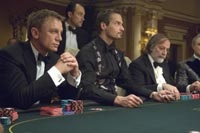
The movie begins, pre-credits, with a fantastic black-and-white film noir sequence of Bond meeting the requirements to reach double-oh status. Bond goes straight to work to track down whoever is financing worldwide terrorists. After creating a small international crisis, harassing his beleaguered boss M (Judi Dench) and doing his own rogue investigation, Bond must go against card shark and terrorism banker Le Chiffre (Mads Mikkelsen) in a high stakes game of poker that could ruin Le Chiffre—if Bond can win.
Bond, a tux, and some high stakes poker
From there, the movie twists and turns through espionage, crossings and double-crossings that gets too convoluted and goes on for about 20 minutes too long. But it's excusable because Casino Royale gives us so much that the Bond franchise has longed for: credibility, actual human drama, maturity, intensity and great unpredicted surprises.
This is the first Bond film in a while to be based on an original Ian Fleming novel—and you can tell the difference. It feels so good to be back on Fleming territory. The film has a gravitas and intrigue missing from recent outings. Part of the credit also belongs to the filmmakers for finally taking the chance of doing a Bond film without the tried-but-true formula.
Almost all of the paint-by-number Bondisms that have been parodied and copied by spies Austin Powers, XXX and Alex Rider are gone. And it's such a relief. As is the film's ability to draw a good balance between exorcising tired concepts—and keeping a definitive Bondness. The smirking and self-referential quipping is gone. But the movie is still fun and often laugh-out-loud funny. The film isn't action-centered, loud and explosion-focused. But there are still three incredibly exciting and impressively executed action sequences that—surprisingly in a day where we've seen it all—offer some action bits we've never quite seen before.
Vesper Lynd (Eva Green) brings out the real person in 007
The Bond franchise has discovered that by stripping down to the bare bones and relying on simple human drama, the movie becomes even more explosive. The new strategy is best defined by an already much-discussed torture scene that simmers with tension and fear. But really, it's very raw and understated. In fact, the torturer tells Bond that everyone seems to prefer extravagant torturing to get results, but he likes going simple. All he uses is a rope. The scene is shot very sparingly and shows nothing more than the torturer's whipping motion and Bond's reaction. We see no contact. But—even worse—we hear it. The visceral and emotional effect of this scene is far greater than many more elaborate scenes of Bond's past.
The greatest origin of drama in Casino Royale has nothing do with torture or espionage at all. Instead, it is the drama occurring inside Bond. Now, I won't go as far as to suggest this is a character study or anything, but there's more introspection into what makes Bond who he is than all the other Bond films combined. Craig's 007 is instinctual, observational and intelligent. But he's also brutish, aggressive, arrogant, and emotionally-detached.
Like 24's Jack Bauer, these traits in Bond aren't portrayed as either good or bad. In fact, like in many films and TV shows right now, Casino carries a sense that the world just isn't black-or-white anymore. There's a lot of gray area. Good guys have dark spots and we're never really sure who the real bad guys are. The movie capitalizes on this with the realistic tension that Bonds' arrogance and emotional detachment are both curses and attributes in his line of work. His arrogance costs him a lot—but it also propels him to success. His emotional detachment is necessary, Bond says, because if he couldn't just move on after killing, "I wouldn't be very good at my job." At the same time, this moral flexibility is slowly killing his soul and removing any piece of the real him that's still alive.
Article continues below
The inimitable Judi Dench is divine as M
This subplot of Bond's psyche develops through conversations with M, but mostly in a well-executed love story with MI6 treasury rep Vesper Lynd (Eva Green). Along to provide Bond with his gambling funds, Lynd quickly became my favorite Bond Girl of all time. Her effect on Bond is unrivaled as she continually reminds the spy he has a choice about who he is; just because he's sinned doesn't mean that's who he has to remain.
Lynd brings out the person in Bond. We begin to see who he is beyond the agent. He begins to open and to question. His armor lifts just a tad. But, nothing in this world is a sure thing. Nothing is black and white. And as the film ends, the internal wrestling is over. Bond's vulnerable spots are covered up. And he suddenly and assuredly becomes the Bond we all know. Really, he was this guy from the very first minute of the pre-credit sequence—but now, in the final scene, he embraces it.
Bond has begun.
Talk About It
Discussion starters
Do you think there are jobs in the real world that require people to, as Vesper says, "switch off" morality? What are they? Would you be able to put aside morality for a job? What do you think that does to a person? Do you think bad deeds can be good if they are done for the overall good
There are two scenes back-to-back in the Casino Royale hotel that show a difference between how Le Chiffre and Bond both treat women in danger. What does this juxtaposition say about both men
At the end Bond says, "I thought he had my back. Lesson learned." And then Vesper at one point tells Bond, "You have your armor back on." What does Bond learn in this film about how he must live his life? Why does he need this "armor?" And what exactly is it
Who do you think is clearly "good" and "bad" in this film? How is this grayish world often seen in pop culture lately. Why do you think that is? Is the world more black-and-white than this?
The Family Corner
For parents to consider
Rated PG-13, the film perhaps should be treated as an R-rated film for intense sequences of violent action (lots of gun play, beatings and blood), an intense scene of torture involving a man's scrotum (the impact is not shown but heard), sexual content (typical Bond euphemisms and unmarried characters rolling around with clothes on or under covers) and nudity (while female characters are often in skimpy outfits leaving little to the imagination, the "nudity" refers to a male character sitting nude in a chair during a torture scene, but nothing is shown).
You've probably heard that, while the name and the number are the same, James Bond, a.k.a. 007, has changed.
In Martin Campbell's latest James Bond adventure, Casino Royale, there's a new actor in the lead—Daniel Craig. Craig will be an unfamiliar face to many, but he's been lurking in the background of many popular films. Recently he appeared in Enduring Love, Infamous, and Steven Spielberg's Munich, and he played the troublesome son of Paul Newman's gangster in The Road to Perdition and an assassin monk hunting Cate Blanchett in Elizabeth. Craig gives James Bond some surprising new dimension. He's more likely to make mistakes. He has a heart, and is fully capable of falling in love. And he's not as preoccupied with sensual pleasure as he is with catching the bad guys.
While the film begins with enough chase scenes and death-defying stunts to fill two action movies, the pace slows as the film progresses, requiring us to turn our brains on instead of insulting our intelligence.
Todd Hertz (Christianity Today Movies) says it "twists and turns through espionage, crossings and double-crossings that gets too convoluted and goes on for about 20 minutes too long. But it's excusable because Casino Royale gives us so much that the Bond franchise has longed for: credibility, actual human drama, maturity, intensity and great unpredicted surprises. … [It's] fun and often laugh-out-loud funny. The film isn't action-centered, loud and explosion-focused. But there are still three incredibly exciting and impressively executed action sequences that—surprisingly in a day where we've seen it all—offer some action bits we've never quite seen before."
"Casino Royale certainly introduces the Bond character better than any of the previous movies," says Mike Parnell (Ethics Daily), "and it offers much hope for the franchise."
Article continues below
Christopher Lyon (Plugged In) says, "At a time when we can be reasonably sure there really are guys out there licensed and eager to kill in the name of country—whether justified or not—Bond seems less naturally heroic and more morally culpable for his actions than ever." He concludes that the story is "far better," but the result is "less outright 'fun' than previous incarnations."
Lisa Rice (Crosswalk) says the new Bond is "gritty and real—but is that what we really want? … Casino Royale's realness might be a bit much to handle." She adds, "The movie's worldview is basically biblical in its extolling of bravery and diligence in overcoming evil, but the tools used are overweening violence and adultery, which dilute the message."
Greg Wright (Past the Popcorn) says, "For Bond fans, I'd suggest seeing Casino Royale with an open mind. For non-Bond action film fans, I'd suggest the same. … For fans of just plain great filmmaking, though, I'd say cast your net a bit wider. Haggis' script is pretty savvy and self-aware, Campbell's direction is competent, and Craig's Bond is very compelling; but the whole affair is pretty transparent nonetheless. There should be better cinematic opportunities over the holidays."
David DiCerto (Catholic News Service) writes, "Some fans will applaud its harder-edged return to the grittiness of Ian Fleming's novels. Others may feel it's too dark and serious, and lacks the sense of campy fun of earlier films."
Christians can disciple each other toward action, prayer, and hope.
Naomi Bosch
Casino Royale
1 of 4
Daniel Craig is the new James BondBond, a tux, and some high stakes pokerVesper Lynd (Eva Green) brings out the real person in 007The inimitable Judi Dench is divine as M
















 While we pray for peace, we need moral clarity about this war.
 As my doubts about his teachings grew, so did a secret fascination with Jesus.
 Christians can disciple each other toward action, prayer, and hope.