Standing in a stable, a man stares, thunderstruck, at a pregnant woman. It's unmistakable—that baby is the hope for humankind's redemption. The severity of this revelation leaves him weak in the knees and almost speechless. Almost.
"Jesus Christ," he says.
Is he taking the Lord's name in vain? Perhaps. Or perhaps he's being reminded of something … a similar occurrence two thousand years ago.
In Alfonso Cuarón's movie Children of Men, the name of Christ is anything but a throwaway expression. Echoes of the gospel—both subtle and obvious—occur at every turn, reminding us that God gave us hope by providing a vulnerable, miraculous child to a dark, dying, violent world. We watch as a man and a woman take enormous risks, seeking help among the humble, and fleeing from cruel and malevolent men in power. It can't be an accident that the film opens in U.S. theaters on December 25.
Still, for all of these allusions to the Christmas story, Children of Men bears little resemblance to The Nativity Story, the more traditional depiction also now in theaters. Cuarón has crafted an intense, decidedly R-rated parable that offers a bleak vision of the world's future.
Clive Owen as Theo, a disillusioned bureaucrat
Children of Men is set in London in the year 2027. But this isn't the futuristic nightmare of Blade Runner, the dreamscape of Brazil, the techno-metropolis of The Fifth Element, or the punishing wasteland of The Road Warrior. Cuarón's movie draws us into a world that bears a striking resemblance to our own. Where Spielberg would have become preoccupied with imaginative gadgetry, as he did in Minority Report, Cuarón prefers to keep our focus on the story and its relevance. (Cuarón recently told me in an interview, "I wasn't interested in the future. I was interested in right now.")
His depiction of England reflects a myriad of modern crises as if in a distorted mirror. London is ablaze with the kind of violence currently associated with Iraq, but it's in good shape compared to other societies. Beleaguered Brits watch television broadcasts of bombings, wars, and natural disasters. Headlines appear against a montage of footage from the world's crumbling cities: "The world is falling apart! Only Britain soldiers on!"
Britain is paying the price of survival; the government has turned aggressive in order to stifle civil unrest and terrorism. Soldiers are rounding up the "fugees"—refugees who are fleeing "the West" for the relative safety of England. What we see bears troubling resemblances to the Holocaust, Abu Ghraib, and Guantanamo Bay, as the police abuse their prisoners, cram them into cages, and ship them out of the city.
Julianne Moore as Julian, an underground opposition leader
At a coffee counter, a middle-aged bureaucrat named Theo (Clive Owen) joins his fellow Brits to gape at a breaking-news headline: "The world's youngest person has died." A plague of infertility has overcome the world's women. And though no one knows what has caused it, the chilling result is clear: No more babies. And now, the youngest person—18 years, 5 months, and 11 days—has died, stunning the public like nothing since the death of Princess Diana.
This threat of humankind's pending extinction has plunged civilization into melancholy and despair. The streets are decorated with doomsday declarations: "Infertility is God's judgment!" "Last one to die, turn out the lights." Commercials offer cold comforts, like happiness in a pill called "Bliss," or suicide in a drug called "Quietus." ("You decide when," says the commercial.)
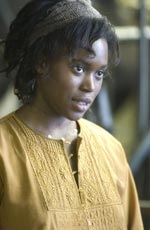
That's why Theo is so awestruck when he finds a pregnant African woman hiding in a barn. Her name is Kee (Clare-Hope Ashitey), appropriately enough; she may hold the "key" to the future. Kee's an illegal immigrant being sheltered by a group of human rights activists called "the Fishes," and Theo's ex-wife Julian (Julianne Moore) is a major player in their conspiracies. Julian explains to Theo that he's their only hope. Kee must be delivered safely into the hands of the "Human Project"—a secret society of the world's "best minds." And Theo is the only one who can help her get past security checkpoints.
Theo's doubtful about why he has been chosen, just as Joseph must have wondered why it fell upon him to protect poor Mary—and the miracle child in her womb—on the road to Bethlehem. The odds are against him. Can Theo get Kee to the Human Project safely? Does the Human Project even exist?
Michael Caine as the pot-smoking rebel, Jasper
It's tough to trust anyone in this town. What about Jasper (Michael Caine), his old friend, an aging activist who now prefers to lounge around, smoking ganja? Luke (Chewetl Ejiofor), the Fishes' principled leader? Patric (the chameleonic Charlie Hunnam), a dreadlocked warrior with a mean machine gun? What about Syd (Peter Mullan), the tank-driving lawman?
And what happens if Kee goes into labor somewhere along the way?
Theo has very little time to think.
And neither do we. Children of Men is based on a story penned by P.D. James, a professing Christian better known for her mystery novels. Her narrative has been streamlined and revised by no fewer than five screenwriters to become an adrenalin-rush action movie. Once Theo hits the road with Kee, we're off and running, dodging armed pursuers until we reach a war zone that recalls the finale of Stanley Kubrik's Full Metal Jacket.
Article continues below
Fans of the novel may argue about Cuarón's many and varied departures. Some heighten the story's connections to present-day crises; others cloud James' moral vision.
In the book, Julian is the pregnant woman; Kee was invented to connect the film version to the present-day crises in Africa. In the book, euthanasia is depicted as a horrible crime against human dignity, but Cuarón recasts it as an act of heroic mercy. Thus, anyone who exploits the film as a "pro-life" movie isn't watching very closely, although it is encouraging to see that several new films—The Nativity Story, Apocalypto, Children of Men, and the upcoming fantasy, Pan's Labyrinth—tell stories concerned with the protection of an endangered, unborn child.
Clare-Hope Ashitey as the pregnant Kee, the planet's last hope
Some will criticize Cuarón for emphasizing spectacle at the expense of substance, and they'll have a point—the constant sound and fury makes it difficult to think through all of the questions that Children of Men raises. But the sensory experience will be rewarding to many all on its own. Seeing so many familiar images of real-world chaos, the viewer can come to a powerful realization of the need for hope beyond ourselves. It's not so much an intellectual exploration as it is a whirlwind tour of the world's worst nightmares, encapsulating just how desperate and dangerous "civilization" has become. The film may not be an immediate box office sensation, but its powerfully convincing spectacle is likely to make it a lasting sci-fi classic on par with Blade Runner.
A director more interested in spiritual inquiry might have mined this material for richer insights. Cuarón's adaptation suggests that he believes the world can only be saved by human ingenuity. How odd—that a story so full of allusions to the Bible would conclude that God is not participating in the world's salvation, and that we are on our own to fix the world that we have broken. (In my interview with Cuarón, he confirmed this belief that we should place our hope not in God, but in "the next generation.")
In spite of its mixed messages, Children of Men is an enthralling film that will reward post-viewing discussion. Cuarón, who previously directed Harry Potter and the Prisoner of Azkaban, Y Tu Mama Tambien, Great Expectations, and A Little Princess, has concocted a provocative mix of horror, suspense, and ironic wit—including what may be the first big-screen car chase in which none of the cars are actually running. Thanks to the effects team, the cast, and the extraordinarily talented cinematographer Emanuel Lubezki, who also filmed The New World, the film's "key" set pieces are among the most elaborate single-take action scenes ever choreographed. As film blogger Jeffrey Wells declared, "If Stanley Kubrick were alive today, he would absolutely drop to his knees."
Article continues below
The cast contributes impressively. With wry humor, Clive Owen turns in a performance that rates with Bruce Willis's famous work in Die Hard as one of the great "Energizer Bunny" performances. We've rarely seen an adventure hero keep going and going and going through explosions, gunshots, and other interruptions. He gets good support from Clare-Hope Ashitey, who makes us care deeply about Kee. The madcap Michael Caine is delightfully amusing. And while the immensely talented Julianne Moore is featured in the film's advertising, her role is actually not so prominent, as the story focuses most of its attention on the elaborate adventures of the characters of Owen and Ashitey.
There have been several versions of the nativity story—literal and metaphorical—on film, each with its own particular strengths and weaknesses. For this reviewer, Children of Men—while it only makes references to the story of Jesus' birth—conveys more powerfully than anything on film the darkness, damage, and despair of the world into which the Christ child was born. And as Theo and Kee flee their pursuers and stagger through the chaos, lost in a world that has no room for them, they make me reflect on what Joseph and Mary risked and endured to deliver the Redeemer.
In one deeply moving sequence, the technical mastery and the spiritual motifs fuse and become something beautiful. As they struggle across a battlefield, Theo and Kee see awe and reverence in the faces of the people around them, and they come to realize just how much their hidden treasure means to the world. Thus, the overwhelming sensory experience of the movie is not wasted. To borrow from a Bob Dylan song, Children of Men assures us that "it's not dark yet, but it's getting there." And by reflecting so much darkness, it allows a beacon of hope to shine all the brighter.
Article continues below
Talk About It
Discussion starters
Is Children of Men a pessimistic view of the future, or a hopeful one? Why? What elements of the film do you feel are fair speculations about our future? What elements seem exaggerated or pessimistic
Why do you suppose the screenwriters revised P.D. James' story, and introduced the character of Kee, instead of having Julian serve as the pregnant woman? If you could have advised the writers, what revisions might you have suggested
Does Theo's character change over the course of the story? If so, how is he different at the end
When armed men come to Jasper's house, Jasper had to make some quick decisions. Do you think he made the right decisions? Why, or why not
What do you think of "the Fishes"? Do they have good intentions? Do they have admirable methods
Would you join a resistance if the government began using extreme force to find and deport refugees? Why, or why not? What do you think of the depiction of the government response here? Do you see any correlation between what is happening in the movie and what is happening in America now?
The Family Corner
For parents to consider
Children of Men is rated R for strong violence, language, some drug use and brief nudity. The film includes depictions of startling violence, sometimes achieves the intensity of Saving Private Ryan. The language includes abuse of the Lord's name. This film is for discerning adults only.
compiled by Jeffrey Overstreet from Film Forum, 01/04/07
Caution: Alfonso Cuarón's new film, Children of Men, is nothing like any of his previous films. It's not a children's flick, like A Little Princess of Harry Potter and the Prisoner of Azkaban. Nor is it a present-day road movie, like his acclaimed Mexican tale Y Tu Mama Tambien. And it's not a romantic classic, like his adaptation of Great Expectations.
No, Children of Men is an R-rated, hyperviolent, nightmarish epic set in a bleak version of the future. It's also an inspiring, bright vision of hope set against a nightmarish backdrop of a disintegrating world.
Based on a story penned by P.D. James, a professing Christian better known for her mystery novels, Cuarón and four additional screenwriters have streamlined and revised the narrative, turning it into an adrenalin-rush action movie. Fans of the novel will debate Cuarón's many and varied departures from the text. Some revisions heighten the story's connections to present-day crises; others cloud James' moral vision.
Article continues below
Whatever the case, it would be hard for any moviegoer to deny that there are obvious allusions to the gospel at every turn, reminding us that God gave us hope by providing a vulnerable, miraculous child to a dark, dying, violent world. We watch as a man named Theo (Clive Owen) and a woman Kee (Claire Hope Ashitey) take enormous risks, seek help among the humble, and flee from cruel and malevolent men in power.
It can't be an accident that the film opened in U.S. theaters on December 25.
Christian Hamaker (Crosswalk) says, "Children of Men moves slowly at times, but always with purpose. It does not meander, nor is it boring. It does, however; require patience. Those who grant it that will be impressed, for the film's periodic payoffs, and its mesmerizing climax, are among the year's best cinematic sequences. … [F]or Christian audiences interested in a radical, contemporary approach to hope amid dire circumstances, Children of Men is bound to stir discussion."
Harry Forbes (Catholic News Service) calls it "a bleak futuristic political thriller with pointed parallels to the present day. … Director Alfonso Cuaron's adaptation of P.D. James' novel is intentionally dark and disturbing. But the chase sequences are undeniably exciting and quite brilliantly done, and it is in those sequences that the film is most compelling."
Responding with a mixed review, Greg Wright (Past the Popcorn) writes, "For those who want a creative, violent, and moderately challenging alternative to the schmaltz, materialism, and Hallmark-card shallowness of the usual vision of the Christmas season, Cuarón is here to save the day. If you're looking for serious sci-fi, earnest political commentary, or a searing depiction of the future of mankind. … Well, don't expect that much."
Even less enthusiastic, Marcus Yoars (Plugged In) says, "While believers may extrapolate matters of faith from this thought-provoking story, its makers clearly intend this to be a political film. … As such, the project offers both a not-so-subtle warning for modern-day politicians and a heartfelt statement underscoring the value of children. Both are messages that need to be heard. But both get overshadowed by 1) gaps in the story, and 2) an even darker cloud of unnecessary content."
Article continues below
Most of these reviewers probably haven't read P.D. James' novel in its entirety before seeing the film. (I didn't.) But Anthony Sacramone (First Things) had read it, and he says the film is an act of vandalism against James' work, calling it "little more than high-tech agit-prop targeting the Bush administration, the war in Iraq, border policing, and Homeland Security. … Throughout the film, characters from the novel are reassigned roles and political stances as Cuarón and co-screenwriter Timothy J. Sexton see fit. In fact, the first thing Cuarón does when he arrives in the year 2027 is eliminate the Christians. … What's insufferable is his pressing into service someone else's vision as a commercial vehicle for a personal political screed."
Meanwhile, mainstream critics are raving about the film as one of the season's most exciting last-minute releases.
from Film Forum, 01/18/07
Christopher Lyon (Plugged In) writes, "The Queen is a quiet, profound, and even gently amusing film that accomplishes the unlikely. It builds empathy for an emotionally distant monarch and a (currently) buffeted politician by following them through a difficult week."
Children of Men: Dennis Mullen (Relevant) says, "What happens to people when hope for the future dries up? … Children of Men … offers a grim answer and tells an incredible story along the way. … [The film] is rough, brutal and profane. It is also a study in magnificent filmmaking. … But in the end, Children of Men is a story lacking any solution to the desperate condition of hopelessness."
After lobbying from fellow Southern Baptists and Christians affected by the war, the House speaker moves a package forward.
Harvest Prude
Children of Men
1 of 4
Clive Owen as Theo, a disillusioned bureaucratJulianne Moore as Julian, an underground opposition leaderMichael Caine as the pot-smoking rebel, JasperClare-Hope Ashitey as the pregnant Kee, the planet's last hope
















 While we pray for peace, we need moral clarity about this war.
 As my doubts about his teachings grew, so did a secret fascination with Jesus.
 After lobbying from fellow Southern Baptists and Christians affected by the war, the House speaker moves a package forward.