A number of big names—Dame Judi Dench, Keira Knightley, Charlize Theron, and Reese Witherspoon—were Academy Award nominees for Best Actress in 2005. And Witherspoon, the winner for her role in Walk the Line, certainly deserved high honors. But could it be that voters overlooked a performance that's even more riveting, memorable, and inspiring than any of these?
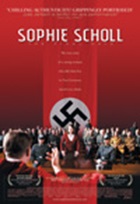
You may think so when you see Sophie Scholl: The Final Days, an Oscar nominee for Best Foreign Language Film. In this German-made movie, Julia Jentsch plays the role of a valiant 21-year-old hero who stood up against the Nazis, and who boldly proclaimed her faith in Jesus Christ even as she denounced Hitler as a liar. Watch her stand strong against the relentless, ferocious challenges of Nazi interrogator Robert Mohr, played with similar intensity by Alexander Held.
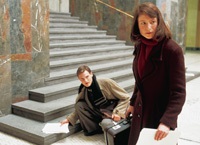
Julia Jentsch as Sophie Scholl, distributing anti-Nazi literature
If the real Sophie Scholl was anything like the character played by Jentsch here—and the extensive research performed by director Mark Rothemund and screenwriter Fred Breinersdorfer indicates that she was—then she deserves a place alongside history's most revered and celebrated Christian women. We haven't seen a comparable clash between a principled heroine and a determined, malevolent villain since Agent Clarice Starling matched wits with Hannibal Lecter in The Silence of the Lambs. But where Starling and Lecter only met in a few fleeting scenes, this battle of the minds goes on and on, until you're breathless with the heat of it.
Working from records of Scholl's interrogation and incarceration that had long been unavailable, Rothemund and Breinersdorfer give us a fast-moving, feverish account of six days, a span of time in which the determined young woman goes from a covert freedom-fighter to a prisoner. In the opening scenes, she's an enthusiastic, appealing student with an irrepressible zeal for the truth. She helps her brother Hans (Fabian Hinrichs) and a covert operation called "The White Rose" produce and distribute pamphlets that describe how the Third Reich caused the massacre at Stalingrad and forced Jews into concentration camps.
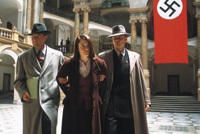
The Gestapo arrests Sophie
But when she's arrested, after a nerve-wracking covert operation at the nearby university, the true tests of her character begin. The virtue and verve that Scholl demonstrated, first in deceiving her interrogators, and later in endeavoring to save her friends and family from execution, will amaze you, just as the real Sophie Scholl inspired Germans. Today, more than a hundred German schools are named after her, and Jentsch's portrayal of Scholl may just inspire more brave young souls to pursue their own quests of justice and truth against all odds.
Scholl stands out on the big screen for several reasons:
First, she's not made up to be glamorous. Hollywood often gives audiences short cuts to feeling sympathy for "the good guys" by casting super-appealing, beautiful figures in the role. Jentsch's portrayal of Scholl lets her strength come from her argument, not her sex appeal.
Second, the filmmakers don't rely on exaggerating the wickedness of the villain in order to make us root for Scholl's survival. Instead, they portray her bravery as so audacious, so intelligent, and so spirited that we cannot help but stand in awe.
Which leads us to the third unique characteristic of Sophie Scholl—she relied on God, not herself, for strength, and Rothemund, a professing atheist, portrays her prayers without flinching. How many Christian artists are so willing to thoughtfully portray the perspectives of unbelievers? The filmmakers' work is an honorable tribute, in that they did not edit this aspect of her life in order to provide something more palatable for mainstream audiences. (Unfortunately, not all critics are willing to acknowledge this. One prominent mainstream critic tells us it was Scholl's "faith in the future" that sustained her. I'm not sure what movie she was watching.)
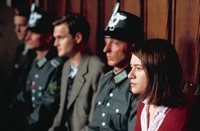
Sophie, ready to stand trial
But Scholl is not the only highlight of the film. Held's portrayal of Mohr is also award-worthy. Moviegoers have become accustomed to soulless big-screen Nazis, but Held gives us a Gestapo agent with a mind like an engine, and we can see the gears in his brain grinding as he analyzes Scholl's impassioned defense. He starts out looking to ensnare her. But as he sifts her words, his face takes on a haunted pall—he realizes, on some level, that he cannot win this fight even if he kills her. She has the moral high ground, and he knows it.
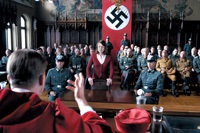
Some may criticize the film's other memorable villain—Nazi judge Roland Freisler (André Hennicke)—whose hysterical shrieking and gesticulating from the bench look like a textbook case of overacting. But records show that, indeed, this is a spot-on impersonation of one of Hitler's maniacal henchmen.
Sophie Scholl is not a perfect film. Martin Langer's cinematography is sufficient, but hardly imaginative. And greater attention to the early scenes might have helped acquaint us with Scholl's personality and past better. But the film's effect on viewers is undeniable. It won two Silver Bear awards—Best Director and Best Actress—at the 2005 Berlin International Film Festival, along with its nomination at the Oscars. And mainstream critics, some of whom jump at the opportunity to smack down faith-oriented films for shoddy craftsmanship, are raving about how deeply it moved them.
Article continues below
At the hearings, Sophie is interrogated by a Nazi judge
If this is not reason enough for you to hurry out and buy a ticket, consider one more remarkable aspect of this film. Rothemund and Breinersdorfer remember to consider something about their champion that most hero-movies forget—her parents. When we meet Scholl's mother and father, they are understandably distressed. But they are proud as well—proud that their daughter would rise to acts of courage and conviction; proud that she learned to care for the weak and the oppressed; proud that she would not merely swallow what her government told her, but followed her curiosity to the truth. Heroes do not spontaneously burst from the ether—they are raised.
That's the kind of heroism the world needs today, both from young people who care about the future, and from parents who set an example. So even if you know how the story ends, take your family, friends, and neighbors to see Sophie Scholl: The Final Days. It's one of those rare and wonderful films that offers a vivid portrayal of faith without compromising standards of excellence.
Talk About It
Discussion starters
What impresses you about Sophie Scholl? What enables her to behave with such courage?
Discuss the intense arguments between Scholl and Mohr. What are the differences in their worldviews? What does Mohr value most? What does Scholl value most? Do you think Scholl causes Mohr to doubt his own convictions? If so, where do you see this happening?
What does Scripture say about Sophie's kind of courage? Can you think of other great figures in history who have demonstrated such courage?
Christians are often villainized and ridiculed on the big screen. What is different about this film's portrayal of a Christian? Is there a difference between Sophie's character and the character of other Christian movie characters?
The Family Corner
For parents to consider
Sophie Scholl: The Final Days is unrated, but feels like a PG-13 movie. It contains no scenes of graphic violence, save for one fleeting glimpse of Nazi cruelty (but the bloody consequences are not shown.) Still, it is intense enough that it is inappropriate for young children.
How many great Christian heroes have you seen at the movies? Thomas More in A Man for All Seasons. Eric Liddell in Chariots of Fire. That passionate Joan of Arc. Sister Helen Prejean in Dead Man Walking. Can you think of others? It's a challenge, because Christian characters are often portrayed as a problem rather than a blessing—and sometimes, it's easy to see why. Christians are, after all, often as prone to misbehavior as anyone else, and we deserve some of the unflattering portrayals that we've seen.
If the real Sophie Scholl was anything like the character played by actress Julia Jentsch in Sophie Scholl: The Final Days, then she deserves a place alongside history's most revered and celebrated Christian women.
The extensive research performed by director Mark Rothemund and screenwriter Fred Breinersdorfer indicates that she was, indeed, a brilliant, brave soul who stood up against the Nazis with fierce determination, making her challengers look ridiculous. Their film about the 21-year-old truth teller is an inspiring testament to faith, passion, and integrity. Sophie Scholl deserved the nomination it received for Best Foreign Language Film at the Oscars.
If it comes to a theater near, don't miss it; check the official site for theater listings. The scenes of Scholl's interrogation by Gestapo agent Robert Mohr (Alexander Held) are riveting—we haven't seen a comparable clash between a principled heroine and a determined, malevolent villain since Agent Clarice Starling matched wits with Hannibal Lecter in The Silence of the Lambs. But where Starling and Lecter only met in a few fleeting scenes, this battle of the minds goes on and on, until you're breathless with the heat of it.
Steven D. Greydanus (Decent Films) gives the movie a rare "A+" rating, saying it's "one of a very few films that accomplishes one of the rarest and most valuable of cinematic achievements: It makes heroic goodness not just admirable, but attractive and interesting. How many films do this?"
He believes the film will challenge viewers to consider their own strength of character. "Throughout the film, viewers are invited to put themselves in Sophie's place: Would I have had the courage and vision to do what she did? In the scene with her parents, viewers may find themselves identifying as much with father or mother as with their daughter: What if it were my child? Would I be as proud and supportive amid such overwhelming circumstances? Not for all the world would I want to go through what Sophie's parents do; but I hope and pray to see my children grow up into young adults not unlike Sophie Scholl."
Article continues below
David DiCerto (Catholic News Service) says, "Though talk of the best films of 2006 is premature, when the time comes, Sophie Scholl: The Final Days … will demand consideration. … Despite his own personal atheism, the filmmaker has crafted a deeply spiritual movie, throughout which he shows Sophie, a devout Protestant, praying to God for strength. … Unvarnished by oversentimentality, the film is a quietly powerful testament to bravery in the face of evil that examines themes of freedom of conscience and peaceful resistance to tyranny while imparting a strong anti-war message."
Darrel Manson (Hollywood Jesus) praises it, with some small reservations. "Sophie's story is an inspiration that is well worth seeing. … It is spiritually uplifting and intellectually challenging. … Sophie's character just wasn't filled in as well as it could have been. … Even a few glimpses into her life before all this could have added a great deal to an already very good film. It would have been especially helpful to understand a bit more of the way that her faith molded her, not just as she faced persecution, but as she saw the work she was doing with The White Rose as calling to a higher law."
Greg Tubbs (Ethics Daily) raves, "While it might be hard to find a showing at your local multiplex, I recommend you hunt it down, because it is worth the extra effort. This film is passionate testament to freedom and personal responsibility that is both haunting and timeless. It should not be missed."
If you think the mainstream media consistently ignores or slanders stories of Christian conviction, think again. They love it.
from Film Forum, 03/23/06
Andrew Coffin (World) raves, "Sophie Scholl: The Final Days makes Sophie's moving story accessible to the rest of the world. Though the film is unrated, it contains nothing objectionable; only the intensity of the subject matter ought to give parents pause in allowing children to see it. It's a story that serves as a powerful example of faith and courage in the face of great evil. Go see it."
The film continues to be one of the year's best-reviewed by mainstreamcritics.
NIL deals in college athletics present new challenges—and opportunities—for colleges and students.
Emily Belz
Sophie Scholl: The Final Days
1 of 4
Julia Jentsch as Sophie Scholl, distributing anti-Nazi literatureThe Gestapo arrests SophieSophie, ready to stand trialAt the hearings, Sophie is interrogated by a Nazi judge













 While we pray for peace, we need moral clarity about this war.
 A Christian reconciliation group in Israel and Palestine warned that war would come. Now the war threatens their relevance.españolالعربيةFrançaisрусскийУкраїнська
 NIL deals in college athletics present new challenges—and opportunities—for colleges and students.