Few names elicit from women both wistful sighs as well as secret gratitude to be alive in this century as does Jane Austen. The 19th century English writer graced us with six classic novels: Pride and Prejudice, Sense and Sensibility, Mansfield Park, Emma, Persuasion, and Northanger Abbey. These beloved tales mostly center on women in Jane's era trying to marry well—for their family's satisfaction, for much-needed financial security, and, wonderfully, often for love.
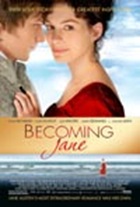
Coming from a family of modest means herself, Austen knew the pressure to marry well firsthand. Becoming Jane draws on what we know of Austen's life through her letters and writings, specifically her flirtations with a young lawyer named Tom Lefroy, and speculates on how this relationship may have unfolded and then shaped Jane's life and literary work.
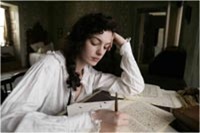
Anne Hathaway as a young Jane Austen
When we first see Jane (Anne Hathaway), she's up before dawn and before the rest of her family, writing. When she finds a just-right turn of phrase, she sits at the piano to pound out her pleasure—waking her dozing but adoring family members. When we first meet Tom Lefroy (James McAvoy) a few scenes later, he's losing a boxing match, boozing it up with his buddies, and kissing on a woman I'm not altogether sure isn't a prostitute.
Our Good Girl and Bad Boy meet when Tom's uncle, a local judge who's providing Tom with lodging and employment, reprimands his party-boy nephew and sends him to live with other relatives (who happen to be close friends of the Austens) out in the country for the summer. This feels like a death sentence to city-boy Tom, who descends on Jane's peaceful, pastoral corner of England with a scowl and an attitude. Within hours of his arrival, he falls asleep while Jane reads one of her works to a gathering of friends and family, much to Jane's consternation.
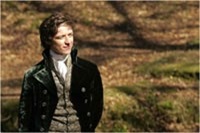
James McAvoy as Tom Lefroy
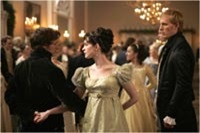
Our pair meets next in the wooded English countryside. Bored Tom is taking a walk and randomly smacking the trees with his walking stick when he happens upon Jane, who's out for an afternoon stroll and giving the occasional trunk a gentle caress as she passes. They spar verbally there, and soon thereafter at a family picnic and at a local dance. Though they appear to be polar opposites, Jane and Tom seem to appreciate the intelligence and feistiness in each other—surely a refreshing change from the lusty women Tom's kept company with and the rich but boring men to whom Jane's parents try to marry her off.
Of course a romance develops amidst all the verbal jousting, but since neither Jane nor Tom is from a wealthy family, it's complicated. Tom is dependent on his wealthy but snobbish uncle, who looks at commoner Jane with disdain. Jane needs to marry well to help provide for her family and provide her the freedom to keep writing. And when she hasn't been hanging out with Tom, her parents have been nudging her toward a rich bachelor with the personality of a houseplant. Jane and Tom both want to marry for love, but feel trapped by a time and a culture in which marriage is much more about securing one's livelihood. The agonizing choices they must make between security and happiness, between self and family, between convention and conviction comprise the rest of the movie—and surely will ring familiar to any Austen fan.
While Tom and Jane dance, Mr. Wisley (Laurence Fox) looks on
Much was made about the fact that an American actress, Hathaway, was cast as Jane, such a beloved British icon. (This on the heels of Renee Zellweger portraying another British literary great, Beatrix Potter.) Though Hathaway's accent does falter in a few places and she's arguably much prettier than Austen was believed to be, for the most part she does an admirable job. She's never overdramatic and doesn't bring a modern ring to a character whose independence and intelligence are before her time, which is a common struggle for such period pieces.
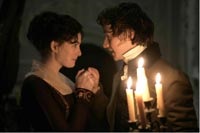
The chemistry between Jane and Tom is pitch perfect. We feel the sparks fly when they argue, we believe their yearning for each other. My main complaint with the movie is that we don't get enough of these two characters falling for each other. They're painted as such opposites from the outset of the movie. And while opposites do attract (in many Austen works, certainly), it's difficult to imagine savvy Jane falling so quickly and completely for a guy who's been a bit of a womanizing cad. As lovely as they were, I would have gladly sacrificed some of the lush pastoral scenes for a few more transitional moments in this relationship. The strength of their bond is the axis for the entire movie, and with this foundation on a bit of shaky ground, it's more difficult to buy and feel the highs and lows this couple journeys throughout the course of the film.
Ah, romance … for one of the greatest romance writers of all time
That said, the film has all the other ingredients we love and expect in a period piece of this sort. The cinematography and costuming are wonderfully executed. Jane and Tom strike a stunning pair in their textured jackets and stately hats. The manors and sweeping valleys—shot throughout Dublin and the Irish countryside—make you want to plan a visit tomorrow. The dances make you long for the days when social gatherings were so grand. With the accents and the locations, every now and then some of the dialogue is hard to make out. And a few scenes feel a tad abrupt—a carnival that comes from nowhere, for example. But the rest of the film is a rich tapestry of beautiful visuals and splendid acting (notably among period-piece regulars Maggie Smith, James Cromwell, and Julie Walters).
Article continues below
Austen fans will have a fun time finding moments and characters who no doubt inspired scenes in Jane's classics. That is, if these moments and characters are among the fact-based parts of the film. A USA Todaystory calls the film a "fictionalized biopic," noting how the movie "imagines" the romance between Austen and Lefroy. The Seattle Post-Intelligencer calls the film an "Austen fantasy." And the Chicago Tribune quotes an Austen scholar saying she will not see the film: "I would not be able to sit through what looks like a tissue of fabrications and nonsense."
While purists are no doubt a little uneasy about the melding of fact and fiction, it's nonetheless a bit fun to speculate on the life of this prolific and somewhat private writer. One can only hope that Becoming Jane will inspire moviegoers to find out more about this beloved literary great. Or hopefully revisit one of her classic novels—and the countless films they've inspired.
Talk About It
Discussion starters
If you're familiar with Austen's novels, point to the characters in Becoming Jane who may have inspired characters in her books.
Jane's father tells her that nothing destroys the spirit like poverty. Do you agree with this statement? How have you experienced that to be true or untrue?
What are Jane and Tom's original perceptions of each other? How do those change over the course of the movie? Why is each of them drawn to the other?
Do you agree with Jane's decision regarding Tom at the end of the movie? Why or why not?
List the ways in which characters are limited by their gender or financial standing. How do they deal with these challenges? In what ways are people in our world still hampered for the same reasons? Are there things you can do to help ease their burden?
Have you ever felt forced into a decision for financial reasons? How did that motivation affect the situation?
The Family Corner
For parents to consider
Becoming Jane is rated PG for brief nudity and mild language. There is some brief male nudity—two backsides as the men jump into a lake for a swim. There's some heaving cleavage during Tom's early carousing days, as well as a few suggestive lines he delivers to Jane about "widening her horizons" (presumably sexually). The latter references will likely sail over the heads of younger kids.
Christian artists work at the intersection of music and climate change.
Kelsey Kramer McGinnis
Becoming Jane
1 of 4
Anne Hathaway as a young Jane AustenJames McAvoy as Tom LefroyWhile Tom and Jane dance, Mr. Wisley (Laurence Fox) looks onAh, romance … for one of the greatest romance writers of all time













 While we pray for peace, we need moral clarity about this war.
 As my doubts about his teachings grew, so did a secret fascination with Jesus.
 Christian artists work at the intersection of music and climate change.