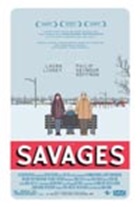
Laura Linney, Philip Seymour Hoffman, Philip Bosco
Theatre Release
January 17, 2008 by Fox Searchlight
The Savages opens amid bright colors, sunshine, and an oddly cheerful (though a bit unsettling) song and dance routine by a troupe of elderly ladies in the golf/retirement community of Sun City, Arizona. This is a land of golf carts and cactuses, townhomes and shuffleboard—a veritable paradise for the over 70 set. But the dreamy façade is quickly spoiled by the cruel realities of aging.
Lenny Savage (Philip Bosco)—an aging resident of Sun City—has just lost his companion of 20 years, and is himself facing the early stages of dementia. After an unfortunate incident involving fecal wall graffiti, Lenny is put in a local hospital for observation, and his two out-of-touch children are called in to deal with their father's deteriorating mental condition. Soon the kids transport Lenny back to the East Coast—specifically the drab, depressing Valley View nursing home in Buffalo, New York. Unlike Sun City, the colors here are muted (captured nicely by cinematographer Mott Hupfel), the air bitterly cold, the spirit less than hopeful. It's not a place to spend one's "golden years." It's a place to wither away.
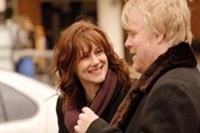
Laura Linney as Wendy, Philip Seymour Hoffman as Jon
Wendy (Laura Linney) and Jon (Philip Seymour Hoffman) are the Savage siblings—East Coast writers with little concern for each other and even less (on the surface) for their father. It is repeatedly suggested that the Savage children had a very troubled upbringing—that Lenny and an unnamed mother were less than ideal parents. Nevertheless, they are the offspring of Lenny, and like every son and daughter of an elderly parent, they must face the tough responsibilities that come with a caregiving role-reversal.
Wendy is a playwright from New York City, struggling to get work and taking temp jobs to pay the bills. Though she is constantly fearful of living a cliché d life (as a "spoiled American bourgeois writer complaining about her difficult childhood"), Wendy nevertheless fits many "single starving artist" stereotypes: She lives in a tiny, trendily decorated East Village apartment, her only companion a stubborn cat she calls "Beast." She is also phoning in an affair with a married man named Larry (Peter Friedman), who is fifteen years her senior and looks a bit like her father. (Is she using him to work through some father issues? Probably.) As the film opens she is sending out grant request letters to help finance her latest "subversive, semi-autobiographical" script that details her troubled early family life. Its title: Wake Me When It's Over.
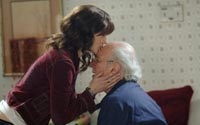
Wendy gives her father (Philip Bosco) a kiss on the forehead
Jon is also a writer, though of a less creative and more academic nature. He's a professor at a college in Buffalo, teaching classes on comparative literature and critical theory while writing books and papers with titles like No Laughing Matter: Dark Comedy in the Plays of Bertolt Brecht. The fact that Jon is an esoteric Brecht scholar is not just a funnily apt character trait; it is also of great thematic significance to the film. Brecht was a modernist German playwright whose concept of "epic theater" saw drama as a forum for social and political discourse—not an "organic work of art" that invoked emotion and passion. Likewise, Jon is a scholar—in the most detached sense of the word—who cannot be bothered with human emotion or personal issues. He rarely laughs and never cries, preferring rather to live mechanically and rationally—fulfilling obligations but never letting his soul into the fray.
Indeed, The Savages has a brutal quality to it that evokes its cleverly chosen title. The Brechtian "theater of cruelty and social unrest" is an apt companion to the film—which holds emotions like love at arm's length and unflinchingly portrays the ugliness of the human condition. What might otherwise be viewed as crass is, in The Savages, simply the unfortunate minutiae of everyday life. Hearing aids, adult diapers, nursing homes, catheters, wheelchairs, human excrement, pap smears—all are part of the world of this film.
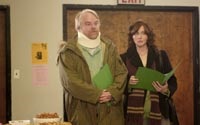
Jon sprained his neck while playing tennis with Wendy
Ultimately, The Savages is a film about decay—about how things fall apart, disintegrate, and age. And it is not just Lenny who suffers from decay. Plants, pets, houses, humans—it is all deteriorating. Jon and Wendy themselves are constantly facing the weight of change and time. A wrinkly world-weariness inculcates their bodies, hearts, and souls. Wendy begins the film with a cervical cancer scare, and is frequently seen jogging or exercising in fervent attempt to stem the aging process. Jon is overweight, suffers from high cholesterol, and sprains his neck playing tennis with Wendy. One of the warmest moments of bonding in the film comes when Wendy and Jon—in a neck brace—toast each other as they each gulp down a Percocet.
As the film goes on, Jon and Wendy try to act the part of dutiful children as their dad transitions to life in a nursing home. Wendy moves in to Jon's Buffalo house in order to be nearer to her father. The two of them visit Lenny often, and Wendy even spices up his antiseptic cell-like room with a lava lamp and puffy red pillow from Urban Outfitters. But Lenny never seems to know what is going on. There are no saccharine reconciliations or heartfelt exchanges of familial compassion. It's too late for that. Jon, Wendy, and Lenny are simply going through the motions that millions of families enact every day: the motions of trying to live right while preparing for death.
Article continues below
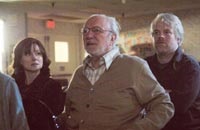
Lenny's body and mind aren't the only things decaying in this film
In some ways the film reminded me of Solomon's reflections in Ecclesiastes, about the cyclical seasons of life ("a time to be born and a time to die"), the meaninglessness of mortality ("naked a man comes from his mother's womb, and naked he departs"), and the aching reveries for the days of youth, before the trouble came. It's a film about death, certainly, but it doesn't dwell on it: it's more about how we live life in the face of such an inevitable and inglorious material end.
The Savages could easily have sunk into a pedantic, politicizing statement about euthanasia-type "life" issues. But that is never even on the radar of this film. And despite the generally morose subject matter, The Savages does a good job keeping things in perspective by pointing out the "what can you do?" absurdity of it all. We all face mortality, our broken-down bodies, our unseemly personal issues. And we can all laugh at it too. Sometimes we have to laugh.
Talk About It
Discussion starters
How does the title, The Savages, fit into the three main characters in the film? Which of them is the most savage? Or are they all equally so?
Why are the personal issues of Jon and Wendy's childhood never directly addressed? Why would the filmmakers insinuate that Lenny was a horrible father?
What do you think the final shot of the film—of the handicapped dog running along with Wendy—is meant to express about the themes of the film?
The Family Corner
For parents to consider
The Savages is rated R for some sexuality and language. It's a somber family drama that deals with some stark realities of life and death. It features frequent use of profanity, some scatological issues (poop on the walls, adult diapers, etc), and a few scenes of sexuality (Wendy in bed with her illicit lover), but in general it does not have a lot of egregious content. Nevertheless, it is not a film for children, but it is one that discerning adults and older teens might appreciate and relate to—especially as it sparks conversations about taking care of aging parents/grandparents.
Christian artists work at the intersection of music and climate change.
Kelsey Kramer McGinnis
The Savages
1 of 4
Laura Linney as Wendy, Philip Seymour Hoffman as JonWendy gives her father (Philip Bosco) a kiss on the foreheadJon sprained his neck while playing tennis with WendyLenny's body and mind aren't the only things decaying in this film













 While we pray for peace, we need moral clarity about this war.
 As my doubts about his teachings grew, so did a secret fascination with Jesus.
 Christian artists work at the intersection of music and climate change.