The re-teaming of Kate Winslet and Leonardo DiCarprio is as far from Titanic as you can get. Their acting is fine here, but the film may be too cynical for its own good.
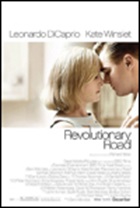
Leonardo DiCaprio, Kate Winslet, Christopher Fitzgerald
Theatre Release
January 23, 2009 by Paramount Vantage
It is fashionable these days to look back upon the '50s and '60s as a time when there was cool fashion and a lot of smoking and martini drinking, covering up for deeply unsettled, Stepford Wives-esque lives of quiet desperation. The AMC show Mad Men revels in this milieu, sometimes to an excessive extent. Were people really this suppressed, oppressed, and unhappy in their cookie-cutter suburban lives? Did Manhattan businessmen really have "swell" afternoon romps with secretaries while their wives baked cakes with the children at home? It's all very convenient and elegant to portray the postwar American ideal as an ill-founded, flashy farce covering up for the ugly truths of life, and it's made Mad Men a pop culture hit. But it's a little too convenient, too expected. And although it has many virtues, Revolutionary Road ultimately comes across as a little bit too cynical for its own good.
The film, directed by Sam Mendes (American Beauty, Road to Perdition) and based on the 1961 novel by Richard Yates, drops us into the lives of April and Frank Wheeler, a couple living an idyllic existence in the Connecticut suburbs of New York City in the 1950s. They have two kids, a house with red shutters, and some really nice neighbors. But the predictability of it all bores them, so one day they decide to drop everything and move to Paris "for something different." April will get a job working at the U.S. Embassy, while Frank just writes and reads and thinks about what he wants to do with his life. Their escape plan is soon thwarted, tragically, by their mutual realization that their move to Paris is really just a last-ditch effort to save their marriage. The rest of the film plays out like a slow burn, intricately and painstakingly unraveling the Wheelers' marriage before our eyes.
Leo DiCaprio and Kate Winslet as Frank and April Wheeler
In many ways, it's American Beauty set four decades earlier. Both films are about marriages that were once loving, once pristine, but are now falling apart. Both films are highly visual, slick masterpieces of technique and photography (Roger Deakins' work here showcases some of the best cinematography of 2008). Both films feature melancholy piano scores by Thomas Newman, oodles of slow zooms, and highly composed mise-en-scene. But while Road does have a bit more subtlety and complexity than Beauty, it has far less empathy and, well, hope. It's a beautiful film, but remarkably bleak.
Much heralded as the first on-screen reunion of "Kate and Leo" since Titanic ten years ago, Revolutionary Road features the pair of actors in considerably weightier, world-weary circumstances than their "I'm the king of the world" antics aboard the ill-fated ship. Like Jack and Rose, April and Frank are star-crossed lovers doomed to an unhappy end. Unlike the former couple, however, the Wheelers hate each other. Or, I should say, the Wheelers sometimes hate each other. Sometimes there is love between them, a little affection and hope (seen largely in flashbacks). But most of the time they are quietly loathing or resenting one another. It's considerably less fun to watch than the "my heart will go on" kitschy romance of Titanic.
Which is not to say that DiCaprio and Winslet are not highly compelling. This film is nothing if not a showcase for their formidable talents, and they are more than up to the challenge of playing tortured, well intentioned but ultimately doomed victims of dashed dreams. They have some truly great scenes together—alternatively throwing chairs at each other and laughing uneasily—including a climactic, passive-aggressive breakfast scene ("Would you like scrambled eggs or fried?") that will make you shiver with tension. Winslet especially is impressive here—displaying a frighteningly intense, full-bodied performance that is sad, maddening, and downright scary. Hers is the more complicated character, frequently unloading lines of confounding brilliance ("You're the most beautiful and wonderful thing in the world: You're a man!") or revealing immense emotions in the act of whisking an egg.
The film at large is respectably detached and impressively subtle. It's hard to affix blame or understand exactly who or what causes the film's events to unfold. At times it seems like these characters might have had a happy marriage. They both seem to share the same dream—of living off the grid of the predictable, technocratic American life. "Who made these rules?" April wonders—these rules of realistic, practical, conventional living that keeps them locked up like a prison? "All I know," says Frank, "is that I want to feel things. Really feel them." They are dreamers, optimistic people. But they are ultimately unable to break free, and in the end they fall victim to the very system that ensnares them. Or maybe their just victims of their own poor decisions—being unfaithful to one another, for starters. Either way, it's a tragedy. And it's not easy to watch.
Frank and April, trying to figure out life
There is a definite sense in which the Wheelers are merely stand-ins for the larger community: that of Revolutionary Road, and that of suburban, post-war America. Other characters and couples in the film (including a fantastic Kathy Bates) seem equally unhappy, equally in despair and denial—just perhaps more capable of hiding it. If that is the case, it's uncertain exactly what Mendes wants us to take away from Road. If the Wheelers are not an anomaly, but the norm, are we to assume that life was just all in all horrible back then? Is it that way today? Are happy, loving, honest marriages ever possible?
Article continues below
This is where Revolutionary Road's ambiguity holds it back. There is too little to take home after seeing this movie, except for a general feeling of having one's wind knocked out. If anything, it illustrates that we should not approach any relationship with a prescribed or scientific sense of expectation. One of the most memorable scenes of the film shows Frank in his office late one night, recording this voice note for his job: "Knowing what you've got, knowing what you need, knowing what you can live without—that's inventory control." It's a line that is obviously meant to represent much more than just practical business advice. It's a way of looking at the world, at morality, at love. And by the end of Revolutionary Road, we know one thing for certain: there has got to be a better way.
Talk About It
Discussion starters
What is the cause of the Wheelers' marital strife? Would things have been better had they gone to Paris?
Does anyone in the film seem genuinely happy? If so, how are they different from those who are unhappy?
How do you interpret the film's final event? Was it accidental? Intentional? Who is to blame?
The Family Corner
For parents to consider
Revolutionary Road is rated R for language and some sexual content/nudity. It's a very adult-oriented theme, with plenty of hateful and profane language, several scenes of infidelity and sex (with no nudity except for very brief shot of a topless female), and a disturbing scene of a self-induced abortion.
















 While we pray for peace, we need moral clarity about this war.
 As my doubts about his teachings grew, so did a secret fascination with Jesus.
 After lobbying from fellow Southern Baptists and Christians affected by the war, the House speaker moves a package forward.