In a world where nobody has ever lied, a screenwriter discovers the advantages of modifying the truth—and it's not the attack on religion that some have made it out to be.
What would it be like to live in a world without lying? I expected the universe depicted in The Invention of Lying to present a reverse image of the Jim Carrey comedy Liar Liar, in which the main character finds himself uncomfortably compelled to tell the truth. I expected, that is, one more brash, noisy, agitated film, replete with insults and gross-out jokes. I wasn't expecting the sweetness in this film, its quietness and thoughtful core. It feels, in spirit, more like a fable, in the mold of mid-century films like It's a Wonderful Life or Miracle on 34th Street.
I just wish it were better. I wish the early promise didn't grow gradually thinner and less authentic—less true.
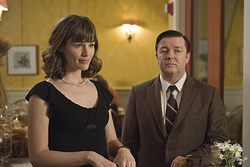
You could imagine a world without lying taking any number of forms. Screenwriters and directors Ricky Gervais (who also stars) and Matthew Robinson give us a world where people not only speak the absolute truth, but also have no internal controls to restrain blurting of uncomfortable and hurtful thoughts. At a restaurant, the hostess looks at gorgeous Jennifer and says, "Hi, I'm threatened by you." The waiter tells Mark and Jennifer, "I'm very embarrassed that I work here." And Jennifer is completely, devastatingly upfront with Mark over dinner: "You're overweight, you have a pug nose, and no job. You're not good enough for me," she says, with the blank honesty of a child and not a bit of (intentional) cruelty.
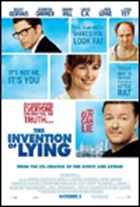
Ricky Gervais as Mark, Jennifer Garner as Jennifer
There are plenty of good laughs in the opening sequences as we get to observe what such an unadorned world would be like. Coke's slogan is "It's very famous." Pepsi's slogan is, "When they don't have Coke." A newspaper is named "Printed Publication" and a nursing home is "A Sad Place for Hopeless Old People." Movies consist of big-star readers, rather than actors, delivering factual lectures about history—because there's no fiction in this world, remember, even in the movies. (See if you recognize the famous "reader" Nathan Goldfrappe; this film is full of cameos.)
Mark is a screenwriter for Lecture Films, as a matter of fact, and has been assigned the fourteenth century. Worse luck for him, because the Black Plague doesn't sell tickets. As the story opens he is on the verge of being fired, and, down to only $300, about to be evicted from his apartment. But at the bank the computers are down, and when the teller asks how much he wants to withdraw, we see synapses firing deep in Mark's brain. He tells her that he wants the entire $800 in his account. The next moment, the computers are back online, and the teller sees only $300 there. Must be something wrong with the computer, she says, and hands Mark $800.
How you know this isn't a Jim Carrey movie is that Mark uses his power for good—well, mostly. At first he tries to scare a beautiful stranger into having sex with him, but her panic is so heartbreaking that he can't go through with it. So instead he begins to say kind and encouraging (and untrue) things to unhappy strangers, who instantly cheer up, given new hope and incapable of doubting his words.
The plot gets into gear when he is at his mother's deathbed. She tells Mark how frightened she is, and can't bear the thought of going into an "eternity of nothingness." Profoundly moved, Mark tells her that's not how it is: "You will go to your favorite place in the whole world. Everyone you love will be there. You'll dance—run and dance." Mark's eyes stream with tears. "There's no pain. Say hello to Dad for me. Tell him I love him." His mother dies full of joy and hope.
But the doctor and nurses have been looking on in astonishment. "What else happens?" "I'm going to see my mother again, when I die!" "Tell us more, please!"
Word spreads fast. Mark holes up for days as reporters and crowds gather outside his home, and eventually he comes forth with ten assertions about "the man in the sky" and his rules for living (scribbled on the backs of stone-tablet-shaped pizza boxes). His hearers are perplexed by some of the assertions and take note of apparent inconsistencies, but instantly accept whatever explanation Mark hands them; they are unable to doubt.
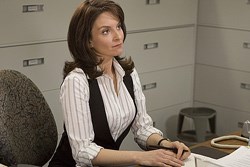
Tina Fey as Shelley
As I've read about this film I've gained the impression that it is intended to be ajabatreligion (and, some have said, at Christianity in particular). I didn't sense that while watching, though. It seemed rather a touching depiction of the human desire to know something more—the mysterious sense we are born with that this life is not all there is (see Eccl. 3:11b). Because, in fact, we are not unable to doubt. We know about the existence of good and evil, truth and lies. We are able to respond to religious truth because something deep inside resonates when it appears, like a gong shimmering in the air.
Faith is not just a matter of forcing belief in "what you know ain't so" (as Mark Twain said). It is an inner meeting that brings with it its own implicit validation—"the ring of truth." (Pondering this lately, I think a source of confusion is that our English word "mind" does not correspond to the biblical Greek word "nous." The nous is not the cogitating intellect but rather the understanding or comprehension, the receptive, perceptive faculty designed to enable direct contact with God.) People of faith recognize truth, rather than reason (or emote) their way to it. To people who don't hear that ring, religious belief must look very odd, and Gervais counts himself an atheist.
Article continues below
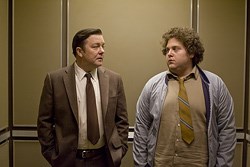
Jonah Hill (right) as Frank
As the film progressed, it has morphed from being a comic depiction of the fortunes of the only liar in a world of unvarnished truth, into something of a statement on religion, though not one recognizable to people of faith. Having Gervais' character posture as Moses or comically resemble Jesus during a dip into unshaven, unshorn depression is by definition superficial, and doesn't pose any challenge to belief. Then the film gets sidetracked again by becoming a will-he-get-the-girl story, wholly unconnected to either the lies-vs-truth or questioning-religion themes. There is, of course, no doubt about whether he will get the girl. In its concluding scenes the movie becomes so predictable that, dramatic tension squandered, it is uninteresting and palpably untrue.
I wish this movie had clung to its initial focus more closely, because the sweetness of trying to do good by the invention of lying, and the paradoxes and dangers that would pose, could have been explored much more effectively. I hope that Gervais and Robinson, having crafted a good premise in this film, will in later ones be able to follow a thought to greater depth rather than scattering too many different intentions into an ineffective stew.
Talk About It
Discussion starters
The premise that people in this world are capable only of truth is taken to mean that they interact only superficially, for example, judging others on their appearance. What other forms might a compulsively truthful world take?
Some people believe that lying can be ethical, for example, when seeking to spare someone's feelings, or to protect someone in danger. Can you remember a time that you told a lie with the goal of doing good?
Christ taught that the DEevil is "the father of lies" (John 8:44), the true inventor of lying, while he himself is "the Truth" (John 14:6). In some ages, people have felt moved to take on the challenge of "absolute veracity" and never telling a lie. Is this a good thing? Is it necessary, in light of Christ's words? Or would it tempt toward shading the truth and omitting elements, in order to meet the letter of the law?
The Family Corner
For parents to consider
The Invention of Lying is rated PG-13 for language including some sexual material and a drug reference. There is frank talk about sex, and one obscenity. It's not a film for children.













 While we pray for peace, we need moral clarity about this war.
 As my doubts about his teachings grew, so did a secret fascination with Jesus.
 C.S. Lewis recommended discernment over diatribes in exactly the moments we’re most eager to indulge in critique.