The Lovely Bones left me torn. On the one hand, it was an astonishingly creative and beautiful film, filled with the sort of deeply imaginative imagery that makes you want to leap from your seat in applause. But on the other, the film suffers from a conspicuous case of style over substance. While it is a message film—and a good one at that—the message is not prominent, and the conclusion needlessly timid. But it is something the film has no control over that impairs it the most—a philosophical aversion to bend to the rapacious human appetite for vengeance.
The main character, 14-year-old Susie Salmon (a terrific Saoirse Ronan), is murdered only minutes into the film. The setting is 1973 in the Philadelphia suburb of Norristown, where Susie is a typical teenager, especially her feelings for a schoolboy with whom she plans on sharing her first kiss. But it is a kiss she is never to have in life. Taking a shortcut through a cornfield after school one day, she encounters her neighbor, George Harvey (Stanley Tucci), who convinces Susie to enter an underground den that he says he's built for the local kids. But once inside, Harvey he rapes her, cuts her throat, and dismembers her body. (Thankfully, this horrific event occurs offscreen.)
Saoirse Ronan as Susie Salmon
How do you continue a story when your protagonist is killed? But as Ghost and other films have shown, sometimes death is only the beginning.
While the Salmon family, led by Susie's parents (Mark Wahlberg and Rachel Weisz), tries to come to grips with their loss, Susie finds herself in her own "personal heaven" from which she can observe her loved ones but not interact with them. She watches as police detective Len Fenerman's (Michael Imperioli) investigation grows increasingly cold. She watches as her father becomes obsessed with solving her murder, at the expense of his relationship with his wife and his own physical well-being. She watches as her sister Lindsey (Rose McIver) comes to suspect George Harvey and goes to perilous lengths to prove it.
Through it all, Susie tries to understand the limbo she comes to call "my heaven," a surreal place where action in the real world influences her own. Her only guide is a girl calling herself Holly Golightly (Nikki SooHoo), who describes the alternate dimension as an "in-between," a bit of both heaven and hell. While this bizarre purgatory does not require her to amend for any sins, Susie begins to suspect that she first must do something before moving on, but she can't help but continue looking down on her family and her old life. When she discovers that she is not Harvey's only victim, but simply his latest of many, Susie decides that hate is the only thing she has left.
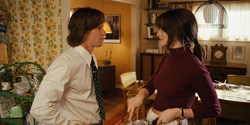
Mark Wahlberg and Rachel Weisz as Jack and Abigail Salmon
Based on the best seller by Alice Sebold, The Lovely Bones is drawn from the author's own experiences when she was brutally raped while a freshman at Syracuse University. Sebold did not attempt to capture the details of her assault in the novel, but rather the emotional and psychological repercussions. I am not sure director Peter Jackson (The Lord of the Rings trilogy) understands this. He seems less interested in Susie's emotional trauma (she doesn't really have one), than her discombobulation with and eventual acceptance of her new surroundings. This has the peculiar sensation of lessening the crime's impact, no matter how much we want to stay with the pain.
Where Jackson excels is with beautiful, surreal imagery, astounding special effects, and imaginative visuals full of odd angles, close-ups, and perspectives. He is superb at capturing the intimate and the expansive, placing cameras into the smallest of places—a dollhouse looking out on the giants looking in, inside ships-in-a-bottle while the rigging is raised. While following Susie around in heaven, Jackson evokes a What Dreams May Come aesthetic, crafting an ever-shifting world built on her fantasies and desires, the detritus of a teenage pop culture that manifests itself in psychedelic kitsch and dazzling daydreams. Monsters, so prominent in past Jackson films, still exist, but they take human form now, and cavort unnoticed among the innocent back on earth.
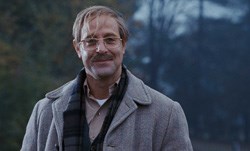
Stanley Tucci as George Harvey
Susie's personal heaven does not resemble an eternal paradise any viewers will recognize. Devoid of identifying religious elements, it has more in common with a generic idea of a blissful, wish fulfillment hereafter than any sort of Judeo-Christian model. There is no God or any supernatural force behind the scenes. There is no sense that Susie or anyone else will find their earthly actions called to account. This heaven is not a reward for a good and faithful servant. The afterlife, while "a wide, wide heaven beyond anything we know" is sweepingly simple, more a reflection of the emotional state of its occupant than anything else. There is an implication that heaven is a place of varying levels and after Susie has completed her tasks in this one, another, even more beautiful one awaits.
While it is beautiful ("Of course it's beautiful. It's heaven."), we only come to realize, with Susie, that her heaven is a place where people go to come to terms with what happened to them, nothing more. More specifically, heaven is a place where you come to find a freedom you could not find while on Earth, to let go of the pain of your final moments and the need to see justice done. This is all extraordinarily admirable, especially given the nature of the violence suffered by the lead character—and the author who invented her. The message, at its core, is quite simple: forgive and forget—even if, by implication, forgiving means justice is never done.
Article continues below
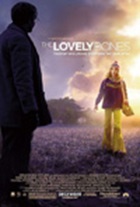
Susie in her own 'private heaven'
It is here, where the philosophical rubber meets the cinematic road, that The Lovely Bones (both the novel and the film) fails. Your definition of justice—how it is meted out and to what degree—will determine, in large part, your satisfaction with this film. Some early test audiences revolted at what they saw, so much so that Jackson altered the conclusion. Our final glimpse of Harvey almost seems like a narrative afterthought, an afterthought that, if the film was honest, was not necessary at all, but which was included because its omission was unthinkable. What The Lovely Bones suggests is that even justice takes a back seat to the liberating power of forgiveness. Vengeance, it implies, is best left to, if not God, then "the universe." But the film tries to have its cake and eat it too. What does it mean when we crave bloody vengeance but call it by the more polite name of justice?
This side of the real heaven, we can find completely happy endings and absolute justice in film alone.
Talk About It
Discussion starters
"Thank God we're not one of those unlucky people who bad things happen to for no reason." Susie utters those words mere minutes before she is killed. How do you read that statement in light of what happens? Is luck the appropriate word? How does the Christian address "bad things happening to good people?"
How do you visualize heaven? How does the film's version of heaven differ from what the Bible says?
Is forgiveness truly more important than justice? Are they both equally important or does one trump the other? Can you think of any Bible verses to support your view?
Why does The Lovely Bones postulate a world devoid of God, and what ramifications does that have, both for the afterlife and justice is this life?
The Family Corner
For parents to consider
The Lovely Bones is rated PG-13 for mature thematic material involving disturbing violent content and images, and some language. All the violence is implied and occurs off screen, but it's clear that as the killer drags a bloody, two-small-for-a-human-body bag across the floor, our minds fill in the sordid details. The language is extremely light. One character always has a lit cigarette and a glass of alcohol. Near the end of the film, Susie takes over the body of another girl — possessing her, in effect — so that she might physically interact with the real world. As discussed in the review, the God-less heaven of the film is like nothing portrayed in Scripture.















 While we pray for peace, we need moral clarity about this war.
 We’ve got little information on Jesus’ appearance and personality. But that’s the way God designed it.españolFrançais
 Beyoncé’s right. Whether listening to Cowboy Carter or reading theology, diversity is a good thing.