Those words echoed in my ears several minutes into this film as Staff Sergeant Will Montgomery interrupted a man working in his yard to tell him that his son had been killed in Iraq. Lashing out with vicious sorrow, the father, Dale Martin (played by Steve Buscemi), trails Montgomery and his commanding officer back to their car, spewing insults, wishing Montgomery, not his son, was dead. "Why weren't you there!"
What this father doesn't know—and probably doesn't want to know—is that Montgomery was there. Played with remarkable control and nuance by Ben Foster, the young sergeant has recently returned from the Middle East after a dramatic brush with his own death. Not that you'll find any explosive flashbacks in The Messenger. The screenplay by director Oren Moverman (I'm Not There, Married Life) and Alessandro Camon focuses on the aftermath of war, a quieter-but-no-less-intense companion to this summer's The Hurt Locker.
Ben Foster as Will Montgomery
Back at home and recovering from injuries seen and unseen, Montgomery is assigned to spend his last few months in the military as a member of the Army's Casualty Notification Team. He protests that he neither received nor gave any grief counseling himself (hinting at his own harrowing story) and is unqualified for the task. But he quickly learns that as a member of this team, his job is succinct—deliver the news. That's all. No counseling. Under no circumstances do you touch the NOK (next of kin, in Army parlance). Notify. Express official condolences. Get in and get out.
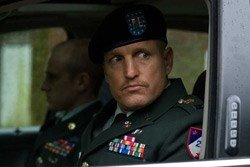
Montgomery is put under the command of the hardnosed Captain Tony Stone (Woody Harrelson), given a pager, and, after a bracing speech from Stone, told to be ready. He pours over a thick, three-ring binder of protocol during nights at his barely furnished apartment where he gets drunk, eats soup from a can, and sometimes sleeps on the floor rather than his bed. After observing Stone in action, Montgomery's first task on the job is to notify Martin about his son's death. As you might expect, thick, three-ring binders are as good as talismans when face-to-face with the NOK; you can never be ready. Or as Stone says after a particularly fraught notification, "There's no such thing as a satisfied customer."
Dealing in patriotism, sacrifice, heroism, and love, The Messenger could easily be suffused with melodrama and cliche. Instead, the movie manages to be emotionally charged without being saccharine—unflinching in the face of grief, the movie stops shy of making a voyeuristic spectacle of the raw pain Montgomery and Stone's visits trigger.
The same deft footwork is shown in the way the characters are drawn. It would have been easy to make a kind of modern-warfare caricature out of Montgomery, giving him a one-note angst—just one PTSD-induced nightmare away from losing it. Instead, Foster's performance is full of pathos, revealing quiet strength and even nascent wisdom as he grapples with the disparity between the idea and the reality of words like "hero."
Harrelson plays Stone with a kind of porous bravado, as a man who has made some sense of his life by being a part of the military, but who also harbors deep insecurity about his own service. Thrice married, he now prefers his sex without strings and maintains a tenuous grasp on sobriety.
The friendship that develops between Montgomery and Stone is halting at first, but sputters to life as the men go about sharing their particularly burdensome task. Despite the fact that Stone insists the Army is the best possible family, that the Army takes care of you, it's clear throughout the movie that the experience of war isolates soldiers not only from their actual families, but also from other soldiers. In each other, the sergeant and captain find an unexpected respite from this isolation, eventually revealing their own war stories to one another.
Samantha Morton as Olivia Pitterson
The always-superb Samantha Morton plays Olivia Pitterson, an NOK with whom Montgomery strikes up a relationship in the wake of her husband's death. And as with so many aspects of this movie, what seems in danger of being maudlin is instead poignant and thoughtful. A scene that finds the two in her kitchen pondering whether they should move to the bedroom is one of the most affecting depictions of heartbreak and desire I've seen. There is a profound kindness between these two, the relational equivalent of a deep, cleansing breath.
This in contrast to Montgomery's relationship with Kelly (Jena Malone), the long-term girlfriend he let go of when he was deployed. She flies to be by his side (or more precisely, in his bed) when he returns from Iraq, but holds his affections lightly and is soon engaged to her new boyfriend. A scene that has Montgomery and Stone crashing her engagement dinner on a drunken bender was perhaps the only misfire of the movie, feeling a bit overwrought in what is otherwise a study in restraint.
The Messenger involves difficult subject matter, but it's not hard to watch. It's sad and sobering, but also humorous and touching at turns. It should only increase the Oscar-contender chatter that started on the heels of the recent release of Precious. And hopefully that chatter will send people to the theaters to watch this moving calculation of the costs of war that never show up on a budget proposal.
Article continues below
Talk About It
Discussion starters
What do you think of the Army protocol for notifying the next of kin? Does this strike you are the best way to do difficult work? If not, why not? How would you go about it differently?
What role should Christians and the church play in serving the next of kin in the wake of a loved one's death? What would that look like in practical terms?
Olivia said her husband's time in the military had changed him into a different man. Do you know anyone who has served in combat? How has that experience shaped him or her? How has it affected your relationship with him or her?
Montgomery is hailed as a hero for his service on the battlefield. After hearing his own account of what happened, do you think he should still be hailed as a hero? Why or why not? How should we define heroism in the context of war?
The Family Corner
For parents to consider
The Messenger is rated R for language and some sexual content and nudity. While the movie doesn't feature any battle scenes, the specter of violence is present in the death notifications and descriptions of military engagements, injuries, and casualties. Crude language is used throughout. The film features nudity in a handful of scenes and depicts sex twice.















 While we pray for peace, we need moral clarity about this war.
 As my doubts about his teachings grew, so did a secret fascination with Jesus.
 Interview with leader of new evangelical alliance describes his escape from Khartoum and the pressure to pick a side.