Smart, old-school sci-fi in the tradition of 2001: A Space Odyssey featuring a terrific turn by Sam Rockwell and solid direction from rookie Duncan Jones. (And yes, he's David Bowie's son.)
There's an ambitious modesty to Duncan Jones's debut film Moon, a smart, existential science-fiction drama with one onscreen actor that runs 97 minutes and goes nowhere more exotic than our planet's natural satellite.
The setting itself recalls the era of the Apollo project, that remarkable period during which, over a three-year span of time between 1969 and 1972, a dozen Americans walked on the moon. Not coincidentally, at least as regards Moon's milieu, it's also the era of philosophically serious science-fiction films like 2001: A Space Odyssey, Silent Running and Solaris, the influence of which is consciously at work in Moon. There is also a connection to Blade Runner (though not in terms of mood, structure or look).
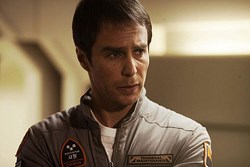
Sam Rockwell as Sam Bell
Yet where these films dealt with apocalyptic, transcendent or large-scale phenomena, Moon engages similar questions of identity and human nature on a smaller scale. Nothing more is ever at stake in the actual onscreen events than the lives of a very small number of characters, although the film explicitly indicates a larger scope of issues. While it doesn't look like a $50 million film, you wouldn't guess Moon was made for just a tenth of that figure—especially with a premise that requires a special-effects set piece for an ordinary game of Ping-Pong.
A great deal of the credit goes to the impressively fluid contributions of Sam Rockwell, who grounds the film's emotional contradictions and disconnects in bruised working-class stoicism and a sly streak of humor. Rockwell plays Sam Bell, an astronaut and mining contractor nearing the end of a three-year term at the Sarang lunar base on the far side of the moon. Sam's job involves monitoring a trio of roaming mining units (nicknamed Matthew, Mark and Luke) and periodically rendezvousing with them via lunar rover to collect shipments of helium-3, now the source of 70 percent of Earth's energy.
An early title tells us that the Sarang base has a crew of one—but Sam isn't entirely alone. For one thing, there's Gerty, who glides about in a ceiling-mounted track system and speaks in the detached cadences of Kevin Spacey, like a mash-up of the HAL-9000 from 2001 and OTTO from WALL-E. Sam also lives with his memories, if that's what they are, of his wife Tess, whose only contact with Sam is via recorded messages from Earth (live communication is down due to satellite malfunction).
Then, on a routine outing in the rover, Sam sees someone or something that can't be there. There is an accident that leaves a roaming mining unit damaged, and Sam is injured. Later, recuperating in the infirmary, Sam learns from Gerty that he's confined to base while a repair crew from Earth makes the three-day trip to get the damaged mining unit back up and running.
But then Sam overhears something that wasn't meant for his ears, and is suddenly dissatisfied with staying inside the lines. He decides to check out the damaged mining unit with or without Gerty's permission, leading to an exchange that deliberately evokes the tacit antagonism of Dave Bowman's relationship with HAL in 2001, though Moon also subverts the genre tropes established by the Kubrick classic.
What Sam discovers when he returns to the scene of the accident, and what he experiences afterwards, is described in many reviews—which is a shame, since Moon is not a mystery or "twist" thriller in which everything turns on a mind-bending explanation. Sam's disorienting experiences are best experienced as he does, with as little context as possible.
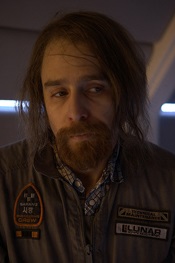
Getting a bit scruffy
Suffice to say, Sam's predicament touches on issues from the deconstruction of human nature and the commodification of human life to existential loneliness, alienation and the dehumanizing effects of corporate ruthlessness. Jones confidently covers this material with efficiency and restraint, avoiding both didacticism and unnecessary pyrotechnics.
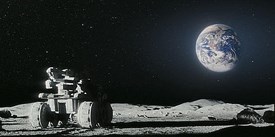
At the same time, the filmmakers create a world of admirable persuasiveness and visual appeal, from the industrial starkness of the base, to the lunar grit of the moonscape and the rover, to the clunky boxiness of Gerty, who looks like some sort of medical scanning unit (with the odd yellow Post-it note for an added touch of lived-in realness).
It's not a perfect film, but Moon earns enough goodwill to warrant overlooking small flaws for all it does right—and this is as good a place as any for the obligatory acknowledgement that the first-time filmmaker is the son of David Bowie.
Traditional dramatic theory outlines basic modes of conflict: character vs. character, character vs. nature, character vs. society, character vs. self. Moon plays ambiguously with multiple modes of conflict—including a sci-fi variant, character vs. machine—in the process questioning, though not dismissing, the relevance of the distinctions.
Although Sam's is the only face we see in person, the story becomes a three-way drama in which the line between the human and artificial worlds is tested. Part of the triangle, of course, involves the interaction of Sam and Gerty. Neither is necessarily quite what we expect them to be—and both, from the perspective of their corporate masters, are merely tools, interchangeable cogs in a larger machine.
Article continues below
Sam chafes at this; Gerty does not. But even Gerty doesn't necessarily play exactly the role assigned to it (him? her?), while Sam's reluctance to accept the obvious implications of his circumstances are potentially as much a comeuppance to human pretensions as they are ultimately, I think, an affirmation of them.
Checking out the lunar landscape
The truth, for Sam, is partly unwelcome—a point wryly underscored by a couple of ironic soundtrack choices. (In one scene, Sam overtly tries to drown out a message he doesn't want to hear by grooving to Katrina and the Waves' "Walking on Sunshine"—whistling in the dark, on the far side of the Moon. Even more pointedly, a morning alarm wakes him to the chorus of Hawkes Chesney's "I Am the One and Only.") More dark humor arises from Gerty's deadpan evocation of emotions, a series of variously inflected smiley faces, digitally displayed in less than perfect sync to the mood of the discussion.
Yet despite facts he would rather deny, Sam is ultimately vindicated—not only by his climactic choices, but by smaller touches, such as the wooden model town that he works on over the years with an X-Acto knife. Granted, he may not remember making all the pieces, but still and all creativity and recreation are an intractable part of the human equation.
By contrast, while Gerty's actions may be at times somewhat inscrutable, the robot's claim to be there to help Sam accurately expresses robot teleology. Robots exist to serve human beings; human existence can't be reduced to a similar teleological proposition. One way or another, Gerty is, in the end, a tool—and Sam, whatever else he may be, is not.
Talk About It
Discussion starters
Have you ever had reason to doubt or distrust that something you "remember" really happened? How important is it to be able to trust our memories? How can we know when memory is reliable and when it isn't?
Which do you think is more important, nature or nurture? Are people more influenced by their genes or by their environment and upbringing? Is there any other component that makes people who they are?
Do you think human cloning will ever be practical or accepted? If so, do you think it would be morally legitimate or problematic? Why or why not?
Would a human clone have a soul? How could you tell?
The Family Corner
For parents to consider
Moon is rated R for language, which almost always means recurring use of the F-word (here used as an expletive, not in a sexual sense). The names of God and Jesus Christ are also repeatedly misused. A character suffers injuries and illness, and there's some blood and a depiction of vomiting. There is also a brief bedroom scene (nothing explicit), and brief rear nudity in a shower scene.













 While we pray for peace, we need moral clarity about this war.
 We’ve got little information on Jesus’ appearance and personality. But that’s the way God designed it.españolFrançais
 NIL deals in college athletics present new challenges—and opportunities—for colleges and students.