1. Which movie line brings the biggest lump to your throat?
"I'm no good at being noble, but it doesn't take much to see that the problems of three little people don't amount to a hill of beans in this crazy world."
"This is true love … you think this happens every day?"
"I don't want my soul if it means I can't have you."
2. Which line leaves you most concerned for the mental well-being of the speaker?
"All right, Mr. DeMille, I'm ready for my closeup."
"You talkin' to me? Well I'm the only one here."
"The pain is my only reminder that you were real."
3. Which line would you most want your daughter to head for the hills if a guy said it to her?
"You should be kissed, and often, and by someone who knows how."
"Men and women can't be friends because the sex part always gets in the way."
"You are my only reason for staying alive."
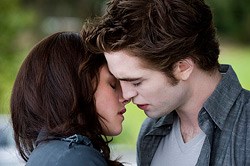
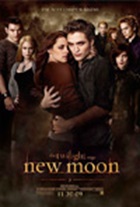
Kristen Stewart as Bella, Robert Pattinson as Edward
Those might not be the exact questions you would be asked on a Facebook quiz to discover which New Moon character you are, or whether you should have a "Team Edward" or "Team Jacob" graphic on your wall. But if you recognized more of the (a) and (b) answers above than the (c) options, you're probably not in the target audience for New Moon.
There are other possible clues. Here is one that worked for me: My favorite moment in the film comes when Bella's friend Jessica is critiquing a zombie movie they had just seen. "What's the deal with zombie movies?" Jessica asks crossly. "Is it like a metaphor for consumerism or something? Get over your self-referential cleverness. Some girls just like to shop."
This pointed critique does not appear in the novel version by Stephenie Meyer, although the zombie movie is there, and Meyer does put a very different critique of the movie onto Bella's own lips: "I got nervous when the movie started," Bella narrates. "A young couple was walking along a beach, swinging hands and discussing their mutual affection with gooey falseness. I resisted the urge to cover my ears and start humming."
Gooey falseness, of course, is the Twilight Saga's whole raison d'être. "[T]he rapt, the intense, the swoony-devout; seldom a hint of gaity" was C. S. Lewis's disparaging description of distorted media images of sexuality (in his chapter on Eros in The Four Loves). It's also precisely what rabid fans of human-friendly vampire hunk Edward Cullen (Robert Pattinson) and mortal chick Bella Swan (Kristen Stewart) want from their story.
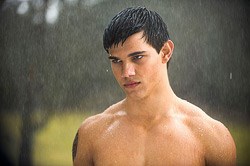
Taylor Lautner as Jacob
When Edward wants to know why Bella won't allow him to give her a birthday present, she responds, "Because I have nothing to give you in return." To which Edward's comeback is "Bella, you give me everything just by breathing." Everything Bella says to Edward amounts to Ah, Edward, you're too good and perfect for me; how unworthy I am of vampire love. And everything Edward says to Bella amounts to Ah, Bella, so pure and ethereal is my love for you that your mere existence is synonymous with my total good; I could neither wish for more, nor endure less.
Ultimately, Edward admits that he does want her blood, pretty badly sometimes, and yet he is adamant about not going there: not getting physical, not going all the way—even when Bella herself begins to pressure him. You can see why 14-year-old girls eat this stuff up. That the Edward Effect is no less potent for many of their mothers seems troublesome.
Twilight and New Moon are essentially uncritical celebrations of that overwrought, obsessive passion that is the hallmark of immaturity—passion that wholly subordinates all sense of one's own identity and elevates the beloved to summum bonum, or even the sole good; passion that leaps as readily to suicidal impulses and fantasies as to longing for union.
The theme of suicide pervades New Moon. Both the book and the film open with an epigraph from Romeo and Juliet ("These violent delights have violent ends / And in their triumph die, like fire and powder, / Which, as they kiss, consume"), and references to Shakespeare's play (the current subject in Bella and Edward's English class) occasion an early remark from Edward envying Romeo the ease of his suicide. It then comes out that Edward has given practical consideration to the difficulties of vampire suicide, when Bella's life was threatened at the climax of Twilight—since, of course, for Edward life without Bella would be not so much unthinkable as a mere oxymoron.
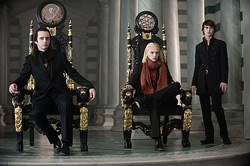
Marcus, Caius and Alec of the Volturi Guard
Likewise, when Edward's vampire clan abruptly bugs out of Forks, Washington—ostensibly because Bella's entanglement with Edward poses a danger to her life—Bella's dark despair leads to self-destructive risk-taking behavior. (Fun fact: According to Amazon.com's search feature, the word "pain" appears in Meyer's book over 50 times—about every ten pages.)
Of course she does this because she learns that (for some unexplained reason) at moments of stress or danger she sees visions of Edward, warning her away from harm. Still, behind her willingness to risk her life to catch even a phantasmal glimpse of Edward is the same self-destructive obsessiveness of all suicidally lovelorn teenaged poetry.
Article continues below
Edward's absence leaves the door open for Quileute Indian Jacob Black (bulked-up Taylor Lautner) to move in on Bella, and so deep is Bella's need for comfort that she willingly accepts his attentions for the sake of the friendship she wants, knowing that he hopes for what he can't have.
Later, Jacob is all running around bare-chested and ripped in the woods with four of his bare-chested Quileute kinsmen, and it turns out he can bound up and down through Bella's second-story window as uncannily as Edward. And then (spoiler warning, sort of, I guess) Bella is saved from a dangerous vampire by four enormous wolves the size of Wargs—and then still later she actually sees one of Jacob's kin turn into an enormous wolf—and still she doesn't put two and two together about her pal Jacob. Not the brightest crayon in the box, Bella.
Along with Bella's physical carelessness is a troubling strand of what might be called soteriological carelessness. When she learns that Edward doesn't want to turn her into a vampire because he doesn't want her to lose her "soul" and be "damned" like him, Bella tells Edward to "take" her soul, which she declares she doesn't want if it means separation from him.
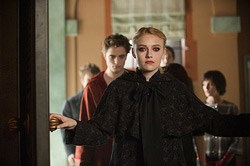
Dakota Fanning as Jane, in search of Visine
The film offers no further clue what "losing one's soul" or being "damned" means, but in the book the Cullen paterfamilias Carlisle affirms the existence of God and a heaven for humans but not (Edward at least believes) for vampires. Bella rejects Edward's pneumatological fatalism, but it's not clear her decision is contingent on which one of them is right. (At one point Bella wonders whether every kind of fairy tale is true after all; if so, the popular notion of vampires being soulless would seem to be worth taking seriously.)
By the way, the unfortunate incident that prompts the Cullens' departure is so jarringly staged that it took me something like twenty seconds to accept that it was actually happening—that it wasn't the sort of semi-comic fantasy sequence in which a character's imagination briefly intrudes into the film's narrative continuity before reality reasserts itself. ("Ally McBeal" famously did this a lot. For a recent movie example, see Pixar's Up, in which Carl briefly fantasizes about lowering Russell from the floating house onto the roof of a passing skyscraper.)
Needless to say, a fantasy of this sort that is easily if briefly confused for reality is no flaw in the filmmaker's art, but you don't want the opposite confusion. As this suggests, director Chris Weitz doesn't exactly raise the bar over Catherine Hardwicke's Twilight; I'm not sure he lowers it either. The height of the bar was more or less set by Meyer and her rabid fans, and nobody wants it moved much.
Article continues below
Talk About It
Discussion starters
Why does Edward leave Bella? What if anything has changed by the end of the story? Do his departure and his return into her life make sense?
Is Bella and Edward's love selfless or selfish? How so?
1 Corinthians 13 says, "Love is patient and kind; love is not jealous or boastful; it is not arrogant or rude. Love does not insist on its own way; it is not irritable or resentful." Which of these qualities might be applied to Bella? To Edward? To Jacob? Which of them might not?
Suppose Edward were not a vampire, just one of Bella's human friends at school. Would you look at his behavior or relationship with Bella differently in any way? How so?
The Family Corner
For parents to consider
The Twilight Saga: New Moon is rated PG-13 for some violence and action. The film contains scenes of menace and fantasy violence mostly among or between vampires and/or werewolves. Themes of suicide and morbid risk-taking run through the film, and there's some mild sensuality.
Christian artists work at the intersection of music and climate change.
Kelsey Kramer McGinnis
The Twilight Saga: New Moon
1 of 4
Kristen Stewart as Bella, Robert Pattinson as EdwardTaylor Lautner as JacobMarcus, Caius and Alec of the Volturi GuardDakota Fanning as Jane, in search of Visine













 While we pray for peace, we need moral clarity about this war.
 A Christian reconciliation group in Israel and Palestine warned that war would come. Now the war threatens their relevance.العربيةFrançais
 Christian artists work at the intersection of music and climate change.