A dramatically overwhelmed army holds out against an aggressor ten times their strength in John Woo's magnificent and sprawling 3rd Century period epic.
Tony Leung Chiu-wai, Takeshi Kaneshiro, Fengyi Zhang
Theatre Release
December 04, 2009
Many people see Red Cliff as Hong Kong actioneer John Woo's return to form. I'm not one of them. John Woo has never once made a film I've liked, though he has made at least one I've detested. For me, Red Cliff is not John Woo returning to form, but entirely redefining himself, transforming both his narrative and aesthetic style into something seldom even hinted at in his earlier work. Red Cliff is a visual masterpiece of both epic sweep and intimate detail. In ways both palpable and intangible, Red Cliff is like a mid-20th century Hollywood period spectacular—brimming with narrative optimism, thematic confidence and the courage of its three-dimensional characters. Sun Tzu had it right; indeed there is an art to war.
Red Cliff takes place in 208 A.D. and highlights a battle that heralded the end of the Han Dynasty's vice-like grip on mainland China. Power-hungry prime minister turned general Cao Cao (Zhang Fengyi) is the real power behind the impotent Han emperor Xian, a leader too young and terrified of his advisor to assert the crushing power his office bestows. Seeking to gobble up the southern provinces, the last holdouts against his geographical appetite, Cao Cao makes up a story of treasonous warlords and convinces the emperor that a military expedition must be launched at once.
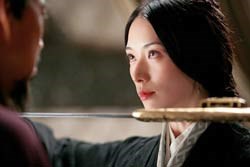
Chiling Lin as Xiao Qiao
Realizing that the full weight of the emperor's massive army is about to be brought to bear on their peaceful realm, the southern warlords, Lui Bei (You Yong) and Sun Quan (Chang Chen), unite to repel the invaders. Spearheading their resistance is Bei's military strategist, Zhuge Liang (Takeshi Kaneshiro), who has an intuitive understanding of warfare as well as a keen empathy with nature, and General Zhou Yu (Tony Leung), who commands a small but powerful army at Red Cliff, a dramatic mountain range spilling into the Yangtze River. It is here that the southern warlords make their stand against an army and naval armada ten times their size. The outcome of the battle will decide not only their fates, but the fate of an entire nation.
Red Cliff, the most expensive Asian-financed film to date (and also one of the most profitable), was originally envisioned as a single film, but when the final cut ran nearly five hours in length, it was split and released to Chinese audience in two parts. These two parts were reunited and then gutted of 2 ½ hours to produce the 140-minute release in the West. As such, large sections deemed too convoluted for those unfamiliar with Chinese history are now gone, prompting Woo to add a lengthy and dense narration to several of the opening scenes. Rather than hobble the film, however, the narration sounds as if it is taken from an erudite historical text, and actually ends up doing exactly what it was intended to do—simplify the players, their enormous stage, and the context for the pending belligerencies.
Most war films, especially those that take place in a time when warfare invariably meant close-quarter, hand-to-hand combat with blade weaponry, love to offer their viewers breathtaking aerial views of opposing armies massed in perfect formation, colliding, surging into each other's ranks, and quickly becoming an indistinguishable mass of slashing swords and failing limbs. Red Cliff's first battle sequence falls into exactly this category and sets the viewer up to believe that the rest of the film will follow suit. But the filmmakers have a surprise up their sleeve. This is the first and last time we will see a clash of that nature, for this is a war film in which the most important muscle is the brain, not the bicep. When you are drastically outnumbered, you win not by sheer might, but by outwitting and outsmarting your opponent. In modern combat parlance, you fight smarter, not harder.
Director John Woo on the set
Red Cliff is like a cinematic approximation of a game of Risk, full of stratagems, tactics and carefully plotted campaigns. In this movie, even an innocent tea ceremony is a premeditated battle tactic. Undercover spies gather information about the enemy and relay it in tiny satchels strapped to the feet of white doves (this is a John Woo film after all; you didn't seriously think there wouldn't be doves?). Commanders use the information to plan complex and intricate counter offensives, carefully delineating battle formations and the movements of their war machines.
Rather than surprise us with exhilarating twists in the midst of battle, Woo grants his full access to the war cabinet. Like invisible generals, we stalk the room, peering at leather maps and figurines representing troop movements. We know exactly what will happen and when. Instead of undercutting the tension, this ploy actually heightens it. We feel as if we have as much invested in the outcome of the battle as the characters on screen. We know how the good guys plan on defeating the bad, but not if they will be successful. There are times when the plans work out so precisely (a scene in which the military strategist Zhuge Liang undertakes a mission to replenish the army's impoverished cache of arrows being a perfect example) that the audience cannot help but whoop and holler in euphoric support.
Article continues below
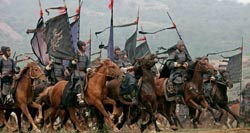
There's battle action aplenty in the film
Red Cliff is about beauty as much as it is about war. Indeed, there are times the two mirror each other so precisely, one cannot tell which is which. Battle sequences are not just shot to be aesthetically beautiful ballets of carnage, they become so chiefly because we know they are so much more than the haphazard class of well-armed men; they are elegantly plotted machinations that either succeed or fail based on happenstances too numerous to count. Woo is as masterful at portraying vast tactical maneuvers as he is at close-quarters combat. He is not afraid for his film to take the time to be beautiful. He suffuses his work with intimate, elemental close ups and populates it with the sort of rich and textured macro-photography not normally associated with cinema. Oddly enough, the only incongruities appear when Woo reverts to his old tricks, moments in which he celebrates the exaggerated physical prowess and superhuman grace of his warriors and the bloodbath they litter in their wake. But even this is forgiven, partially because it only occasionally breaks the film's spell and partly because it is an example of an aesthetic Woo has refined to an admittedly exhilarating art form.
But being Woo, he is also not intimidated by grand gestures. There are scenes of grandeur here that would make Akira Kurosawa proud. Red Cliff is also layered with great swaths of computer generated imagery, luxuriously rendered. We don't simply sweep over naval armadas surging down river or clustered together at port, we linger on them for minutes at a time, invited to allow the breathtaking images to sear themselves into our memories. Woo, who was granted the use of 100,000 Chinese soldiers, seamlessly combines the real and the imaginary to create an intoxicating illusion of awe-inspiring sprawl. Where Red Cliff gets excessive (and it does), it becomes something akin to pure poetry.
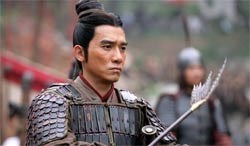
Tony Leung Chiu Wai as Zhou Yu
What is perhaps more amazing is that Woo, known for his fetish with expressing violence, should so gracefully handle the well-roundedness of his main characters. His protagonists are observably the best of men (and women), honorable, upright and virtuous. We watch them in the best of times loving each other and caring for all those around them. They are without flaws, and while this representation is unrealistic, it is a concession Woo makes across the board. The tyrant Cao Cao is perhaps one of the least caricatured villains in recent memory. There are times we almost mistake him for a decent man. And his assignment as the villain in no way dampens his intellect. Quite the opposite. He is every bit as perceptive as those he seeks to crush. For every stratagem they devise, he too conjures one to match. While we never forget he is the reason for all the misery in the film, we also find him profoundly human. A scene in which Zhou and Zhuge play a musical duet together on a guqin, an ancient stringed instrument, becomes the perfect metaphor for this point/counter-point. The music escalates, growing into something unmistakably beautiful yet also frenzied and urgent, both melodically hypnotic and violently aggressive. Both men are master of their instruments, and in their hands, they produce divine music.
Article continues below
Rarely has so much history, strategy and culture and been crammed into one film. Red Cliff is an ambitious, visually stunning, sensationally entertaining epic, the offspring of a filmmaker both at the height of his powers and remolding himself into something far greater than what came before. Red Cliff takes its place in the pantheon as one of cinema's the truly great epics.
Talk About It
Discussion starters
In Red Cliff, several disparate Chinese tribes unite in the face of a common foe. What can we learn about strength in numbers and why is that important in the life of a Christian?
What does Red Cliff say about courage in the face of overwhelming odds? Does courage mean one does not feel fear or one suppresses that fear? Why is the distinction important?
Many critics have said that every war film is an anti-war film. Do you agree? Or can you think of examples of film in which war is glorified? Into which category does Red Cliff fall?
The protagonists in Red Cliff live and die by how well they know their enemy's tactics and intentions. How does this idea square with the Christian's need for vigilance in a fallen world ruled by forces in opposition to God?
The Family Corner
For parents to consider
Red Cliff is rated R for sequences of epic warfare. There is neither language nor nudity, though there is a very tame and mostly clothed (bare backs are about all you see) love scene between a married couple. The film earns its R-rating because of violence alone. As one might expect with bronze-age warfare, many body parts come to a quick and very bloody end at the edge of innumerable swords and spears.














 While we pray for peace, we need moral clarity about this war.
 A Christian reconciliation group in Israel and Palestine warned that war would come. Now the war threatens their relevance.العربيةFrançais
 Christian artists work at the intersection of music and climate change.