The latest from Japanese director Hirokazu Kore-eda is a nearly flawless film that delicately and beautifully deals with memory, family, death, and life.
Japanese director Hirokazu Kore-eda started out making documentaries, then moved into narrative films, for which he has been highly praised. He commonly explores death, shame, and memory—themes that are embedded into the fabric of Japanese society—and though his early work is sometimes rendered stilted by its detached approach, he has lately warmed to his audiences, inviting them into his stories.
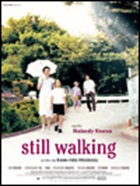
His latest, Still Walking, is, quite frankly, a nearly perfect film, and one that even non-Japanese audiences will find accessible and engaging. Shot beautifully, directed skillfully, it bears a domestic naturalism that is surprisingly absorbing, given its fixation on the everyday while telling a story of greater, deeper meaning.
Family and food are dominant themes
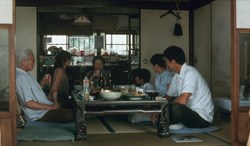
The Yokoyama family gathers each year to memorialize the day of their oldest son's accidental drowning. On the fifteenth anniversary of this memorial, the children return home to their parents' small-town house with their families in tow. Ryota, recently laid off and too ashamed to tell his parents, reluctantly brings his new wife and young stepson, who lost his own father when he was too small to remember him. Chinami, bubbly and cheery, arrives with her husband and two rambunctious children; they'd like to move into the family home alongside the grandparents in the near future, but the older folks aren't so sure.
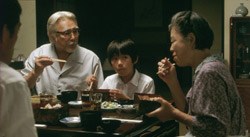
Grandmother Toshiko busies herself cooking for her family, alternating a bustling industry with that familiar passive-aggressive prodding of offspring unique to mothers. Grandfather Kyohei, who was forced to retire from his medical practice because of sight problems, now hides out in his office, unable to help his neighbors with their health problems and bitter that the son who might have maintained the practice was cruelly snatched from him.
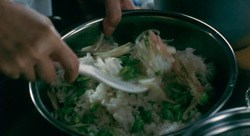
Nearly the entire film takes place over the course of the overnight visit. The family prays briefly before their brother's memorial shrine, then spends the rest of the time chatting, teasing one another, telling stories, revealing secrets, laughing, crying, and eating together. (The food is one of the most beautifully shot parts of the film: sizzling tempura corn cakes, carefully chosen sushi, brightly colored shelled edamame, and much more. You'll want to go to a Japanese restaurant after the movie.)
It's a story that covers multiple generations
The tale unfolds slowly. Various narrative threads unwind and then slowly combine. Quiet and buoyant, humorous and sad, Still Walking skillfully captures the universal dynamic of most families, who at once harbor bitterness, forgiveness, anger, and love within their relationships.
Its musings are important, reminding the viewer to treasure loved ones before it's too late, exploring regret and bitterness and their ramifications over time, and playing with the nature of memory. As a photograph of the missing loved one is carried into the family photograph that's being taken, we are reminded that, as one character says, "People might die, but they are never really gone."
Though it's certainly unintended, Still Walking's resemblance to Summer Hours, a French film from earlier this year, is striking. Both films deal with intergenerational familial conflict—and truly believable love. They both confront the changes in a family and a society that happen when the younger generations come of age, causing parents and grandparents to move out of the spotlight and sometimes into obscurity. It happens in youth-obsessed cultures, like ours, and it happens in cultures that have a more historic respect for their elders, like Kore-eda's. It is fascinating—and revealing—that films from such disparate cultures share this common theme.
After watching, you may want to go to a Japanese restaurant
Kore-eda also pays homage in this film to Yasujiro Ozu's classic Tokyo Story, which tells of ungrateful but sophisticated children (and a compassionate daughter-in-law) who visit their simple, aged parents, not realizing how brief and precious their time with them is. Kore-eda renews these themes while approaching his own familiar themes of memory and shame from a compassionate, humane perspective.
These characters are reserved, but still manage to reveal themselves to us. The camera drifts about, linking people with objects, ideas with experiences, reality with memory. Visually stunning, genuinely acted, with a truthfully told story that is both familiar and new, Still Walking is itself an homage to an older generation of Japanese filmmakers that has something relevant and meaningful to say to today's world.
Talk About It
Discussion starters
What rituals or experiences does your family share, either around celebrations or remembering your loved ones? What stories come up at every family gathering? What tensions exist?
In the movie, how do the children treat the adults? How do the adult children treat the parents? How do the grandparents treat the younger generations? What tensions are underneath these actions?
One of the film's major themes is to treasure the time you have with family, because you can never be sure when things will change. What do you do to create memories? Are there ways you could do this better?
The Family Corner
For parents to consider
Still Walking is not rated. It is joyful and sad, appropriate for nearly everyone, though the main themes involve "adult situations": death, recurring bickering between the parents, underlying familial tensions and a few strong words (in subtitles). There is a very veiled allusion to a long-ago affair.















 While we pray for peace, we need moral clarity about this war.
 As my doubts about his teachings grew, so did a secret fascination with Jesus.
 The founder of Concerned Women for America was credited by President Ronald Reagan with “changing the face of American politics.”