Listening to Clint Eastwood talk about his latest film, Hereafter, one gets the impression that the director views this one as a bit of a departure. Speaking to the UK's Telegraph, Eastwood called this his "French" film, which is only partly true on a literal level—about a third of the movie is set in France, and in the French language—but is a reasonable enough way to summarize its comparatively artsy feel, as well as its structure of three initially unrelated but eventually intersecting stories. He's also called this his "chick flick," which is, again, an exaggeration, but only a slight one; by Eastwood standards, there's very little violence here, and a larger-than-usual role for romance.
Fair enough. Hereafter is, in many ways, a different sort of movie from any of Eastwood's previous. And yet, in other ways, it's not so different at all.
Eastwood the director has been obsessed with human mortality at least since 1992's Unforgiven. Now 80, Eastwood is more prolific than ever, and much of his career as a filmmaker has been spent toiling in the shadow of death. Is it a natural reaction to his age and his long, storied career—or is he simply drawn to the subject in the same way Scorsese is drawn to the causes and ramifications of violence? Tough to say. There's little denying it, though: His thriller Blood Work had human frailty as its core, Space Cowboys was all about old men playing a young man's game, Million Dollar Baby had an ominous undertow from the first frame, and Gran Torino had Eastwood himself playing a man who knew he was in his last days. And oh yeah, he made a pair of World War II movies.
Cecile de France as Marie Lelay
Some of these films are pretty terrific, some not so much; taken together, though, they make for an interesting, running discussion about death and what it means. Hereafter is no different—in fact, it addresses dying and the afterlife as directly as any film Eastwood's ever made. Don't let its directness fool you, though; Eastwood's film seems to think it's confronting these issues head-on, but really is mostly avoids them altogether.
The plot is a three-way split. In the first story, a French journalist (Cecile De France) has a near-death experience when she is swept under the waves of a tsunami, her survival something of a miracle. She has a vision of the afterlife, and what she sees shakes her to the core—enough so that she essentially throws her career down the tubes in order to write an investigative book about, well, the hereafter. This is the least eventful of the three stories, and yet it might also be the most engaging, if only because of the superbly sympathetic performance from De France.
In story two, Matt Damon stars as psychic who can communicate with dead spirits simply by touching another human being. This is more of a curse than a blessing, something he spells out explicitly and which we see firsthand when he strikes up a charmingly bumbling romance with a virtual stranger (Bryce Dallas Howard) and makes the mistake of giving her a "reading."
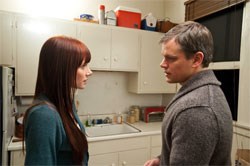
Matt Damon as George, Bryce Dallas Howard as Melanie
And in the third arc, two young boys (Frankie and George McLaren) live in London with their heroin-addict mum (Lyndsey Marshal) and try their hardest to cover for her self-destructive habits, simply so they aren't taken into foster care. This story is heartbreaking and harrowing, all the more so when one of the boys has a tragic accident that changes things for the both of them.
It's a film structure similar to other character mosaics like Babel or Magnolia. Eastwood weaves his three strands with precision and care, though it's not as complex or as sophisticated as either of those other films. Decidedly irreligious and spiritual only in the vaguest possible terms, Hereafter is a rather toothless movie that purports to ponder big issues but has no voice, no vision, and absolutely nothing substantive to say.
There's never any real debate here, never any sense that the film is weighing different points of view. Its mind is made up and remains unshaken throughout. The question of whether there is indeed a hereafter is never really a question at all; the supernatural gift of Damon's character, to communicate with spirits from the next world, is not a gimmick or an act, but is instead taken as reality and never really questioned. But the movie's implicit belief in the supernatural doesn't mean that it's an argument in favor of any particular spiritual reality; at one point De France's character says that there are mountains of scientific evidence for … well, something beyond this life, but we never get any further sense of what that evidence is, or what it is supposedly proving.
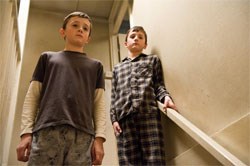
Frankie and George McLaren as Marcus and Jason
If anything, religion in any meaningful sense is rejected out of hand, never being allowed to actually participate in the dialogue. This is yet another movie in which Eastwood squares off with a priest—only where he at least has the decency to do so face to face in Million Dollar Baby and Gran Torino, here he smirks at religious authority from behind the camera, giving us a mean and uncaring minister and an abrupt scene in which one of our young boys thumbs his nose at the mention of Jesus Christ, with no further argument or explanation given.
Article continues below
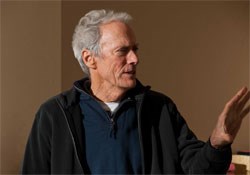
Director Clint Eastwood on the set
That God is altogether absent from this film is problematic, but just how problematic is it? Remember the character that was miraculously spared from a tsunami? The film also tells us that there are thousands of lives that are not spared. We never hear anything else about those tragedies; neither do we hear the name of God invoked, or experience any spiritually and intellectually robust arguments about why a loving God would allow this sort of thing to happen. It is simply a plot device, its result simply that of driving our heroine into her own introspective quest for spiritual assurance. Those other lives lost are merely casualties along the way, as are the lives of those who are presumably lost later in the film when a bomb is detonated on a subway, simply for the sake of propelling one of the story arcs forward.
There is no broader sense of meaning to any of this, no compassion or empathy for those at the edges of the frame. There is only the unerring inward gaze of a film that refuses to engage spiritual matters with honesty or integrity, instead honing in on the vague, impressionistic platitudes it has clearly accepted from the outset.
Talk About It
Discussion starters
Do you think the film arrives at any conclusions or answers about death and the afterlife? If so, what are they?
What might you have done differently if you were the filmmaker?
How would you describe the film's attitude toward the supernatural?
Do you think God is present in these stories?
What do we know about heaven from Scripture?
The Family Corner
For parents to consider
Hereafter is rated PG-13 for its mature thematic content, which in this case means a lot of discussion of death and the afterlife as well as some fairly intense scenes of a tsunami and a train explosion. There is also an f-word in one scene.
The Grammy-winning artist was found dead at her home in Nashville at age 47.
Diana Chandler - Baptist Press
Hereafter
1 of 4
Cecile de France as Marie LelayMatt Damon as George, Bryce Dallas Howard as MelanieFrankie and George McLaren as Marcus and JasonDirector Clint Eastwood on the set














 While we pray for peace, we need moral clarity about this war.
 As my doubts about his teachings grew, so did a secret fascination with Jesus.
 The Grammy-winning artist was found dead at her home in Nashville at age 47.