Leonardo DiCaprio, Joseph Gordon-Levitt, Elliot Page
Theatre Release
July 16, 2010 by 20th Century Fox
A day or two after seeing Christopher Nolan's much-anticipated Inception, my head's still reeling. I don't think it will stop until I see it again. Once is not enough.
One thing I'm confident of: Inception is the most audacious and multifaceted Hollywood entertainment for grown-ups I've seen in years: a brainy, bravura achievement inviting comparison to the most inspired work of Hollywood visionaries from Michael Mann and Charlie Kaufman to Ridley Scott and the Wachowskis.
Some spoiler-free first impressions. One of the film's most iconic images starts with two characters sitting at a cafe in a Paris street market. One of them has an epiphany, and the next thing you know the whole street starts to explode—not like a bomb site, but like fireworks and confetti, with flying chunks of vendor wares and debris hanging in mid-air and bursting anew until every square foot of space around the characters is strewn with suspended fragments of stuff, like a snow globe. The shot, which took weeks of preparation and testing, is a mirror image of the film itself, meticulously controlled despite a superficial impression of chaos, exploding in all directions at once, bursting with creative ambition.
Leonardo DiCaprio as Cobb
Like an even more spectacular set piece in which an entire Paris neighborhood folds over on itself, the film's narrative doubles down on itself three, four, even five times, with reality and unreality in layer under layer, like catacombs. On the surface, Inception is a glossy sci-fi caper film, an ambitious, mind-bending action thriller about an elite team of identity thieves hacking into a target's subconscious mind through shared dreams—the ultimate in identity theft.
It's also a dazzlingly virtuoso cinematic spectacle, stunningly converging in a single narrative structure a far-ranging gallery of effects and techniques at times evoking past landmarks: time-bending, gravity-defying action scenes recalling The Matrix; surreal architectural fluidity suggesting Dark City; crumbling dreamscapes reminiscent of Eternal Sunshine of the Spotless Mind. There are also more conventional set pieces, from a Bond-style commando assault on a heavily guarded mountaintop compound to a Bourne-style street chase.
Marion Cotillard as Mal
The plot is about a caper, a journey into the mind of a target carried out by a team of professional "extractors" led by Dom Cobb (Leonard DiCaprio). But it's just as much about Cobb's inner world, a multilayered reality visually represented in dream architecture by floors accessed via elevator. Inception contemplates guilt, grief and regret, and how they come to define us and our reality. Thematically, it's about the power of ideas, the power—and vulnerability—of the mind.
Philosophically, Inception invites existential and epistemological comparisons to Solaris and Eternal Sunshine with respect to how we live in relation to reality and unreality, doubt and leaps of faith, truth and memory, and other minds, as we imagine them and as they really are. Poetically, recurring images are invested with gathering weight: a pair of small children glimpsed from behind as they dart away; a tiny spinning top; blowing curtains; the surf crashing on a beach; a vault door; a hospital bed.
On one meta-level, Inception is a movie about moviemaking, about the process of creating illusory worlds and narratives that seem real to others. But it's also very much about the relationship between the screen world and the viewer, to a greater extent than any recent Hollywood film I can think of. "Everyone wants catharsis," one character observes in relation to plotting the caper. Nolan, plotting the film, is aware that the audience desires catharsis. Will we get it? On what terms will we accept it? Is illusory catharsis as good as the real thing?
Ellen Page as Ariadne
The joy of invention runs through the film as Nolan takes his premise from one startling extrapolation to another, seamlessly running together the reality and popular mythology of dreams. The association of falling or dying in a dream with waking up is juxtaposed with the common experience of physical sensations (such as being cold or hearing sounds) manifesting in the dream world. The saw of time in dreams being compressed or telescoped is startlingly combined with the notion of "dreams within dreams." Then there's the experience of lucid dreaming and the unsettling awareness of other people in dreams as projections of one's own mind—and with it the sickening sense of a nightmare foe who seems to know what you're thinking and can match you move for move, because you're actually up against your own subconscious.
Amid this whirlwind of creative razzle-dazzle, some viewers may occasionally lose track that they're watching a crime in progress, an act not only of corporate espionage but of intellectual sabotage, an offense against human dignity.
Cobb's mission is almost unheard of: not to extract information but to plant an idea in such a way that it will seem to be the subject's own idea (an operation called "inspiration" or "inception"). Cobb's employer, a Japanese entrepreneur named Saito (enigmatic Ken Wantanabe) wants a business rival (Cillian Murphy) to decide to break up the corporation he inherited from his father—a decision that may begin with the seed of an idea planted in his subconscious. Saito claims that the company is becoming too powerful, and its dissolution will benefit the world. Certainly it will benefit Saito.
Article continues below
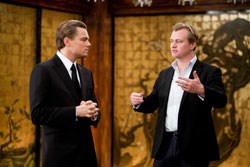
Director Christopher Nolan (right) on set with DiCaprio
If the mission is fraught with grave moral problems, Cobb's motivation is more sympathetic: He's a fugitive living abroad, unable to visit his children in the United States. Saito claims he can fix things for Cobb with one phone call. It might be a slim hope, but it's all Cobb has. As affecting as Cobb's predicament is, some have found Inception chilly and emotionally uninvolving. The film may not play directly on audience emotions, but it's very much about emotions; we're meant to think about them first, and only feel them second.
Whether or not the filmmakers are conflicted about Cobb's predicament, Cobb himself is deeply conflicted in various ways. For reasons we don't learn right away, he doesn't trust himself to plan the caper personally, and the crack team of accomplices he assembles includes a new recruit, the pointedly named Ariadne (Juno's Ellen Page, excellent in an even brainier role), who serves as "architect," shaping the various levels of the dreamworld where the caper will take place.
There's also "forger" Eames (a scene-stealing Tom Hardy), a dreamworld impersonator; "point man" Arthur (smooth Joseph Gordon-Levitt), who dominates the most spectacular and demanding scenes; and "chemist" Yusef (Dileep Rao), who supplies needed soporifics with very specific attributes. Lurking behind the scenes is Mal (a haunting Marion Cotillard), whose role is in a way the most crucial in the film, even though she's never part of the actual story arc.
Inception feels like the culmination of Nolan's career to date. Watching this, it's almost as if everything else I've seen from him, from Memento to The Dark Knight, was preparation. The success of The Dark Knight paved the way for Nolan to go anywhere he wanted. With Inception, he's way out in front, confidently blazing a trail into new territory that's all the more exhilarating in a movie year when Hollywood seems to have lost its way.
Talk About It
Discussion starters
Have you ever kept a dream journal? Do you often remember your dreams? Do you tend to dream about ordinary things or impossible things?Do you often find meaning in your dreams, or act on them in any way?
Article continues below
Have you ever had a dream that you felt came from outside yourself? Was it a benevolent dream or a disturbing one? How did it make you feel? Did you do anything as a result?
Cobb's story is concerned in several ways with certitude and doubt, with leaps of faith both true and false. Are faith and doubt mutually exclusive? Is it possible to have faith and doubt at the same time? Is it possible to have faith without doubt?
The Family Corner
Inception is rated PG-13 for "sequences of violence and action throughout." There's wall-to-wall action violence, from large-scale shoot-outs to car chases (all realistically presented whether or not real lives are actually at stake). There are disturbing themes and imagery including flashbacks of a suicide. Language includes taking God's name in vain. Also, obviously, the whole plot is about a corporate crime violating the dignity of a human being.
















 While we pray for peace, we need moral clarity about this war.
 As my doubts about his teachings grew, so did a secret fascination with Jesus.
 NIL deals in college athletics present new challenges—and opportunities—for colleges and students.