As a member of the royal family, George VI was not born great. As a prince who desperately shunned the limelight and inherited the throne when his brother abdicated to marry a divorced woman, he most certainly had greatness thrust upon him. It was in accepting the position he dreaded and, particularly, in preparing for the possibility that became an eventuality, that he achieved greatness.
The King's Speech won the Cadillac People's Choice Award at this year's Toronto International Film Festival (previous winners include Bella and Slumdog Millionaire), and like similar films with populist appeal, it both embraces its feel-good intentions and wears them on its sleeve. If it avoids the critical backlash that plagues some films that actively try to be inspirational, that may be because it doesn't overreach and because it executes its model to near perfection.
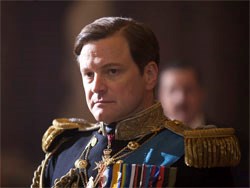
Colin Firth as King George VI
The basic structure of this sort of inspirational drama should be familiar to most viewers. Early scenes introduce a seemingly insurmountable obstacle. In this case the film opens with a humiliating failure in George's attempt to give a speech at a soccer match. In the first half of a film, those obstacles will be compounded. We see how misguided professional treatments render the problem worse rather than better and how the domestic conditions—that speech therapist Lionel Logue will suggest are connected to George's stammer—render it nearly impossible to ask for help. Such a film may then show—as this one does—early, failed attempts to address the obstacles to reinforce the bravery and persistence of the protagonist. Finally, there is a climactic test of resolve: a big game, a key confrontation, a second chance at a failed accomplishment.
Where The King's Speech elevates itself over more conventional films in this genre is in its ability to overlay internal and external obstacles. Firth opined to audiences after a festival screening that film was, for him, about the difficulties in forging and maintaining intimacy in the face of his character's political, cultural, and psychological conditioning to reject it. The extent of that conditioning is poignantly and brutally depicted in scenes where George's father berates him, where his brother mocks him, and where his own children (after his coronation) learn to suppress their natural easiness around him and adopt a formal reserve viewed more appropriate for public, royal interactions.
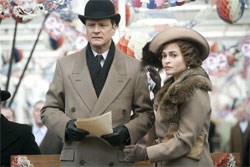
George VI and the Queen Mother (Helena Bonham Carter)
The psychological barriers to such intimacy also extend to Logue, who must overcome the political and ethnic prejudice directed at him because of his Australian heritage and his own conflicted feelings at being called on to serve a social system that has treated him as a second class citizen. Logue, like George, acts from a sense of duty, and it is in the main characters' placement of duty above self-interest that the film should appeal to socially and culturally conservative viewers.
The fact that both characters are acting out of a sense of duty is underscored by the fact that their work toward improving George's public speaking is primarily necessitated by the proximity of a second world war, something that both characters fervently wish will not happen but prepare for nevertheless. In one of the film's best scenes, Logue, finally questioned about his lack of academic credentials, speaks eloquently about how his techniques grew out of witnessing the trauma experienced by soldiers who experienced the last war.
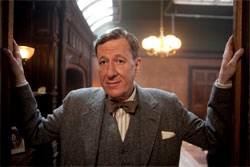
Geoffrey Rush as Lionel Logue
As well as providing insight into how Logue is able to succeed—is there ever a substitute for genuinely caring about people and wanting to relieve their suffering?—the proximity of the war keeps the film from becoming breezily triumphal in tone. Firth also mentioned in his post-screening comments that George never completely overcame his stammer. Triumph, like greatness, is a relative thing, and successes, while they make us feel good, rarely insulate us from further hardship, further efforts, and further sacrifice.
Talk About It
Discussion starters
Why is Lionel Logue able to help King George when other experts failed?
Besides the stammering, what other obstacles—social, cultural, or emotional—does King George have to overcome in order to get help? What obstacles must Lionel overcome in order to be able to help?
Many historical films or accounts glamorize Edward VIII for choosing love over position when he abdicated his throne. How does the film view this relationship and this decision?
Besides personal embarrassment, what is at stake in the climactic scene? What does the film argue would have been the consequences had King George been unable to give this speech?
The Family Corner
For parents to consider
The King's Speech is rated R for persistent profane and obscene language. One of King George's techniques for coping with and overcoming his stammer is to spout obscenities and profanities because, it is noted, people rarely stammer when they are using this sort of language. Within the context of the film the language is not portrayed nor used to shock or offend, and it is occasionally used for comic relief as the character schooled in royal deportment learns to express his feelings rather than repress them. There is, however, a lot of it, enough to warrant an R rating, which is relatively rare for a film without violence or strong sexual conduct. The adulterous relationship between Edward VIII and Mrs. Simpson is alluded to, and there are instances of emotional cruelty between characters. Several characters drink alcohol.













 While we pray for peace, we need moral clarity about this war.
 As my doubts about his teachings grew, so did a secret fascination with Jesus.
 Beyoncé’s right. Whether listening to Cowboy Carter or reading theology, diversity is a good thing.