Despite the potential for thrilling adventure in an exotic setting, this adaptation of the popular video game series is an ultimately forgettable summer blockbuster.
With the second half of the film's title, it's obvious that Walt Disney Pictures would love for Prince of Persia: The Sands of Time to kick off a new action-packed franchise. Reteaming again with producer Jerry Bruckheimer, they're clearly positioning this as the next Pirates of the Caribbean. And since it's inspired by a popular video game series dating back to 1989, the hope is that Prince of Persia has a strong built-in audience.
But that's all marketing rhetoric. I'd love to say POP:SOT is the first truly successful movie adaptation of a video game (at least it's better than most attempts) or that it's true to the source material (though faithful in spirit, the plot details are different), but who cares? Does any of that ultimately matter if the results yield another mediocre and forgettable summer blockbuster?
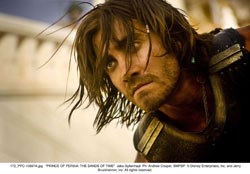
Jake Gyllenhaal stars as Dastan, the prince in the title, and there lies one key problem. With all-American boy-next-door good looks and a put-on British accent, Gyllenhall looks about as Persian as Canadian teen-pop star Justin Bieber (or as Siamese as Yul Brynner in The King and I, or as Mongolian as John Wayne in The Conqueror). The story takes place within the heart of The Persian Empire during the height of its reign hundreds of years before Christ's birth—not exactly an ideal time for Persian-European relations. Gyllenhaal isn't the only casting oddity, though at least some of the other British actors are passably Middle Eastern.
Jake Gyllenhaal as Dastan
Still, the main problem isn't whitewashing, but believability. Everything seems staged rather than recreated; it feels more like another sword-clanging fantasy in Middle Earth than an adventure in the Middle East.
Dastan, a street urchin, is adopted by King Sharaman because he shows "great courage" standing up to guards who threaten one of his orphan friends. He leaps across rooftops like a monkey before he is caught, pardoned, and ultimately raised as royalty with the King's sons Tus (Richard Coyle) and Garsiv (Toby Kebbell).
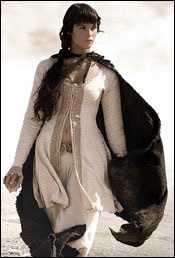
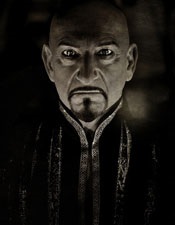
Fifteen years later, the three brothers are off to war with their uncle Nizam (Ben Kingsley) as their military advisor, who suggests they attack the holy and peaceful city of Alamut for suspicion of forging weapons for enemies of Persia (WMDs, anyone?). The brothers reluctantly agree, despite Dastan's misgivings, capturing the city along with its beautiful Princess Tamina (Gemma Arterton, Clash of the Titans).
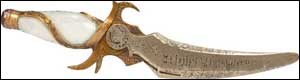
After single-handedly infiltrating the city, Dastan uncovers a strange (plastic-looking) dagger with magic sand inside its handle, allowing whoever wields it to rewind time by a minute and change events—it's basically a "save game" device. Soon, King Sharaman is killed and Dastan is framed for the murder. He flees with Tamina, who turns out to be the sworn sacred protector of the magic sand, and the two forge the usual squabbling romantic-comedy bond while trying to uncover the villain responsible for Sharaman's death and to thwart a plot to use the sands of time for evil.
POP:SOT aims for a swashbuckling Arabian Nights-styled adventure with feats of derring-do, but it never provides enough thrill to set it apart from so many other CGI-fueled fantasies over the last decade. Given the agility of the Prince from the game—leaping the rooftops, diving off ledges, and climbing up walls—you would think the movie would be filled with breathtaking parkour ("free running") action sequences similar to the chase from the beginning of Casino Royale or the French film District 13. Instead we have lots of slow-motion leaping that often suggests the use of wire work and quick-cut editing. As far as the swordfights, they're not impossible to follow, but they tend to be shot close-up with lots of noise and little attention to technique.
This is another one of those films that relies more on effects than good stunt work. When Dastan makes the game's trademark dive near the start of the film, there's no sense of dizzying vertigo or danger to the event—he looks like a guy standing on a platform with computer-generated special effects in the background. For that matter, the nasty looking snakes used by the villain's "Hassansin" henchmen are all computer-generated. Even the fire looks fake in a couple battle sequences. Topping it all off is one of those big effects-heavy finales that's heavy on magical swirls of fire and sand where the hero doesn't seem to know what's going on—and neither do we.
The time-changing dagger
It doesn't help that the story doesn't aim for anything new either. Of course Star Wars and Lord of the Rings still played to archetypes, but the characters were fleshed out with heart and humor. Here everyone seems conventional and two-dimensional, with forced attempts at humor by Alfred Molina as a black-market sheik, played as a more comical version of Oliver Reed's character from Gladiator. He has a knife-throwing African sidekick who is silent for his couple scenes in the first half, but later he suddenly gets dialogue and a pivotal action sequence.
Article continues below
Meanwhile, Dastan and Tamina fall in love not out of natural chemistry (or a sense of destiny as the film suggests) but because the script requires them to. And particularly frustrating is the way the trailers and character makeup make it painfully obvious who the bad guy is, yet the script boldly pretends as if there's mystery and surprise to the identity of the King's assassin. Trust me, you already know.
Ben Kingsley as Nizam
Director Mike Newell is capable of heartfelt romantic comedy (Four Weddings and a Funeral) and drama (Donnie Brasco), but he's struggled with fantasy-adventure (Harry Potter and the Goblet of Fire, the weakest of the franchise). He seems similarly ham-fisted here, going through the motions of a typical lame-brained Bruckheimer blockbuster.
The film isn't awful, but how I miss the days when big-budget movies (Avatar notwithstanding) actually delivered on memorable thrills and characters. POP:SOT has neither—only a lazy script enhanced by computer-generated visuals.
Talk About It
Discussion starters
Why does the king show compassion to the orphan Dastan? What does this say about our potential to overcome destitution and achieve greatness? How does this compare with our relationship with God?
Shortly before his death, King Sharaman explains why he admires Dastan. What does he mean by the difference between a good man and a great man? How does Matthew 5:43-48 fit in with this philosophy?
Princess Tamina tells a story of how the gods threaten to destroy mankind for their evil with a massive sandstorm, only to show compassion in the end. Does this remind you of any stories from the Bible? (See Genesis 6-8. Why do the gods show compassion in Tamina's story? Why does God show compassion to Noah and what does he promise at the end of the story?
What would you do with a device that could turn back time? Would you use it to correct mistakes? Exploit it for personal gain?
The Family Corner
Prince of Persia: The Sands of Time is rated PG-13 for intense sequences of violence and action. There's lots of swords clanging and arrows through chests, but little blood. Several scenes involve menacing snakes, sometimes leaping at the screen—the ickiest scene involves gutting a snake to retrieve an item. King Sharaman is murdered with a poison-lined robe that burns his skin like acid. Aside from a passing reference to a venereal disease the film is free of profanity, and aside from a few scenes of scantily clad women there's little sexuality. Keep the rating in mind when considering whether to take small children.













 While we pray for peace, we need moral clarity about this war.
 As my doubts about his teachings grew, so did a secret fascination with Jesus.
 Christians can disciple each other toward action, prayer, and hope.