As a nurse in a pediatric cardiac intensive care unit, my wife Suz watched couples not unlike this film's Becca and Howie (Nicole Kidman and Aaron Eckhart) in a particular sort of crisis: not the crisis of a sharp, sudden catastrophe, but a long, numbing slog through a seemingly endless twilight between agony and normality. Sometimes there's a sudden calamity at the beginning, or the slog might be punctuated by new crisis—a new operation, a downturn, death—and in the throes of trauma the flickerings of normality are extinguished. But one can't live long in that state of trauma. The crushing darkness yields imperceptibly to a Cimmerian gloom.
Not infrequently, the couple find their way through the gloom at different rates, or in different directions. A sharp moment of suffering draws them together, but in the long slog it's not uncommon for them to drift apart. They suffer and grieve, but they grieve differently. One spouse (more often the wife) may be wholly consumed by the crisis, while the other (more often the husband) feels that their relationship (or he himself, or their family) is being neglected. Divorce is a common hazard for couples who lose or almost lose a child.
Nicole Kidman as Becca
It's indicative of the muddle of life in the shadow of crisis that critics seem divided on whether to focus on the poignancy or the humor of Rabbit Hole. "Grief may be the topic under examination," one writes, "but humor—incisive, observant and warm—is the tool with which it's dissected." Another goes so far as to call the film "a dryly un-sentimental black comedy." It's not that, but Rabbit Hole knows that sentiment and unsentimentality are very different and even incompatible drugs to which different people turn to help them cope through dark times.
Becca is a confirmed unsentimentalist. Dragged by Howie to a support group, she's repulsed by a couple who introduce themselves as group veterans of eight years—"professional wallowers," she snorts later. Pressed beyond endurance by another grieving couple's pious declarations that "God had to take" their child because "he needed another angel," Becca blurts, "Why didn't he just make one? I mean, he's God after all. Why didn't he just make another angel?" By this point Becca is pretty sure that group is not for her, and Howie's probably figuring it out too.
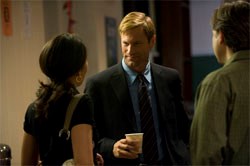
Aaron Eckhart as Howie
Written for the screen by David Lindsay-Abaire (adapting his own 2005 play) and directed by John Cameron Mitchell (Hedwig and the Angry Inch), Rabbit Hole takes its time establishing the particulars of Becca and Howie's crisis. I won't preempt the film's storytelling strategy here, but I will say that Kidman and Eckhart embody Becca and Howie with such unforced ease, interacting so naturally in both relaxed and tense moments, that they seem to be not so much playing characters as playing a relationship—a fragile, troubled marriage with a long history, in which more is unsaid than said.
For Becca, tense and brittle, contact with other people has become burdensome even when they aren't actively annoying her, which is often. Her well-meaning neighbors with their invitations; the friends who should have called but haven't; her garrulous mother (Dianne Wiest) with her conventional religiosity and anecdotes of her own bereavement; her unmarried, blithely pregnant kid sister (Tammy Blanchard of Bella) with her musician boyfriend … it's all too annoying.
Dianne Wiest as Nat, Becca's mother
Howie's grief is different. He's trying to grieve in a healthy way, to follow the program. His wife's pain brings out his protective instincts, and he wants to be the good guy, but he's also concerned that her isolation and ruthless purges are becoming more morbid, not less. One night he puts on Al Green, dims the lights, and starts rubbing her shoulders. The way that it doesn't go exactly how either of them would like perfectly encapsulates the growing wedge between them.
The stages by which Howie finds some relief in another relationship are plausible enough, although the movie goes back to that well for one scene too many. I'm not sure I understand the psychology behind Becca reaching out to the one person that would seem to be the last person in the world she would want to talk to. Perhaps he's the only one who wouldn't dare try to help her. Or perhaps his own pain, and the possibility that she might help him, offers her something.
Sandra Oh as Gaby
But it turns out he does have something to offer her: the "rabbit hole" supposition. Becca has no use for religion—for "God talk" and "God freaks." Her mother tries to talk about how helpful she found the church in her own grief, but Becca won't hear it. The only God she can imagine is a cosmic sadist who rewards his worshippers with more suffering. "No wonder you like him," she snaps at her mother, regretting her words too late. "He sounds just like Dad."
But then Becca encounters the idea of multiple worlds—the notion in speculative physics of alternate realities or parallel universes. According to some versions of the notion, all possible histories and futures are real; everything that can happen, does happen. According to this supposition, there are countless versions of you out there somewhere, with every possible life that you could have led. The film gives this notion a pop-culture sci-fi twist in the form of a homemade graphic novel depicting an endless maze of "rabbit holes"—a metaphor borrowed from Lewis Carroll by way of The Matrix and Alternate Reality Gaming (ARG)—connecting infinite realities to one another.
Article continues below
"It's basic science," someone ventures. "If space is infinite, then everything is possible … There are tons of you's, and tons of me's."
"So … this is just the sad version of us," Becca reflects. "But there are other versions where everything goes our way." The notion that somewhere out there she's having a good time strikes her as a comforting one: a kind of alternate myth in place of the religious sentiment she won't countenance. A recurring structural element—images from the "Rabbit Hole" graphic novel in progress—give additional emphasis to the many-worlds theme, and by extension to the devaluing of religious hope.
For what it's worth, the many-worlds supposition is not one that I find comforting. Granted the premise, the version of me having a good time isn't me; and of course there's also all the versions of me even worse off than I am. Beyond that, the notion may be felt to undermine not only the drama of Rabbit Hole, but all possible drama. For example, will one of the spouses stray? Suppose the answer is that they will both stray, and they won't stray, and one of them will stray but not the other, and vice versa? The only conceivable dramatic question remaining is not "What will happen?" but only "Which world has the storyteller selected?" Oh, he chose the world in which X happened. How about that.
I can wrap my head around living without faith. I can't imagine burying a loved one without faith. Most of the couples Suz saw in the hospital weren't actively religious, but in that moment of crisis, even in the long slog, whatever vestiges of religion they may have been raised with often came to the fore. This is not necessarily hypocrisy. "Why should they not have been sincere?" writes C. S. Lewis in The Four Loves.
"They were desperate and howled for help. Who wouldn't?"
Some people wouldn't. Becca is one of them. I understand that, but it doesn't change the fact that between her rejection of God in the throes of grief, the less-than-compelling portraits of faith (the couple at group, Becca's mother), and the rather pathetic attempt to find solace in a sci-fi conceit, the film feels airless, spiritually speaking. There may be hope in the end for Becca and Howie, but Rabbit Hole seems pretty closed to the possibility of Hope.
Article continues below
There is a hint, if one cares to see it, that Becca's riposte at group wasn't entirely fair. Right before saying "God needed another angel," one of the "God freaks" says, "We can't know why. Only God can know why." A little sympathy and openness for that point of view—not necessarily from Becca, but from the film—might have made Rabbit Hole a more cathartic experience.
Talk About It
Discussion starters
Have you lost anyone close to you? Do you know anyone who has? Were you ever responsible for an accident? Do you see yourself in any way in any of the characters in Rabbit Hole?
Why do you think Becca reaches out to Jason? In what way(s) is that appropriate or inappropriate?
Have you ever been part of a support group? Did it help? Is it something that can help everyone, or is it only helpful for some people? If someone isn't helped, is that their fault? What else have you found helpful in dealing with problems too big for you?
Can a support group work if someone doesn't acknowledge a higher power? Does it matter if they recognize that power as God? Can God help people who don't believe in him? Have you ever had to comfort or encourage someone bereaved or otherwise in great difficulty who had no faith? How can believers help nonbelievers in situations like that?
Why does Becca spurn the invitations of her neighbors, but resent the silence of the friends who don't call? Why might socializing with one or the other be more or less preferable or helpful?
The Family Corner
For parents to consider
Rabbit Hole is rated PG-13 for mature thematic material, some drug use and language. Grief and the loss of a child are major themes. The story explores marital conflict and estrangement; there is some discussion about Becca and Howie's sex life (or lack thereof), and the possibility of adultery surfaces. Two characters are shown smoking pot with a bong, and apparently make a habit of it. There is also discussion about a character's responsibility for the death of a child. Language includes repeated misuse of the names of Jesus and God, some crass language and one f-bomb.
















 While we pray for peace, we need moral clarity about this war.
 A Christian reconciliation group in Israel and Palestine warned that war would come. Now the war threatens their relevance.españolالعربيةFrançais
 After lobbying from fellow Southern Baptists and Christians affected by the war, the House speaker moves a package forward.