After Ocean's Eleven (2001) opening weekend, I gathered with coworkers for a coffee break and raved about how much fun it was. A respected mature Christian within earshot lightheartedly joked, "Because rooting for immoral thieves is always fun!" He wasn't being a curmudgeon but was just pointing out a very real discernment issue: crime movies often present criminals as heroes. And we buy into them.
From Robin Hood to Godfather to Butch Cassidy and the Sundance Kid, we find ourselves rooting for the guys on the wrong side of the law. This aspect of the cops-and-robbers thriller Takers really stood out to me—and hurt my enjoyment of the film.
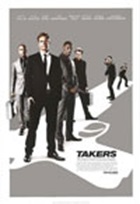
Takers (whose producers include rapper T.I. and singer Chris Brown) is a standard cat-and-mouse plot about a group of talented, big-ticket robbers and the cops who chase them. Imagine a cheap MTV remake of Heat and you aren't far off. The film follows this slick band of "takers" as they complete a stunning bank job (with a neat getaway) and are then talked into aborting their usual one-year break between gigs by a former member of their group, T.I., who's newly released from prison. Reunited, the group plots an armored car heist—all the while dodging threats from various angles.
Hayden Christensen as A.J.
The film is a grittier, urban-L.A. spin on Italian Job (2003) and Ocean's Eleven—but it feels very different in the morals department. Yes, each of these movies invites us to get to know a group of veteran thieves planning and pulling a huge heist. And each also uses the old "well, they are bad guys but they aren't as bad as the other bad guys" approach to create sympathy for the devils. So what is the difference? For me, it boiled down to three traits of Takers.
First, Takers doesn't just follow the group of thieves; it takes the viewer on a parallel journey with them and the cops hot on their trail. In fact, by beginning the film in the police officers' squad car, the director frames the movie as being from their perspective. For all intents and purposes, Matt Dillon's detective is the protagonist. But yet, we are clearly supposed to care for and root for the criminals as well (or most of them). This tension of "who do we really want to win?" comes to a head when one taker is chased by the cops. When he kills a cop to get away, people in my theatre literally cheered for him. Really.
Matt Dillon as Det. Jack Welles
I'm not saying movies should only have clearly defined white hats and black hats. Nor am I saying we should only root for morally perfect characters and actors (we wouldn't have anyone to root for!). But Takers is so morally ambiguous it seems that it wants us to sympathize with almost every character—cop or criminal (because they are really the same here)—without creating the needed character depth to really dive into this complex arena. Movies like The Departed, The Godfather, or Butch Cassidy can exist in this moral ambiguity because they have the gravitas to explore that territory and create full characters to study. Takers seems to either want to be a fun and sexy Oceans-like caper (but without any moral reserve) or a much smarter movie than it really is.
Secondly, the thief-heroes of Italian Job and Ocean's Eleven were given moral codes and noble goals to win sympathy. They didn't kill innocents—did they even use guns?—and they stole for (believable or not) bigger purposes like love, avenging someone's honor, because they're being forced, etc. Here, these guys are violent killers who are all about the cash. There is no attempt to downplay the immorality or redeem them. (One could argue that Takers is admirable for showing criminals in a realistically complex light instead of manipulating viewers to think its sugarcoated criminals aren't so bad. But it's hard to show realistic thugs and ask an audience to care for them.)
Finally, Takers bugged me because its blatant audience manipulation—not by manipulating us to think these bad guys are actually good, but through other manipulative tactics like sympathetic music, slow-motion of the criminals doing seemingly heroic acts. Every cliché is pulled out to get us to care—a character gets engaged, a character has a hurting sister he's trying to help, etc. (Minor spoiler alert) Death scenes of various takers are especially played up to twist the heart strings. But wait. Aren't they the bad guys? (End spoilers)
T.I. as Ghost
Takers is pretty exciting at times—there are three good action sequences—and has a definite sense of attitude and a slick, high-energy style, though it degrades into incomprehensible frenzies of flash and blur. The plusses don't outweigh the minuses, mainly that this is just a Frankenstein monster of every other heist movie. There are so many laughable and tiring cop/criminal clichés it's like they were writing a Police Squad-like spoof and then made it sincere. This is one of those movies you might wait to watch bits of on Spike TV or FX someday.
Talk About It
Discussion starters
How do feel about movies that want you to care about immoral, unredeemed characters? Did that bother you here? How did the end leave you feeling? Who was the "hero" of Takers? Explain.
Article continues below
At the end, a character says to the cop, "You shouldn't have gotten involved." What is the film saying? Does it agree with that character? Did the cop's obsession lead him to where he shouldn't be? Should he not have tried to stop these guys?
What did you make of the cop's line, "I need help; I want help." Help for what? What was going on inside the character at this point? What realization had he made? What happens next in his life?
One character says, "Take care of the real stuff, Jack." What did that mean to you for your own life?
The Family Corner
Takers is rated PG-13 for intense sequences of violence and action, a sexual situation/partial nudity and some language. The partial nudity is a shot from behind of a naked man getting into a pool, where two waiting girls are implied to be naked but nothing but cleavage is seen. There are several references and implications to sex. The language (including taking the Lord's name in vain), suggestiveness, and violence push the PG-13 rating.

















 While we pray for peace, we need moral clarity about this war.
 We’ve got little information on Jesus’ appearance and personality. But that’s the way God designed it.españolFrançais
 The Grammy-winning artist was found dead at her home in Nashville at age 47.