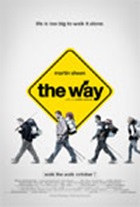
One of the best films of the year, Emilio Estevez's The Way is about a man, Tom, who is confronted with the death of his only child, his son Daniel. Tom, played by 71-year-old Martin Sheen, learns that Daniel was killed in a freak accident in Spain while walking the pilgrimage of Camino de Santiago, commonly referred to in English as "The Way of St. James" or, simply, "The Way." Tom heads to Spain to retrieve Daniel's ashes—then decides, practically on the spur of the moment, to process his shock and grief by walking the Camino himself, while wearing Daniel's hiking boots and strapping on Daniel's already well-stocked backpack.
With The Way, writer/director Emilio Estevez—who also plays Daniel in flashbacks in the movie—continues to build his reputation as a filmmaker. Like his 2006 film, Bobby, about a day in the life of the hotel where Robert Kennedy would be assassinated, The Way begins with setting rather than character. Estevez the writer has a knack for picking settings that allow him to bring together characters who might not interact much in other contexts, and the result is that the relationships come across as anything but rote.
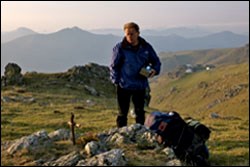
Martin Sheen as Tom
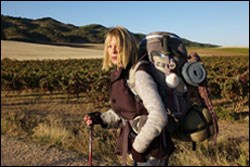
Tom starts out on his trek alone, but as is often the case in close environments, he is thrown together with a small group of people whom fate has brought together at just the right time. Sarah is a woman who uses an abrasive, assertive demeanor to keep the world at arm's length, but who is herself carrying a load of hurt. Joost is more outwardly cheerful, insisting that the pilgrimage is recreational, but gradually letting his guard down to reveal his wounds. These three are eventually joined by Jack, a travel writer whose alcoholism may be either the cause of or an attempt to numb many of his own personal demons. I really admire the way the film conveys the spiritual and emotional dynamic of how being acutely conscious of one's own brokenness can make a person more empathetic toward others—particularly those who might simply rouse our censure or irritation at other times or in other circumstances.
The interplay between Tom and Sarah is particularly complex and moving. Unger is not as widely known or celebrated as Sheen, but she holds her own in scenes with him, building a multi-faceted character in a supporting role. Some of the film's most moving moments come in the interplay between these two. As we learn more about Sarah and her reasons for walking the Camino, we not only understand her character better but also why these two people are well suited to understand and help each other. Grief and sorrow often alienate those who feel it from others; words of sympathy grate when we feel those expressing them cannot truly understand what we are going through. When Sarah finally shares a difficult part of her past with Tom, it is one of the more powerful moments in the film because the emphasis within the story is less on what she did than on the devastating emotional consequences of her actions.
Estevez's success as a writer is helped by his choices as a director. According to Estevez, the film was shot with Super 16 film in part to help keep the production crew small and (relatively) mobile. This decision is a great example of a director not only being wise in the technical aspects of cinematography and composition, but also understanding his subject matter. The story is, in many ways, about intimacy—particularly about how grief removes some of the social boundaries we keep up, boundaries that prevent intimacy in more normal circumstances. One suspects that a more structured and storyboarded film would have risked coming across as artificial, even maudlin. It is to Estevez's credit that he was apparently able to create a tight-knit fellowship during filming, and the rapport of the community making the film comes across in the tone and atmosphere of the performances, which are all very natural. Too many actorly moments or self-conscious film gimmicks would break the illusion of intimacy that is one of the best features of the film.
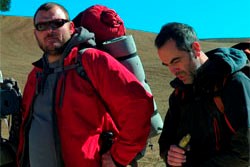
Yorick van Wageningen as Joost, James Nesbitt as Jack
Like most great films, The Way is about more than one thing—family, grief, community, hiking (Sheen and Estevez have said the project began in part as a valentine to their beloved Spain), each a potential hook for a different audience segment. It is first and foremost, though, a meditation on the waning spiritual discipline of pilgrimage.
Is this a "Christian" film? Probably not, at least not in the niche-marketing sense of the word. It is not constructed to lead audiences to affirm a particular answer so much as to depict people asking the most fundamental of spiritual questions. I would argue that it is Christian but not evangelistic. That is, it is situated in a place in which spiritual questions are framed in a Christian context, but it does not attempt to compare religions or emphasize the notion that Christian answers to universal questions may have singular distinctives.
I am tempted to argue that the film isn't really ecumenical so much as it is specific, concrete. If we hear more about (or are prompted to think more about) God in general than about Jesus specifically, that has more to do with where these characters are on their path than it does about what path they are on. The inclusion of footage taken at the historic church in Santiago de Compostela (The Way was the first non-documentary given permission to film inside the church) goes a long way toward reminding the audience that while the idea of pilgrimage is not unique to Christendom, this film's specific manifestation of it is Christian, however much walkers may want or try to syncretize or abstract it.
Article continues below
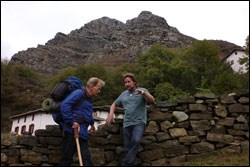
Emilio Estevez directs his dad in a scene
Whenever a good film comes out that deals with faith and/or spirituality intelligently and sympathetically, the tendency is to champion it for raising the bar in a genre where quality can often be uneven. The Way, though, is not (just) a good film because of its subject matter or in comparison to some other, more overtly self-conscious (and self-proclaiming) Christian films. It is a great film, period.
Talk About It
Discussion starters
What is a pilgrimage? Why do people go on pilgrimages?
Each of the major characters in the film was, in some way, broken. How are their reasons for going on the pilgrimage different? Are there ways in which their reasons are really the same?
For Tom, is the pilgrimage ultimately successful? Does it accomplish what he hoped it would? If so, how? If not, why not?
Tom initially eschews companions on the pilgrimage road, preferring to walk the "camino" alone. How does the presence of others both help him in his journey? Are there ways in which it makes it more difficult?
The Family Corner
For parents to consider
The Way is rated PG-13 for language and mature themes. By today's standards, it is relatively benign, but it does deal with the themes of death and grieving in a manner that may be disturbing to younger viewers. Characters smoke, drink, and cuss, but these elements are present in relative moderation. The film may be a little too slow for younger viewers to understand what is happening, but The Way is the sort of film one could watch in a large group and be reasonably comfortable that there won't be many complaints about content.













 While we pray for peace, we need moral clarity about this war.
 A Christian reconciliation group in Israel and Palestine warned that war would come. Now the war threatens their relevance.españolالعربيةFrançais
 When I married into a Jewish family, antisemitism hit home. Now, the holy day reminds me of our future hope.