Reader, you're likely here to find out if Extremely Loud & Incredibly Close is worth your time. You're looking for an assessment of its virtues and vices, its strengths and its failings. Maybe you read Jonathan Safran Foer's novel on which it's based and—like me—thought it was an unlikely candidate for adaptation to the big screen. You want to know what you'll think when you see it.
I could start by telling you about the plot: Oskar (Thomas Horn) is an odd boy, living in Manhattan with his family, when the "Worst Day" happens—September 11, 2001. Oskar is certainly precocious, a wealth of information about the world ("Did you know humans are the only creatures who can cry?") and might have Asperger syndrome (though, he tells us, the test results were inconclusive). His devoted father (Tom Hanks) has spent an enormous amount of time devising "reconnaissance missions" (scavenger hunts) that also help him break out of his shell and move past his fears. Oskar has lived his whole life in the happy knowledge that his father adores his mother (Sandra Bullock), and if he's feeling lonely, he can just use his walkie-talkie to talk to his grandmother, who lives across the street.
But then the Worst Day happens, taking Oskar's father away, and the boy's slow discovery of the new shape of his life changes him forever.
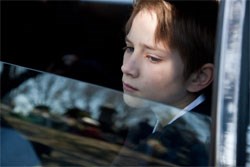
Thomas Horn as Oskar
A year later, in a moment of rare courage, Oskar ventures for the first time into his father's closet and discovers a vase on the top shelf; when he accidentally breaks it, he discovers a key inside, tucked inside a tiny envelope with one word written on it: Black. His father's last reconnaissance mission for him! This key must unlock something important, and since Oskar can feel his father's presence receding from his life as time wears on, he reasons that he must find that thing in order to keep his father nearby. And so starts an adventure through New York City, where Oskar struggles to make sense of what has happened to him, to his father, and to the world.
I suppose that plot outline might help you decide whether to see the movie. But I could also tell you about the filmmaker's skill in taking the novel—which is famously postmodern and, since it's narrated by Oskar, somewhat unreliable—and turning it into a navigable, heartfelt narrative of loss and care. Director Stephen Daldry, whose previous films include The Hours and Billy Elliot, is no stranger to these intimate stories of loss and longing that stand in for larger themes, and this is an excellent match for his particular talents, especially when coupled with screenwriter Eric Roth (Forrest Gump, The Good Shepherd, The Curious Case of Benjamin Button). And set against a backdrop of the "real" New York, outlying boroughs and all, the story captures the life-goes-on attitude of New Yorkers after the Worst Day.
Or I could reflect on the cast: there are some tried-and-true actors here, like Hanks and Bullock, but newcomer Thomas Horn (who, unsurprisingly, was cast after winning Kids Jeopardy!, something his character would absolutely do if he could overcome his terror of people) is simply excellent, whether he's raging or curious or innocent or manic. He's only overshadowed by Max Von Sydow, who plays the mysterious mute boarder at Oskar's grandmother's house who joins Oskar in his quest and expresses more with his eyebrows and gait than a skilled orator might in a grand speech.
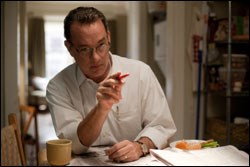
Tom Hanks as Thomas Schell
I could also tell you about the strange affinity between this story and another strange story about a little boy: Where the Wild Things Are. (The parallels in some ways are so striking that I keep typing "Max" when I mean Oskar.) Where the Wild Things Are is a story about a young boy who has experienced loss in his family, who feels the senseless brokenness of his world, and solves it only by slipping into his imaginary world. Oskar is the slightly older Max, thrust painfully into reality and tragedy that is far beyond his years. In some ways, Oskar has lost an imaginary world to escape to. The world he lives in is too real. But Max and Oskar both have to find their way home.
Sandra Bullock as Linda Schell
But I can't really tell you what you'll think of the movie. All I can really tell you is this: I settled into the back row of the movie theater with my notebook and a soda, and a moment later a herd of seventh and eighth graders tromped in and sat, all in a row, to my left. They were excited to be there, spending their Martin Luther King, Jr. holiday seeing a movie together. The boy two seats down from me was especially excited, and kept chattering to his friend about the book. I inwardly sighed, knowing that there was no way this would be the quiet matinee I'd intended to attend. Pre-teens are never quiet moviegoers.
The trailers started and, as is customary in New York movie theaters, most of the audience was still buzzing, quietly making snide asides to one another. The girls down at the end of my row erupted in squeals when Zac Efron's face appeared in a trailer for a Nicholas Sparks movie; they almost hyperventilated at the trailer for Titanic in 3-D.
Article continues below
Then the movie started. In a breathless ballet-like image, we saw a floating body—first a knee, then a shoe, then a hand, all against the backdrop of a clear azure sky. Instantly, all was silent. Eight pre-teens breathed out as one.
And as the film continued on, it became clear that this is a film for them, these children who, in 2001, were three years old and probably living not far away when the towers fell on their hometown. Four seats down, a girl quietly sobbed when Oskar lashed out at his mother. The pre-teen years are rough on parents and kids; being reminded at the movies that nothing is forever might be even harder.
And in the midst of an image of a man dropping through the sky, lifted directly from the novel (which in turn plucked it from the newspaper), the boy two seats down from me, the one who was so excited about the story, whispered to his friend, "That picture's on the last page—I looked at it for a really long time."
When the credits rolled, the kids clapped, and the rest of the audience followed their lead. "That was so sad, you guys," one girl said, wiping her eyes with her tissue. "But it was really good," one of the boys said. "Yeah," the girl replied. "It was."
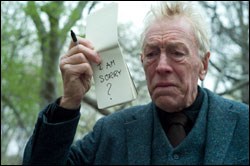
Max Von Sydow as The Renter
Some will doubtless find the story a bit too sentimental, too precious or twee. Others are bound to criticize its repeated return to the all-too-memorable image of a man falling from the tower. Those who read the novel know how central that image is to the story, and even those who haven't can tell how important it is to Oskar, how tightly he holds to security. But as he learns, everyone loses someone or something when they are young. Everyone has a Worst Day, even those whose worst days will never be remembered by a nation for their whole lives. Everyone loses, and everyone must find out how to move on. And Extremely Loud & Incredibly Close reminds us that we can only do that in the company of others—that time doesn't really heal wounds, but love helps.
Talk About It
Discussion starters
Oskar feels different—and is different—from those around him, and he must overcome his fears and differences in order to go on his quest. What fears do you have? Where do you go to face those fears?
Oskar's father's love drives his discovery and helps him mature, even after his father is gone. In what ways does his father show that love? What effects does that love have on the people around him? Do you know anyone like Oskar's father?
Article continues below
This movie is ultimately about the losses that everyone experiences. What loss have you experienced in your life? What helps heal that loss? Where do you find comfort?
One character tells Oskar, after praying for him, that finding the answer to his quest would be a miracle. Do you feel like a miracle occurred in the film? Do you see God's hand in what happened? Why or why not?
The Family Corner
For parents to consider
Extremely Loud & Incredibly Close is rated PG-13 for emotional thematic material, some disturbing images, and language. The language is largely Oskar's roundabout way of swearing (forbidden to swear, he makes up words that contain the profanity); he also says some very hurtful things to his mother as he grapples with his loss. But the larger story here is still raw for many, and could very well be too powerful for some, especially those who have experienced tragic loss or who were close to the events of September 11. The filmmakers' depiction of the destruction stops at the falling bodies and the film is not graphic, but it could certainly be disturbing.
















 While we pray for peace, we need moral clarity about this war.
 As my doubts about his teachings grew, so did a secret fascination with Jesus.
 Interview with leader of new evangelical alliance describes his escape from Khartoum and the pressure to pick a side.