Robert Wieckiewicz, Benno Fürmann, Agnieszka Grochowska
Theatre Release
January 05, 2012 by Sony Pictures Classics
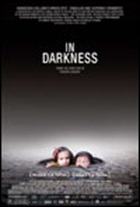
As Holocaust dramas go, In Darkness stands firmly in the tradition of survival stories like Schindler's List and The Pianist, true-story films about Polish Jews who, against all odds, lived through the Nazi atrocities of WWII with help from some non-Jew protectors. In this case, the Schindler "protector" character is the morally dubious Leopold Socha (Robert Wieckiewicz), a sewer worker and petty thief in Nazi-occupied Lvov, Poland circa 1943. Socha, a Polish Catholic with a wife and young daughter to support, is offered reward money by the Nazis for every Jew he finds hiding in the sewers below the recently liquidated Lvov ghetto. But when Socha stumbles upon a group of Jews willing to pay him even more money to protect their hiding place, he begins a journey down a somewhat accidental, opportunistic path toward heroism.
Based in part on Robert Marshall's 1991 book In the Sewers of Lvov and penned by first-time screenwriter David F. Shamoon, In Darkness—nominated for an Oscar for Best Foreign Language Film—earns its name because most of its action takes place in the murky, claustrophobic, grotesque sewer system below the Lvov ghetto, where Socha hides a ragtag band of Jews for over a year. The group—which includes the wealthy Chiger family, an older rabbi, a young con man named Mundek (Benno Furmann), the feisty Klara (who falls in love with Mundek), and the tempestuous Chaja (Julia Kijowska)—hides in wet, black, rat-filled tunnels; and yet in spite of the inhumane misery, it's a safe haven compared to the world of daylight above their heads, where merciless Nazis randomly kill Jews and ship the live ones to concentration camps.
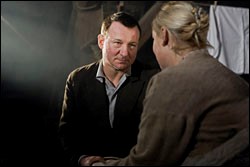
Robert Wieckiewicz as Leopold Socha, Kinga Preis as Wanda Socha
The name In Darkness represents more than just the literal setting, however; it's also a metaphor for the darkness of humanity, which comes through loud and clear. One of the ways Darkness differs from its companions in the Holocaust genre is that there isn't a clear delineation between the heroes and villains, the good and bad. Here (with a few exceptions), it's more like the bad and the worse. Under the direction of acclaimed Polish filmmaker Agnieszka Holland (Europa, Europa; The Secret Garden), Darkness explores ambiguous moral territory, where the Jews aren't all good and neither is the Gentile who protects them. Holland, who collaborated with her friend Krzysztof Kieslowski on the screenplay for the Three Colors trilogy, is no stranger to telling stories of moral complexity, and in Darkness she offers a nuanced document of the Holocaust that is strengthened by its realistic reluctance to put halos on any of its characters.
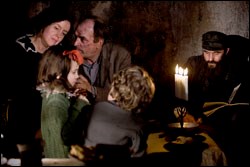
The families make the best of their underground haven
This is not to say we don't feel connected to the characters or root for them to survive. We do, perhaps even moreso because of their blatant imperfections. And Socha—a flawed man whose good heart is gradually revealed as his bond with the Jews grows throughout the film—is a genuinely likeable protagonist. Wieckiewicz's superb performance as Socha is the film's heartbeat, for it embodies in microcosm the moral murkiness of the film at large. Socha is a man who spends his life pulled between the dark underworld (literally) and the goodness of daylight, family and faith. He's driven by money, power, and pride, but also by selflessness and love; the latter are drawn out as his role as protector of the Jews transitions from merely mercenary motives (they pay him well) to personal and spiritual ones (as their money runs out).
Within Socha is a spark of humanity, a conscience that leads him to do what's right and to even sacrifice his own well-being for the sake of others. It's this spark—this light amidst the overwhelming darkness—that seems to interest Holland most. Her camera beautifully captures the dynamics of dark and light throughout the film, putting audiences in the painful, disorienting darkness for much of the time but offering occasional glimpses of the above-ground world and its accompanying bursts of light.
Where does that light come from—that spark of goodness? Holland is certain that it does not come from the church, which frustratingly acquiesces to the Nazi atrocities in the film. Notably, the final "hiding place" of the Jews in the sewers is a cavern beneath the town's cathedral, where echoes of the monks' hymns can be constantly heard, even while the hiding Jews are starving and suffering underneath. In one memorable scene as the Jews celebrate a makeshift Passover meal underground, the church above offers communion elements to newly confirmed Catholics. The two groups are celebrating communion and thanksgiving in their own ways, and yet they are worlds apart … and the grace of those above seems so far from the plight of those below.
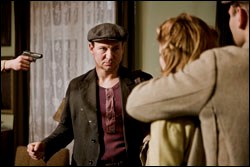
Leopold's life is often on the line
Where was God? That is a question every Holocaust film, book, article, and discussion eventually comes to, and it's certainly a major question in Darkness. As one watches a film like this—with its numbing brutality, unspeakable horrors, and bleak depictions of man at war with himself—it's hard to conclude that God is present. And indeed, Holland's film only mentions God's role directly once: in the final shot of the film, as a chastisement to religion for invoking God as a justifier of unholy wrongdoing.
Article continues below
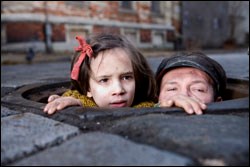
Socha and Krystyna (Milla Bankowicz) peek out into the daylight
But God is present in the film. What drives Socha's sacrificial actions, that he would risk his life for something he knows is right? Where does this sense of "right" come from? At various points, Socha has "baptismal" moments that symbolize his gradual redemption and spiritual renewal. One evening after a day of grimy work in the sewers, he's cleansed in a bathtub by his wife. And in one dramatic sequence, Socha dives into a potentially deadly situation to save those below the ground—and he emerges a new man as a result. It makes for an unlikely redemption story, a cleansing renewal in the midst of humanity's dark night, surely God is at work.
In Darkness, Poland's official foreign-language Oscar submission, is a valuable contribution to the canon of Holocaust films and a strong, provocative offering from one of the world's most notable female directors. It's a difficult, sobering, ultimately encouraging reminder of what humanity is capable of doing to one another—for ill, but also for good.
Talk About It
Discussion starters
At what moments do we see Socha's heart begin to soften toward the Jews?
What do you make of the ending, specifically Socha's final words?
What hope is there in a bleak film like this? Why is it important that we watch such films?
The Family Corner
For parents to consider
In Darkness is rated R for violence, sex, language and brief nudity. In addition to the violence one would expect in a Holocaust drama (indiscriminant killing, bodies all over the place), there are also a few scenes of sex that are brief but moderately explicit. Some objectionable language and a few scenes of brief nudity also contribute to the film's rating, as well as a general ambience of death and despair.
NIL deals in college athletics present new challenges—and opportunities—for colleges and students.
Emily Belz
In Darkness
1 of 4
Robert Wieckiewicz as Leopold Socha, Kinga Preis as Wanda SochaThe families make the best of their underground havenLeopold's life is often on the lineSocha and Krystyna (Milla Bankowicz) peek out into the daylight













 While we pray for peace, we need moral clarity about this war.
 As my doubts about his teachings grew, so did a secret fascination with Jesus.
 NIL deals in college athletics present new challenges—and opportunities—for colleges and students.