In one of the few five-star reviews we've had so far this year, Sandra McCracken's recently released In Feast or Fallow "presents us with perhaps the most beautiful, poignant collection on this side of the century," as our critic wrote. Five-star albums don't come around every day, so we wanted to ask McCracken to tell us a little more about the project, how it came about, why she loves hymns, what "blended" worship looks like, how motherhood affects her songwriting, and what her husband, fellow folk singer Derek Webb, brings to her own process of making music.
Sandra McCracken
The press notes say you asked, "What are we afraid of?" in 15 different ways on these 15 songs. Please elaborate on that.
Sandra McCracken: After making The Builder and the Architect in 2005, and realizing that there are churches and communities who are singing these songs, I wanted to make these melodies more sing-able, and the content more relevant. I've noticed lately how pervasive the fear-driven "news product" is on our culture, and the church community is not immune. But we have great hope in the promise of the gospel, in the freedom of the Spirit, and in a God who C.S. Lewis tells us is not safe, but good. We have to combat fear with freedom at every turn.
Some of the things I wrote about are personal reflections or stories of the people I love—fear of economic crisis, of losing your job, of having a baby, of not being able to have a baby, of raising a child in 2010, of Obama's political change, fear of not having any political change, fear of doubt, fear of spiders. The list is endless. None of these fears are fictional. And none of these fears are a match for the love of God.
You've used the metaphor of a farmer's crop rotation when describing this album. How does that metaphor relate to your own life, and to the album?
McCracken: On one level, my life rhythms swing between touring, writing, recording, and resting. These pendulum swings often leave me wondering what is normal. I am always straining to find balance of energy—input vs. output. This week I feel spiritually skinny, and yet outwardly I just released an album of content-rich spiritual songs. It's funny how that goes sometimes—your "virtual" life can be exploding with activity while you sit in a quiet house with the kids on an ordinary Tuesday. But I digress …
The methodology of leaving the land fallow intrigues me. It is known by organic farmers as an effective farming practice. Leaving a field to rest for a season actually makes the soil more productive the following year because the nutrients are able to replenish. In human experience, setting aside first-fruits, or lighting a Sabbath candle, or even just taking an afternoon nap demonstrate small effects of this same renewal and restoration. It is a simple, and counter-cultural, idea in our 24/7 world.
On another level, the metaphor of crop rotation also says something of the larger narrative of life seasons for me in terms of being an artist who has made both singer-songwriter albums and (now two albums) that are just hymns. I see this cycle as sort of a fallow for one side of my artistic expression, and a feast for the other. This rotation gives me a chance to explore many different aspects of the same plot of land.
How has motherhood affected your songwriting in recent years?
McCracken: I have to be more efficient when I work these days. I am learning not to place my kids and songwriting against each other in competition. If I do that, the child will always win out and I will resent them for it. Songwriting and other aspects of my work make me a sharper more energized caregiver. And being a mother makes all my senses and creative instincts more keen and focused. Each benefits the other, as long as the balance is right.
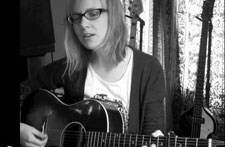
Singing the title track to her new album (click to watch)
What sparked your interest in hymns, both old and new?
McCracken: My mom taught me hymns when I was a little girl. I memorized hundreds of stanzas without thinking anything of it. As an adult, in college actually, I was part of Reformed University Fellowship, where we regularly sang old, and sometimes obscure, hymns with acoustic guitars. It was liberating to get away from a square organ or classical piano approach to accompaniment. So, RUF cleared a path for the Indelible Grace albums, which in turn inspired my own hymn writings. Hymns have always been like nourishment for my soul, in whatever capacity I've been able to absorb them—whether as a child or a student, or as an adult. They seem to have expanded in proportion to my life and need, strengthening and supporting my faith along the way.
Is "new hymn" an oxymoron? Are ancient texts a necessity, or can a modern writer pen his/her own words and still call it a "hymn"?
McCracken: The term "hymn" does not necessarily mean old. Hymn to me is more about form, a song with stanzas, with a range of content from verse to verse. There are patriotic hymns, battle hymns, work hymns, or I suppose you could even call some Irish and English folk songs sort of narrative hymns. But generally "hymn" means music written for the church, for congregational singing, with gospel content.
Article continues below
What's the difference between a "hymn" and a "worship song"?
McCracken: I'd say they are primarily different in form. A worship song is more of a contemporary pop song (with a bridge and a simple, repeating chorus). Also, worship songs often have a more casual, contemporary vernacular, whereas a hymn sounds more formal, or uses traditional language. I think of the word "hymn" also as having some sort of "classic" quality, too. The old ones have stood their ground, but only time will tell what will become of these new ones.
You fit the "folk singer" genre. Do you ever think of the great hymn writers (Wesley, Crosby, Luther, Cowper, etc.) as sort of the "folk singers" of their day—writing about society, culture and the human condition, while pointing to the answer?
McCracken: I'd like to think that Wesley, Crosby, Luther, Cowper, Steele, had a folk singer quality about them. Although their notoriety was limited to church culture, there was a wide audience for their poems, across Europe and then America. They surely didn't think of themselves that way, but some of our more recently famed folk singers (Dylan, Cash) did not see their prophetic position while they were in the middle of their work. As a side note, I think Stewart Townend and Kevin Twit have made great modern contributions to the church/hymn catalog.
Why do you think so many churches today are mostly ignoring hymns, but favoring "modern worship" instead? Will hymns make a comeback?
McCracken: I see the hymns already making a comeback. In our fast-paced, portable, disposable, 2010 culture, young people (30 and under) are grasping for a more ancient, even liturgical style of worship. The older groups have a bit of an allergy to the hymns that they grew up on and that have grown stale to them. I think there can be a middle ground, and that by finding a blend of ancient and modern, there is something for everybody. Also, I will add that Marva Dawn (an excellent resource for thoughts on worship and Sabbath practices) makes the point that if church music style is blended and balanced to appeal to everybody, on any given Sunday, there will be some songs you love, and some songs you don't. And odds are, the guy next to you is thinking the same thing, but in reverse. This means you're doing something right—reflecting the diversity of your community even in song.
Article continues below
Husband Derek Webb
What does Derek bring to your music? Is he part of your writing process, or does he mainly do his thing when you're making the albums?
McCracken: We have always been, and continue to be, pretty independent as creative people, as writers, etc. But we have learned more how to work together, for him to help me with my ideas and for me to help with his. This way there is always a feeling that I have the final word on how things turn out on my songs and vice versa. But I am absolutely more of an artist because of his support, his ideas—even the ones I don't agree with. This mutual sharpening is crucial to who we are as artists and people. After 10 years, I don't think I could separate the two of us completely (artistically or otherwise) without removing part of myself.
Derek's songs can be "in your face," but you're more of a "kinder, gentler" musician. Do you ever find yourself encouraging him to back off from a feisty lyric? Or vice versa, does he ever encourage you to be more "confrontational" in your own songwriting?
McCracken: I think we're a good match in this regard. I don't think we try to sway each other's written voice, per say. But we do naturally learn from each other by example in these ways. Sometimes we slide further to our respective roles because of the contrast between us—me as the peacemaker, he as the agitator. Ultimately, though, both of these attributes, when used for good, are needed in gospel work.
McCracken: I hope for it to be a central place to cultivate new hymns, new melodies for old hymns, and as a resource for churches who are looking for this kind of material for their services. Even though it starts with my albums, I want it to be about the collective effort, groups like Red Mountain, Sojourn, Indelible Grace, BiFrost Arts, and many others. We're off to a good start, but ultimately I need to find the best person (or people) to run the site, research for more content, and to document the movement of modern hymns that is organically happening all around the country.
What's next for you?
McCracken: In the fall, Derek and I will be doing a tour called "Swim the Sea" (the name is based on a G.K. Chesterton quote). We will tour mostly in churches and colleges, playing In Feast or Fallow, and music from Derek's upcoming record, Feedback. It will be a great chance to dialog about these very ideas we've covered in this conversation.












 While we pray for peace, we need moral clarity about this war.
 As my doubts about his teachings grew, so did a secret fascination with Jesus.
 Christians can disciple each other toward action, prayer, and hope.