

Red-Faced Pastor in a Blue State



Free Newsletters
More Newsletters
Recommended Resources
With the current political climate one of the most divisive ever, the challenges for a pastor are immense. Do you try to minimize the heat being generated? Or go along with the leanings of the congregation for the sake of peace? Or preach the always-countercultural kingdom aspects of the gospel? Or what? Perhaps the best perspective comes from observing a pastor navigating the dangers in a slightly different political climate. Editor at large Gordon MacDonald tells his story in this Leadership Classic.
In 1966 my young family and I moved into a southern Illinois town where I became pastor of one of those ubiquitous First Baptist Churches you see everywhere. It was a time of serious racial tension in America, and that tension was palpable in our new neighborhood.
There was only one African-American church in our community, and its pastor and I cultivated a friendship.
 |
One hot summer evening in our community, a number of African-American young people reacted angrily to some racial slurs made by whites on Main Street. Store windows were broken, cars were "keyed," and police authority was defied. Within hours the town polarized along racial lines.
I called my friend and proposed conversation. Would he, I asked, consider gathering a group of those who'd been involved in the meleé and bring them to our home? He would, he said, and he did. Perhaps if I'd been wiser, I'd have gone to his home. But the word I'd heard was that a white guy would not be warmly welcomed on his street at the moment.
A day later two dozen young men and women came to our home for a long discussion in which I tried to listen, ask questions, and respond with an idea or two. The meeting set up a rapprochement with the police and the beginning of dialogue, which helped the community face its problems. I assumed everyone (especially my congregation) would be thrilled.
A week later, at a church leadership meeting, one of our deacons arrived carrying a tape recorder. He had taped a message, he said, because he was so angry that he could not trust himself to speak spontaneously. This certainly caught my attention.
"How you respond," he said, "will determine whether or not I stay on this board and in this church."
We listened.
The pastor (that was me), the taped voice said, had betrayed the responsibilities of ministry by engaging in "social gospel" activity. It was the deacon's opinion that I had no business conferring with the African-American leadership in our community, and that if I did not renounce what I had done, write a letter of apology to the town newspaper, and promise that I would never again do such things, he would resign the board and, perhaps, leave the church.
As I listened I began to visualize the loss of my pastoral mandate. It was a scary moment. I am not by nature an activist, nor do I have the makings of a prophet, but I was convinced that I had acted in obedience to the scriptural mandate: to be a seeker of reconciliation.
When the tape ended, the chairman—a remarkable man—looked the deacon straight in the eye and, calling him by name, said, "We're very sorry to lose you from this board." And then he turned to the rest of us and said, "Let's turn to tonight's agenda." The now ex-deacon packed up his recorder and left the room.
Should I rock the vote?
I grew up in traditional fundamentalism. "This world is not my home, I'm just a-passing through" could easily have been our defining hymn. The faith community of my boyhood was relatively disinterested in any public issues except those that had something to do with family or matters of private morality. Everything else was "of the world." Result? I was quite naïve about how to sort out the kind of public issues with which a pastor should identify.
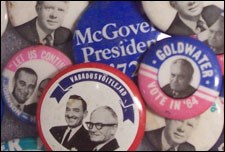
Figuring all of that out began during my seminary days. On weekends I pastored a tiny, rural church in northwestern Kansas. As I was preaching my first sermons Lyndon Johnson was running against Barry Goldwater for the Presidency. I determined to break from my Republican roots and associate with the Democrats. I pasted a Johnson sticker on the back of my Volkswagen. I did this in a Kansas county that would eventually vote overwhelmingly for Goldwater! Was I brave or stupid?
My father (full disclosure: he was a Goldwater man), always candid, saw my Johnson sticker and said, "Are you prepared to take a political position that will cause some people to stop listening to you when you preach the gospel?"
Now there was a show-stopper of a question, and not a bad one. It challenged me to rise to a new level of consciousness in determining when I should go to the wall for an issue and when it might be prudent to avoid the wall. In truth, I had not moved to Cheyenne County in Kansas to stump for Lyndon Johnson; I was there, presumably, to represent the interests of Jesus.
In that case I removed the sticker. My political preferences would not be a deal-breaker when it came to engaging people in my congregation. And the moment birthed a new insight: In matters political, I needed to discern the difference between a preference and a conviction.
In both of these cases, I was free to assert my rights. But while I asserted that right in the first story because of conviction, I chose not to in the second because it involved preference.
As the years passed, I came to see that the practicalities of a Christ-following faith almost always have political, social, and economic implications. But when and how to use my pulpit privileges or the influence of my pastoral position to bring attention to these issues was a serious challenge. I did not enjoy the job security of a tenured professor, and, to be frank, I did not possess the bravado of a zealot. By nature I wanted to get along, to be a priestly presence for people, to build a strong church.
So when should I take the plunge and declare myself or act upon controversial issues and when should I stay away? The answers that came to me over time are what I call soft answers … or judgment calls.
Principles I (now) live by
Most importantly, I learned to seek a convergence of impressions from biblical reflection, historical precedent (as I gained insight from my hand-picked heroes of faith), vigorous prayer, and the wisdom of a few close confidants. If one of these was out of alignment with the others, it was a wake-up call that I might be on my way to making a fool of myself.
It became important to ask, Who am I, and what have I been called to do? By nature I am not an adversarial person; I am not politically minded, and I do not function well in the world of debate. I was (still am) called to be a pastor—a spiritual father—who functions best when he asks tough questions and challenges people to listen for God's voice and its potential to direct them into action. There are some in my world—even good friends of mine—who are naturals at entering the fray of the public political arena. But that seems to be both their strength and their prophetic call. It's not mine.
A second thought that developed was to make sure I was aware of the priority themes of the Bible and their practical or political implications. One might be tempted to say, "Well, duh!" except for the fact that many of us come from traditions that have manufactured great conviction out of just two or three lines of Scripture while ignoring other possible convictions based on scores and scores of scriptural lines.
This meant that issues like compassion for the weak and the poor and justice for the powerless became more than matters of conscience to me. It meant that I could not take the doctrine of creation seriously without recognizing the concomitant issue of the proper care of the earth. Can one seriously claim to follow a crucified and stripped Savior and not have conviction about the irresponsible uses of wealth? I saw such things oozing from all sections of the Bible.
A third principle that became important to me was to become a listener. It's a discipline: to patiently hear what someone else has to say and reserve judgment until they have fully spoken their piece. I'm amazed at what I have learned and how often I have been humbled when I follow this principle. This is the beginning of genuine Christian discourse, something not well developed in my background.
Fourth: I determined to stay as free as I possibly could from ideological entrapment. There are worthy ideas and solutions that come from the minds of good people who populate both the conservative and liberal constituencies. The God of the Bible is neither Republican nor Democrat; the biblical framework cannot be reduced to the agenda of either the right or the left.
Fifth: I determined to renounce the temptation to bash those with whom I do not agree. It is one thing to poke and prod at an idea, another to attack the person who bears the idea. Too often I have failed here.
The arrogance and smugness of too many Christian spokespersons has cost us greatly. We will pay a price for years to come for their mean-spirited and intemperate remarks. Bible-believing Christians are not usually characterized by the larger world as compassionate, gracious, and thoughtful. Rather, we are typed as angry, win-at-all-costs, insensitive people. How can our higher message—that Jesus is mighty to save—be taken seriously if we are perceived in this way? This is worth weeping for.
It was helpful for me to carefully select three (just three!) issues with which I would identify over a long period of time. The three for me were famine-related issues in Africa, racial reconciliation, and environmental matters.
As a leader, it is all too easy to get involved in myriad issues, to become a "lobbyist" for every decent cause. But I could not afford to be pulled away from my core sense of call: to shepherd a flock of souls and to help them follow Jesus. Obviously, I would—from time to time—illustrate issues of discipleship in terms of their political implications, but extensive, time-consuming, passion-draining involvement in non-pastoral matters was probably for other people, not for a pastor.
That didn't mean I would not occasionally point out political and social applications of the gospel. I had to steel myself against the possibility of losing an occasional friend or church member. In my world I found that I was something of a hero if I spoke against abortion and for the sanctity of life. But I lost my heroic status if I dared to extend the principle of life-sanctity to the matter of capital punishment, or the fact that 27,000 children die every day in our world due to diseases that are treatable.
A sermon that protests gay marriage would be welcomed, I learned. But a sermon that reminds us that, statistically speaking, divorce and spousal abuse is just as flagrant in our congregations as it is in the secular community, is shrugged off.
Perhaps my greatest disappointment with the tradition I consider my "home" is that it wasn't and still isn't a safe place to ask questions, explore alternatives, launch creative ideas of a political or social orientation. It is often overrun by a mindset that puts people in a box after just a few words are said that don't sound safe and familiar.
It has been said that the role of a prophet is never to compliment government but rather to critique it in the name of the living God. The traditional Quaker phrase—"truth speaking to power"—applies here. But how shall we know what to say to political and economic power, if we cannot convey thoughts to each other in respectful dialogue instead of battering each other with labels, disassociation, and slander?
Learning from Lewinsky
The most challenging issue with political ramifications I ever faced came when, in 1999, President Clinton asked Tony Campolo, Philip Wogaman, and me to form an accountability team around him when his relationship with Monica Lewinsky became public.
I remember exactly where I was when the President phoned and asked if we could talk. A day or two later I sat with him for several hours for the first of many conversations, which were always candid, confrontational, and, I hope, redemptive. Several times during these encounters (which continued until the last week of President Clinton's administration), I remembered the days when all I had to worry about was whether or not to "wear" a bumper sticker on my car.
When the press revealed the accountability team's existence, there was a firestorm of protest—from people in my tradition—that we would associate with such a man. My inbox became overloaded with thousands of e-mails. I heard an amazing array of reasons—many cast in a most disrespectful way—as to why I should have nothing to do with this man, and I began to grasp what Jesus must have faced the day he visited the home of Zacchaeus. To my knowledge, Zacchaeus hadn't apologized or repented of his presumably scurrilous life as a tax collector, but Jesus sat with him anyway.
What I learned was that almost every person who came into my life with an opinion did so out of an ideological perspective. If they had been anti-Clinton before the Lewinsky scandal, they were even more so after it. If they had been pro-Clinton before the scandal, they were defensive for him and encouraging to me. It made little difference to anyone that a person ordained to the pastoral calling has an obligation to hear anyone out who even hints at a repentant attitude (which I think was true in Zacchaeus's case). Our calling is to walk with them until they prove themselves incorrigible.
My own congregation with whom I had years of history was ambivalent about my relationship to the President. Many people (even some members of our pastoral staff) visibly stiffened when the subject of my presidential connection came up. At best support was spotty. So I learned not to talk about my visits to the White House, not even to ask for prayer, in most cases, and not to even hint that I thought something good might be happening as a result. It seemed as if people did not want to believe that was possible.
For all of the talk among so-called Christians about national revival, I shall always wonder if we came as close as we will ever come in my lifetime to revival in those first months of the Clinton scandal. When the subject of repentance and forgiveness was on the lips of almost every American, I fear that much of our Christian world responded with more condemnation and an I-told-you-so smugness.
Choose your moment
As this national election process determines who will occupy the White House for the next four years, I know that many pastors will struggle to know when to speak and when to remain silent about all of the issues that a national election raises. I am one who has found this struggle more difficult than ever. More than once I have been in conversations where a political or ideological position was far more divisive than a discussion over a piece of orthodox Christian doctrine.
Regularly pastors thread their way through the labyrinth of opinions and debate knowing that a misplaced word can sometimes set a pastoral relationship back many months if not permanently.
But every once in a while, a word well-spoken because it is immersed in prayer, clothed in humility, backed with solid thought and the fullness of God's Spirit breaks through and people see something differently.
Result? They go on to make a God-intended difference in their communities. That is one great moment.
Gordon MacDonald is editor at large of Leadership Journal and chancellor of Denver Seminary.
Copyright © 2004 by the author or Christianity Today/Leadership Journal.
Click here for reprint information onLeadership Journal.



Support Our Work
Subscribe to CT for less than $4.25/month