Five months after Seung-Hui Cho shot and killed 32 students and faculty members at Virginia Tech—the worst shooting in U.S. history—the community of Blacksburg, Virginia, was given a chance to forgive. That opportunity came when Martin Doblmeier, the award-winning director of Bonhoeffer and other spiritual documentaries, agreed to screen his newest film for the campus.
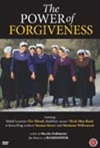
The Power of Forgiveness is a collection of seven short stories showing the limits, difficulties, healing qualities, and unforeseen effects an act of forgiveness can have in the lives of the people who give it. The 78-minute documentary features interviews with forgiveness experts like Nobel Peace Laureate Elie Wiesel, Thomas Moore, and Buddhist master Thich Nhat Hanh, as well as new research into the psychological and physical benefits of forgiveness. A speech by Desmond Tutu on the role of forgiveness in ending apartheid is included in the DVD's special features.
In the two years Doblmeier spent crafting the film, he traveled across the globe—from Northern Ireland to Ground Zero to the Amish countryside. Along the way, he encountered powerful stories of healing and freedom, bitterness and loss. He was even confronted with his own misconceptions and, he says, his life will never be the same.
The Power of Forgiveness was recently screened at Virginia Tech and the headquarters of the United Nations, among other places. Is it gratifying to see your film make that kind of impact right off the bat?
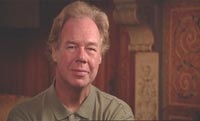
Filmmaker Martin Doblmeier
Martin Doblmeier: I think people are responding to the idea of forgiveness as an antidote to all the anger and vitriolic behavior going on around us. You see it in movies, in the news—even on the highway when you're driving. And I think a lot of people believe it's time to go in a different direction.
So I don't take it as an accomplishment on my part to have had the chance to show the film in these great places. All those people have one thing in common: they are dealing with profound hurts, and they'd like to explore the possibility of how forgiveness might be able to help in some way.
What attracted you to making a documentary on forgiveness?
Doblmeier: I was invited to a conference in the fall of 2004 where people were presenting research on the clinical aspects of forgiveness—psychologists, family therapists, people like that. And what I saw there was something very new.
The faith traditions have talked about the virtues of forgiveness for centuries. But there I saw the health sciences discovering forgiveness as a totally new science for them. And the intersection of those two moments made it a really good time to do a film on forgiveness.
In addition to the health scientists, you've included conversations with people like Elie Wiesel and Thich Nhat Hanh. How important was it to have a variety of faith traditions represented in your documentary?
Doblmeier: I wanted to have at least a sense of the different faith traditions—both to see how they were similar and to see how they were different. Forgiveness is valued, it's held up, in all the faiths. But it's seen a little bit differently in each one.
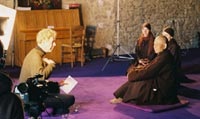
Doblmeier interviews Thich Nhat Hanh
In Buddhist tradition, for example, you don't speak so much about forgiveness, but about compassion. In Judaism, which has a stronger law base, Jews are very clear about saying that certain requirements must be met before you can offer forgiveness. And there's also a formula for giving the forgiveness—if you don't give the forgiveness after three requests, you're guilty now for not having given forgiveness!
I remember Elie Weisel saying that in the film. That was fascinating, to me.
Doblmeier: Yes, and every time I've played the film in front of a group with a large Jewish audience, they've said, "Oh, yeah, that's what we believe. That's central to who we are."
What about Christians?
Doblmeier: For Christians, I think the real challenge is to believe at your very core that everything can be forgiven. Because if Christ could forgive those who killed him on the cross in such a cruel and brutal way, then it seems as though nothing is beyond forgiveness.
Also—and Christians have this in common with other faith traditions, as well—we don't approach forgiveness as something that's good for "number one." Sure, it may be able to reduce your blood pressure and your heart rate; that's what science looks at; it's good for you, so do it. But I think the faith traditions, which have a sense of social responsibility, see forgiveness as a way to transform the culture.
There's another moment in the film when Elie Wiesel is talking about a prayer he composed after his experiences in a Nazi concentration camp. He said, "God of mercy, have no mercy on these souls. God of compassion, have no compassion on these murderers of children." I've heard similar sentiments from Americans referring to Islamic terrorist groups, such as Al Quaida. From your experience making this film, what would you say to those people?
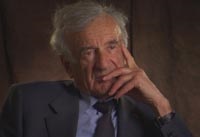
Elie Wiesel talks about forgiveness from a Jewish perspective
Doblmeier: I think that kind of response really is a reflection of your own anger, and how you respond to that moment. I come from a tradition that says we need to be open to the possibility of forgiveness even at the deepest and most painful level.
Article continues below
And so, while one side of me wants to understand how it's possible to feel that I can never forgive, I'm not sure whether that's the healthiest way to be. I'm not sure if it's good for you, first of all, or whether holding on to that anger in the end would be corrosive to yourself.
In your work with Journey Films, you've spoken with a lot of high-influence individuals—Nobel laureates, heads of state, religious leaders. Was it different in this film to be talking with a lot of "ordinary" people who have been the victims of extraordinary circumstances?
Doblmeier: Well, my thought was this: all of us have trials. We've all been hurt, and we've all been guilty of hurting other people. And that goes for both the "great" and the "ordinary," if you want to call them ordinary. But what seems to be unique for all of them is the aspect of community.
So the big question for all of us now is: What is the expectation of the immediate community that we're involved in, in terms of forgiveness? If you belong to an L. A. street gang, for example, you know what the expectation is regarding forgiveness—it doesn't work. But if you're in the Amish community, there's an expectation that you'll extend forgiveness no matter how tragic the occurrence is, and that we together as a community of Amish people will hold you up.
I think that applies not just in extreme situations, but in the daily life of things, too. How does your family speak to you in terms of forgiveness when something happens to you? How does your church talk in terms of forgiveness as a virtue, and in a practical way hold you up?
If we really want to transform the culture, it's not going to happen with just one person doing it. It's going to take small pockets of communities who decide this is not the way it should be. We're going to band together and hold each other up. And together maybe we can make a difference through forgiveness, moving forward and letting go of the anger.
So, is it a goal of your documentary to lift up a standard of forgiveness that we can all rally around, or were you trying to be more objective?
Doblmeier: One of the things I intentionally did was include inherent contradictions throughout the film. You see one person who says, "I get really angry with God." Another says, "I don't get angry with God." One says, "Forgiveness is a process. Take your time, but if you don't feel it, don't be giving it away." Another says, "No, you can make a decision to forgive, and then you can hope that your emotions follow through."
Article continues below
So there are contradictions laced throughout the film that serve, on my part, to be less didactic in teaching about the idea of forgiveness. I'm more interested in raising the idea of forgiveness as this lost virtue that we really believe in, but struggles for its survival in the culture we've created today.
Intelligent people don't want to be told what to think. Intelligent people want to have the resources and the material and the inspiration to rethink things they already believe and feel. And that's what I hope the film does—sort of rekindle the opportunity to say, "Look, we don't like the way things are going here. Maybe we need to go back to the basics, and maybe forgiveness is one of those things we've left behind."
Did any of your ideas about forgiveness change or evolve as you made this film?
Doblmeier: Yes, they did. I used to think of forgiveness, frankly, as a spare tire that you keep in the trunk of your car and you hope to God you never need it. But now I see it in a very different way. I have begun to use forgiveness as one of the windows through which I observe the world. And in doing that, I get a slightly different perception of why family members act the way they do, why community members behave they do, why workmates and associates act the way they do—sometimes even why countries behave the way they do.
These unresolved issues of forgiveness—the inability to come to a point where you feel at peace with yourself and those around you—really become a way to see the world anew. I'm not saying that it's the only way; I wouldn't even begin to say that. But it's one of the paradigms through which I now try to observe the world, and it's been really an interesting experience to do it that way.
I think it's something that will stay with me for the rest of my life.
For more on the film, click here. A one-hour version of the film will air on public television in late March; check your PBS schedule, or check www.ThePowerofForgiveness.com in early March for info.
Sam O'Neal is managing editor of the Discipleship Team for Christianity Today International.














 While we pray for peace, we need moral clarity about this war.
 As my doubts about his teachings grew, so did a secret fascination with Jesus.
 We must always be people of the Word, but we’ll have to reimagine deep engagement with Scripture.