It should come as little surprise that a culture obsessed with CSI and Hannibal Lecter would also be fascinated by a true-life mystery like The Black Dahlia murder. A simple Internet search yields a slew of sites dedicated to the subject, including the basic facts, FBI case files, a list of possible suspects (including Orson Wells and Woody Guthrie), and some of the grisliest morgue photos around. Does it remain popular because it remains unsolved, because it happened in Hollywood, or because such a heinous and gory killing could took place in a seemingly more innocent era like 1947?
Whatever the allure, it is a little surprising that the murder is almost tangential to the movie The Black Dahlia. Based on the novel by James Ellroy, who is best known for the similar Hollywood crime noir book L.A. Confidential, this is a fictionalized account of what could have happened in the aftermath of one of the most infamous unsolved cases in history—not too unlike certain dramatizations that attempt to apprehend Jack the Ripper. But rather than focus on apprehending a murderer, The Black Dahlia seems more a story about the relationship between two friends on the police force.
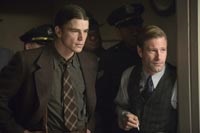
Josh Hartnett and Aaron Eckhart as cops Bucky Bleichert and Lee Blanchard
Those two cops are Leeland "Lee" Blanchard (Aaron Eckhart) and Dwight "Bucky" Bleichert (Josh Hartnett), also nicknamed Fire and Ice not just for their respectively explosive and reserved personalities, but also for their experience in L.A.'s boxing circuit. They meet in the middle of a downtown riot, form a bond out of mutual respect, and end up becoming minor celebrities after a charity bout to benefit the police force—Bleichert graphically loses his two front teeth, hence his nickname. Nevertheless, they develop a strong camaraderie and are soon partnered together in the same department.
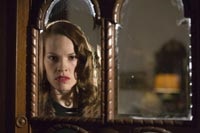
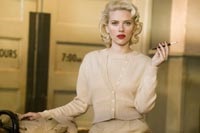
It's there that they stumble into the murder of Elizabeth Short (aka The Black Dahlia), whose body is found just a few blocks away from their stakeout of another case. Like many L.A. cops at that time, Blanchard is noticeably affected by it and pulls strings to get himself and his partner reassigned to the case. It becomes his obsession, interfering with his personal life, including his relationship with Kay (Scarlett Johansson), a pretty blonde who has captured the hearts of both men. The more levelheaded Bleichert, however, becomes involved with Madeleine Linscott, an eccentric socialite who may or may not be one of the last people Short saw before her death.
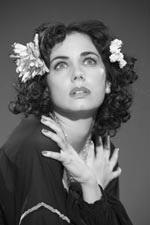
Mia Kirshner as aspiring young actress Elizabeth Short the infamous Black Dahlia
The Black Dahlia is all about the noir, drawing on the snappy dialogue of yesteryear that you just don't hear anymore. "Tried to tell myself I was the sturdy leg in our little triangle," says Bleichert. "I was afraid it was true." There's a charm to the setting, despite some vulgarity, and fans of Curtis Hanson's outstanding cinematic adaptation of L.A. Confidential will find a lot to love here.
Moreover, it proves to be terrific source material for Brian De Palma, the director best known for Scarface, Blow Out, Mission: Impossible, and most pertinent to this movie, The Untouchables. His highly stylized camera work is an excellent match to the writing with a slightly washed out Technicolor look, swooping angles, the trademark first person perspective shots used in most all his movies, and a slow-motion staircase sequence that slightly recalls the famous train station shootout in The Untouchables.
He also draws some excellent performances from just about everyone in his cast. Hartnett has never been better as the collected everyman at the center, and Eckhart excels as the passionately square-jawed heavy. Johansson also shines as the main romantic interest for the two, "Never between [them], always in the middle." And Swank shows a new side to her acting range, smoldering like Rita Hayworth in her seduction of Bleichert. But it's Mia Kershner who perhaps gives the most memorable performance, depicting Elizabeth Short in a series of creepy, sad audition films that admittedly go on a little too long. Nevertheless she effectively plays to the camera with vulnerability, showing the mournful tale of naïve would-be starlets all too willing to give too much in their quest for stardom.
Hilary Swank as the enigmatic socialite Madeleine Linscott
Unfortunately, it's just too much to hope for a De Palma film that doesn't go over the top in excess and ending. The Black Dahlia thankfully doesn't revel too much in gore and serial killer violence. There are a couple of intense moments, including a disturbing flashback showing the earliest moments of Short's murder, but they're actually quick and few. We see her body from a distance at the crime scene and at the morgue, just enough to establish some of the gruesome characteristics of the death without focusing on it. Otherwise, the film is more about quality than quantity with violence—The Black Dahlia is more Chinatown than Seven.
More troubling is the sexuality, which at times focuses on the taboo lesbian subculture of the period. We never see too much that's graphic, with couples shown in bed together before and after intimacy, not to mention one of those clichéd "clear the dinner table" segments. But there's a lot that's implied, including some lesbian action in a silent stag film that sadly shows the lengths to which young women would go to make their big break in show business. De Palma shows a little more than necessary to make a point that could have been handled more subtly with equal effectiveness.
Article continues below
The biggest problem is that the film derails as it progresses. Despite its effectiveness in the first half, De Palma allows the story to gravitate toward camp, especially with the introduction of the Linscott family. They're initially effective, used to depict the first date from hell, but they're not given enough screen time to justify the weirdness—particularly Fiona Shaw's crazed performance, which is so-good-it's-bad-and-visa-versa in the way it adds aristocratic snobbery to alcoholism and yields insanity. Eckhart's performance becomes a little off kilter too, his obsession with the case never explained until we've stopped caring for the man.
Scarlett Johansson as Kay Lake who has captured the hearts of both policemen
And then there's the final half hour, which is almost a complete mess—that pivotal staircase sequence mentioned above seems to be the turning point. Why ignore the case for so long in the movie, only to attempt to quickly wrap it up in too little time? Pivotal characters are suddenly used without proper introduction earlier in the movie, clues are discovered through happenstance, and everyone seemingly jumps off the deep end in their behavior. A fictionalized explanation for the murder is fine provided that the motivations and methods are made clear—they are not in this case.
The Black Dahlia is indeed tragic, but not because of the murder depicted. It's unusual to see a movie start off so strongly (De Palma's best work in a decade), only to collapse so badly by the finale. It begins like L.A. Confidential, but ends like a bad direct-to-video release. The real mystery in this movie is not who killed Elizabeth Short, but why the storytelling and filmmaking couldn't be consistently strong.
Talk About It
Discussion starters
What is it that causes young girls to leave home for Hollywood? Is it really a career choice, or is it to escape the life they know? Are they looking for self-esteem? Does this still happen today? If you knew someone contemplating such a move, what would you say? Would you encourage them or stop them
Considering Bucky's relationship with Lee and Kay, do you think he shows restraint with his feelings? Was he honorable, or did he place himself in a position that opened him to temptation? How might he have better protected himself from hurting his relationship with his two friends? Can men and women be "just friends" if there is physical attraction involved
Article continues below
Why does Lee become so obsessed with the Dahlia murder? At what point do you think he allowed the case to overwhelm his life? Or was it simply his nature? What can we learn from the effect his decisions have on his relationships?
The Family Corner
For parents to consider
Though there are a few quick scenes of shocking violence, The Black Dahlia is only a little more graphic than CSI, more similar to crime noir like L.A. Confidential than a slasher thriller like Seven. Elizabeth Short's autopsy is explained in graphic detail, but her body is generally shown from a distance, and most of her murder happens off-screen. The film revels more in its sexual content, which includes some brief nudity, a lurid stag video depicting lesbian pornography, various couples before and after being intimate, and several women dressed down to their skivvies. There's also lots of R-rated language, including the f-bomb.
The Black Dahlia just won't stay buried. Since remakes are almost as frequent as original films these days, it was probably inevitable that this famous unsolved murder case from 1940s Hollywood would be revised for the big screen. And sure enough, audiences are venturing back into this dark, troubling piece of film noir, which is brought to life this time by an all-star cast, including Josh Hartnett, Scarlett Johansson, Hilary Swank, and Aaron Eckhart.
This time, Brian DePalma, a veteran director of sinister crime stories and sleazy mysteries, calls the shots. And, true to form, he delivers two hours of gloss, glamour, and grisly violence. It's enough to make some critics argue that the film is exploiting is subject matter, inviting us to revel in the portrayals of wicked behavior.
The film follows the young, gorgeous Elizabeth Short in her attempt to fulfill her dreams of big screen stardom. But when she is brutally murdered, the investigation of her death reveals a maddening puzzle.
"The Black Dahlia is indeed tragic, but not because of the murder depicted," says Russ Breimeier (Christianity Today Movies). "It's unusual to see a movie start off so strongly (De Palma's best work in a decade), only to collapse so badly by the finale. It begins like L.A. Confidential, but ends like a bad direct-to-video release. The real mystery in this movie is not who killed Elizabeth Short, but why the storytelling and filmmaking couldn't be consistently strong."
Article continues below
Harry Forbes (Catholic News Service) writes, "DePalma's film-noir homage looks terrific in terms of production design, but is uneven as drama (with an overly complex script). So, too, there are many stylish flourishes and generally good performances … " But he finds the film "morally offensive" due to "the pileup of sordid revelations" and "sundry other lurid plot elements."
Christopher Lyon (Plugged In) notes that the director's "ability to capture and maintain a stylistic tone—as well as his technical achievements with the camera—are simply undeniable. … Again, however, the famed director puts all that skill into the service of a gruesome, ugly, ultimately unredeemed story that leaves you feeling the need for a shower."
Here comes the obligatory movie play-on-words: Mainstream critics, often enthusiastic about DePalma's thrillers, aren't so thrilled this time around.
We must always be people of the Word, but we’ll have to reimagine deep engagement with Scripture.
Brad East
The Black Dahlia
1 of 4
Josh Hartnett and Aaron Eckhart as cops Bucky Bleichert and Lee BlanchardMia Kirshner as aspiring young actress Elizabeth Short the infamous Black DahliaHilary Swank as the enigmatic socialite Madeleine LinscottScarlett Johansson as Kay Lake who has captured the hearts of both policemen













 While we pray for peace, we need moral clarity about this war.
 We’ve got little information on Jesus’ appearance and personality. But that’s the way God designed it.españolFrançais
 We must always be people of the Word, but we’ll have to reimagine deep engagement with Scripture.