Question: What do a 16th-century conquistador, a 21st-century medical researcher, and a 26th-century astronaut have in common?
Answer: A longing for eternal life.
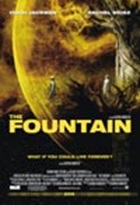
That's the premise of Darren Aronofsky's three-strand film The Fountain. In this dazzling new science fiction mind-bender, we learn that our sufferings are caused by our separation from the Tree of Life mentioned in the book of Genesis.
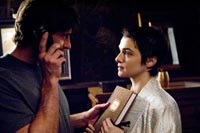
Hugh Jackman, in his most challenging role to date, plays Tommy Creo, a present-day scientist laboring zealously in a laboratory to find a cure for cancer. There's a reason for his determination—his beautiful young wife, Izzy, is suffering from an aggressive brain tumor. Science, Tom believes, is the only way to save her. More specifically, the bark of a mysterious South American tree may be the miracle cure he's been seeking.
Hugh Jackman and Rachel Weisz as Tom and Izzy
But in his frantic rush to find the answer, Tom is missing out on what may be Izzy's last days. His quest illustrates what can happen when fear overpowers love. He's right to desire her healing, but clearly this cure-seeking obsession is narrowing his vision, so that he neglects Izzy's need for intimacy and spiritual healing as well.
Meanwhile, Izzy—played by the radiant Rachel Weisz—is responding to her affliction with art. She's composing a novel that dramatizes her own soul-searching. And that narrative provides The Fountain's second thread—the story of the queen and the conquistador.
In scenes from Izzy's novel, filmed in extravagant detail and color, Queen Isabel of Spain (Weisz, again) is besieged by Inquisitors who belong to a Gnostic distortion of the Christian church. This crusading church believes that the spirit cannot be saved unless the body is deplored, abused, and cast aside. But Queen Isabel stubbornly rejects this heresy. Determined to demonstrate that eternal life—eternal bodily life—is possible, she sends her Catholic servant, the conquistador (Jackman), on a mission to find that legendary tree so they can live forever. She believes that the Genesis story mirrors ancient Mayan mythology, which points to the secret location of the tree. In journeying to find it, the conquistador will help her resist what could be called a "culture of death" being advanced by the church.
Writing this historical fantasy brings Izzy some solace. While she is the one facing death, she's the one learning to cherish and savor every moment of her life. Sitting on the roof with her despairing husband, she tries to encourage him by pointing out the beauty of a dying star.
That bit of stargazing gives us an entry point to the film's third thread—a story set far in the 26th-century. A meditative astronaut (Jackman, of course) is questing through the galaxy in the merest of starships—a transparent bubble—when he suddenly finds himself in the pull of a vast and colorful nebula.
Weisz as Queen Isabel
Sound ponderous? It is. The Fountain staggers awkwardly under the weight of its own ambition. A little more levity and character development—especially in the stories of the conquistador and the astronaut—might have helped. Aronofsky lays down one layer of visual metaphor after another, and loads his characters' statements with melodramatic severity, to the point that many will have a hard time taking it seriously.
But Aronofsky shouldn't be punished for his seriousness. The film's solemnity is appropriate for its subject matter, and it reflects the artist's sincerity. It's not often that moviegoers have such a tangible sense of the storyteller's own struggle to work through personal experiences, questions, and fears. (It's worth noting that both of Aronofsky's parents have survived bouts with cancer. And, in the past year. he's become a father. Experiences like that can make a philosopher out of you.) And in a time when few films have the courage to say anything more than "seize the day," isn't it refreshing to find someone willing to take cosmic questions seriously?
Spiritual exploration seems to be Aronofsky's forte, after all. His first film, Pi, told a troubling tale about a headache-prone mathematical genius who began to suspect that God was speaking to him through the numbers. The next film, Requiem for a Dream, portrayed people succumbing to addictions of all kinds, looking for satisfaction and solace in all the wrong places. Each project has been risky, experimental, and uniquely philosophical. In The Fountain, it becomes clear that Aronofsky believes our sufferings stem from both spiritual and physical lack. So his characters take dangerous risks in order to find healing for their bodies and their hearts.
Scripture tells us that God has set eternity in our hearts, and it is that very principle we see at work here. J.R.R. Tolkien convinced C.S. Lewis that fairy tales and legends have similar themes and events because all human cultures have a sense of "the true myth"—that is, the gospel. Aronofsky is picking up on gospel truth in mythology and the world's religions, and tracing them in hopes of arriving at a profound revelation.
Article continues below
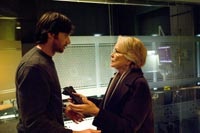
Tommy meets with Dr. Lillian Guzetti (Ellen Burstyn)
So, does it all lead to a profound revelation? Unfortunately, no.
Despite its brave exploration of essential questions, The Fountain fails to lead us to any substantial conclusions. Tom and Izzy give us an affecting picture of our need for humility and love. But for all of their talk about the Tree of Life, the characters seem curiously uninterested in God himself. And they don't seem overly concerned with what might have separated us from the Tree of Life in the first place—namely, sin. They're more interested in finding eternal life through their own striving. These pilgrims seem preoccupied with, as one character puts it, achieving grace.
Further, the film's title refers to a rather troubling and ambiguous picture of "eternal life." In Aronofsky's view, it seems that we're part of an eternal "recycling," our lives eventually becoming fertilizer, from which some new reality springs. That seems to stray from the Christian idea of resurrection, in which Christ declares victory over death—rather than surrender to it.
Nevertheless, The Fountain is a challenging film about humanity's mad struggle to find a cure for our condition, and Aronofsky is clearly a man on a spiritual journey. While some critics are jumping at the opportunity to sneer and call the whole thing ludicrous, this brave filmmaker deserves applause for giving us a work that is uncompromisingly bold and heartfelt. In spite of its flaws, it merits comparison with such daring and personal visions as Malick's The New World, Gibson's The Passion of the Christ, Coppola's Apocalypse Now, and Kubrick's 2001: A Space Odyssey.
Some of the scenery is breathtaking
Nor are we often blessed with portrayals of a meaningful, passionate marriage like this one. In Jackman and Weisz, the director finds two actors willing to go as far as his imagination will take them.
Jackman, who stepped in when Brad Pitt dropped out of the project, commits fully to the demands of his role—even shaving his head for the sake of space travel. In his busiest year yet—X-Men: The Last Stand, Scoop, The Prestige, Flushed Away, and Happy Feet—this is his most vigorous work.
And while it would have been great to see Aronofsky's original choice for Izzy, Cate Blanchett, play the part, Weisz—an arresting actress in her own right—is effortlessly appealing and endearing. (She also happens to be the director's fiancée.)
Together, they deliver some wonderfully intimate moments, including one in a bathtub that's much more affecting than … well … the last time we saw Rachel Weisz acting from a bathtub. (Who really wants to remember Constantine?)
Article continues below
The Fountain's colorful supporting cast reunites Aronofsky with Requiem's Ellen Burstyn, and includes Ethan Suplee (TV's My Name Is Earl) and Cliff Curtis (Whale Rider). But their characters don't have much to do except criticize Tom's desperation and sigh over Izzy's dilemma.
If the film earns any Oscars, they're likely to go to the special effects team for their awe-inspiring work. They've set an admirable example, creating amazing visions without the massive expense of digital animation. (The original budget for the film was $75 million; the final budget, $35 million. Now that's what I call savings!) The Fountain's effects are almost entirely handcrafted. The spectacular imagery of the film's outer-space finale was achieved through micro-photography, capturing the behavior of chemicals in petri dishes. Sometimes, a step backward may be the best way to break new ground.
The attractive set designs help us navigate easily from one thread of storytelling to the other. And they continually reflect the spiritual journey of the heroes by showing us glimmers of light at the end of long, dark passageways. Aronofsky's faithful cinematographer, Matthew Libatique (who also filmed Inside Man), frames this artfully and beautifully.
While it won't be everybody's cup of science fiction, The Fountain is likely to inspire other artists to take chances and illustrate their own spiritual journeys with passion and imagination. And hopefully, moviegoers will seize this opportunity to consider and discuss what these three stories represent: the sufferings we endure in our exile from Eden, and that nagging notion that we were meant for everlasting life.
Talk About It
Discussion starters
What, if anything, is wrong with the scientist's response to his wife's illness? Who responds to the cancer more appropriately, Tom or Izzy? Discuss the differences in their perspectives.
What does Izzy's novel reveal about her own attempts to reckon with her illness? How does the story reflect her own predicament
What do you think the film is trying to convey to us about death? Does it portray death as a natural, proper part of existence, or as a wrong that needs to be set right
How is the church portrayed in the film? Does this resemble any period of the church's true history? Do the inquisitors demonstrate any true-life misconceptions or embrace any real heresies
Article continues below
Which elements of Aronofsky's film move you and resonate with you? What, if anything, rings false?
The Family Corner
For parents to consider
The Fountain is rated PG-13 for some violence, and that violence is startling. There is one scene of a sexual nature (between husband and wife), some imagery of experiments on a monkey that might be troubling, and some bizarre and creepy sequences. It also includes some of the most aggressive vegetation since the Ents of The Two Towers and Seymour from The Little Shop of Horrors.
When Adam and Eve were driven from the Garden of Eden on account of their sin, they lost access to the Tree of Life. And things have been tough all over ever since. But what would happen if we gained access to the Tree of Life again?
The Fountain, a new film by Darren Aronofsky, tells three love stories—all of them starring Hugh Jackman and Rachel Weisz—in which lovers struggle with the reality of death. And while the movie avoids the subject of sin—and, in fact, barely even acknowledges God's part in all of this—it does offer us a rare big-screen example of a romantic, happy marriage and some thought-provoking portrayals of how we react when reminded of our mortality.
Fans of thought-provoking science fiction, dazzling visuals, and stories of passionate love may find themselves transported by Darren Aronofsky's film. Some Christian film critics are rating it among their favorites for the year. One Christian media personality has hastily written it off as a "New Age piece of propaganda," but that's far from the case. No, Aronofsky's storytelling demonstrates what C.S. Lewis and J.R.R. Tolkien knew so well—that myths and religions around the world exhibit traces of the truth, revealing that all of us have the same longing for redemption, and all of us have eternity "written in our hearts." Further, it encourages us not to spend our lives in a frantic attempt to escape death, but to instead respond with love.
Adam R. Holz (Plugged In) writes, "Genesis references notwithstanding, The Fountain is a syncretistic mishmash that never addresses core biblical teaching about humanity's sin and our need for a Savior." He concludes that "violent imagery, harsh profanity and a sexually suggestive scene may well render The Fountain's confusing spiritual and philosophical meandering moot."
Article continues below
Greg Wright (Past the Popcorn) says that viewers might find it "baffling, pompous, and preposterous," or they might find it "stunning and spellbinding." Nevertheless, he was mightily impressed. "Ultimately, The Fountain analyzes our perceptions of death, and our perceptions of life. … [It's] a brilliantly conceived and executed artistic vision."
"Is The Fountain a movie worth the time and effort that Aronofsky put into it? Absolutely," raves Matt Wiggins (Relevant). "This isn't a movie that everyone will love, however. It requires engagement and patience by the viewer. … For those prepared for a brilliantly profound mixture of story and visual, The Fountain will undoubtedly be the best film of 2006."
David DiCerto (Catholic News Service) says the film is "poignant and confusing, but the visuals are striking and the unifying themes of love and mortality provide for some thoughtful reflection on the way death helps delineate our humanity and give our lives meaning."
Mainstream critics are divided, some thrilled and inspired, others shaking their heads in bewilderment.
After lobbying from fellow Southern Baptists and Christians affected by the war, the House speaker moves a package forward.
Harvest Prude
The Fountain
1 of 4
Hugh Jackman and Rachel Weisz as Tom and IzzyWeisz as Queen IsabelTommy meets with Dr. Lillian Guzetti (Ellen Burstyn)Some of the scenery is breathtaking















 While we pray for peace, we need moral clarity about this war.
 As my doubts about his teachings grew, so did a secret fascination with Jesus.
 After lobbying from fellow Southern Baptists and Christians affected by the war, the House speaker moves a package forward.