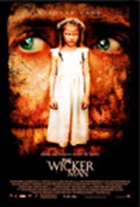
Devoted fans of 1973's The Wicker Man make claims about the film's cinematic greatness, claims which are probably exaggerated—that's what makes them fans. Critics will no doubt massacre this new version, starring Nicolas Cage, but they are probably overly critical of the film's flaws—that's why they're called critics. When it comes down to it, this remake of this oddly chilling curiosity is neither a Big Deal nor a Big Bust. It's just a movie. And that's a real disappointment.
Director Neil LaBute has penned his own adaptation of the intelligent and troubling Anthony Schaffer screenplay, and it's obviously a labor of love. Offered a role in the remake, lead actor Edward Woodward (not to be confused with Ed Wood) politely declined, but remarked that the new script was surprisingly good. So LaBute settles for renaming the missing girl "Rowan Woodward." Nice touch.
Not only the overall arc of the story remains the same—a conventional cop travels to a secluded island to search for a missing child, and comes to suspect that the secretive, cultish residents know more about the girl's fate than they are admitting—but entire scenes are carried straight over into the new film, the dialogue virtually unchanged. The arrival by seaplane and the policeman's bar-pounding lawman-righteous speech at the pub are taken straight from the original, as is the wonderful confrontation with the school-teacher and her classroom full of eerily complicit students. Only it's William Blake on the blackboard rather than quasi-wiccan wisdom: "Toadstone preserves the newly born from the weird woman, the hagstone preserves people from nightmare" is replaced with a so-apt-as-to-be-prophetic passage from "The Marriage Of Heaven And Hell":
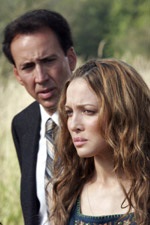
Nicolas Cage as Edward Malus and Kate Beahan as Sister Willow
Once meek, and in a perilous path,
The just man kept his course along
The vale of death.
Roses are planted where thorns grow.
And on the barren heath
Sing the honey bees.
The problem with the new film is that there's less of both heaven and hell, and while the man's path is strewn with plenty of new (and superfluous) perils, he's no longer particularly just.
Like his identical twin Peter (note the eerie profusion of twins in LaBute's isolated island community—another deft tip of the hat), writer Anthony Schaffer is fascinated with the collision between conventional law-and-order Christianity and wilder, more primal religious and creative forces. In The Wicker Man, Schaffer tackles preoccupations that his brother will later take up in Equus and Amadeus.
In the 1973 version, the investigating officer is a devout-to-the-point-of-priggishness Christian. On Summerisle, he encounters not only pre-Christian (even anti-Christian) religious practices, but also a darkly tinged and blatant sexuality that not only offends but also tempts him. These are the tensions that give the original film its charge: we see the islanders through the Christian copper's eyes, and while we can't help but recoil at the cruelties and crudities we glimpse, we're uneasy with the reactive, judgmental self-righteousness he struts around town. Both the sensuality and the spirituality are absolutely essential to the film's power, not only aesthetically but also spiritually. His (self)righteousness and virginity—he is engaged to be married to a nice Scottish Presbyterian girl—is essential to the story, held in painful tension with the morality and sexual license of the islanders (a carnality memorably incarnated by Britt Eckland in the '73 version).
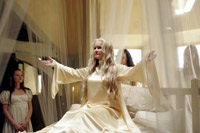
Ellen Burstyn gets ethereal as Sister Summersisle
In this version, director LaBute, for all his Mormon background, astonishingly guts the story of both these crucial elements—a perverse and ironic prudery, as if too much (or too real) sex or religion just wouldn't be acceptable. His policeman (Cage) travels to the island community in response to a letter from Willow (Kate Beahan), who turns out to have been his fiancée—so of course it's taken for granted that they've slept together. So much for the whole virgin thing. And if it makes dramatic sense to give the investigator a stronger personal link to the case, it makes no sense to tame the story's thematic polarities. Much is made of the mainlander's Christian faith in the original script, and if he comes across as something of a judgmental prig, it also lends real power when he cries out to God in that film's stunning climax. Here, when Cage gets in a similar scrape, he's got Nobody to call on.
The 1973 version had a peculiarly British blandness to it, a drab ordinariness and a plodding, linear story progression that rendered the occult elements much more deeply troubling for their everydayness. The practices which so disturb Sergeant Howie are rooted in very real, very ancient pagan beliefs, their stony roots (and the clash with orthodox Christianity) buried deep in British soil, woven into the cycle of the seasons in harvest and May Day celebrations and the rituals of birth, procreation and death.
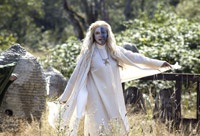
Hey, didn't they paint their faces like that in 'Braveheart'?
For the historically convincing pagan religion (many wiccans and neo-pagans celebrate the original film for its authenticity), LaBute substitutes a made-up feminist (or misogynist?) beekeeper's cult. Sister Summersisle replaces Lord Summerisle (and what's with that extra "s"? Did LaBute get the wrong pronunciation in his head when he read about the movie as a kid? Couldn't Nicolas Cage pronounce "Summerisle" properly?) as the queen bee in a metaphorical beehive community of dominant women and barely-seen, never-heard subservient males. It's a fascinating invention, but ultimately takes away from the unsettling and unexpected plausibility of the story and its resonances.
Article continues below
Critics will readily seize on the new film's quirks and deem it a turkey. It's easy to point out the obvious incongruities of tone and routine dead-end plot detours, easy targets for mockery. But the film has many (moderate) strengths. There's a great sense of place—though it must be said that the Pacific Northwest has been far creepier, in The Ring, or even Twin Peaks. The Angelo Badalamenti score is fine and fittingly filmish, though surprisingly lacking his distinctive sense of menace.
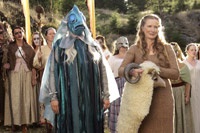
There's something very fishy going on here …
It's easy to mock the sometimes jarring incongruities of tone, but they're utterly true to the spirit of the original, and true in turn to the spirit of May Day (when both pictures set their story), a spring fertility festival that mixed playfully outrageous folly with deadly earnest pagan ritual. If Cage traipsing through the woods in a bear costume is an easy target for the scoffers, so was Edward Woodward in a Punch costume, chased by a hobby-horse—and frankly, those are some of the elements that are most interesting in both films. For my money, it was gutsy for LaBute to retain the bizarre—I only wish he'd done more of it.
For the average moviegoer, this remake is likely to be more enjoyable than the Robin Hardy original. The troubling mix of occult elements and pagan sexuality lend the original cult classic most of its interest, taking seriously the clash of two very real spiritual worldviews—but in the process, and adding in the oddly drab and dreary tone of much of the film, it would likely alienate many of the viewers who would consider its core themes worth considering. The un-sexed, de-spiritualized modern retread renders the story far more palatable for many moviegoers, but what remains is far more ordinary, and much more dismissible. It's just a movie.
Many folks who see Cage's Hollywood version this weekend will like it better than they would the stranger, artier Hammer Studio original. But they'll forget it by Monday—something you couldn't count on with the original.
Article continues below
Talk About It
Discussion starters
The "beekeeper cult" of the film resembles some "New Age" or neo-pagan practices, perhaps even certain forms of wiccan religion. What do you think about such "religious" people you may have come in contact with? Jesus says, "Whoever is not with me is against me," but on another occasion he says, "Whoever is not against me is for me." Which of these principles would you apply to religious but non-Christian people you have met
While the element of sacrifice is taken to a horror movie extreme, there are various elements of ritual sacrifice in many religions. What is the difference between these practices and biblical sacrifice? Consider Old Testament sacrifices, and how these point to the ultimate sacrifice of Christ on the cross. What does that sacrifice mean to you personally
The film imagines a society dominated by women, where men are not only subservient but also silenced. What is the biblical view of the relationship between men and women? Jesus was radical for giving women much greater status than was usual in the culture of his day, while Paul wrote of women submitting to men in certain situations (and of husbands submitting to their wives in love). How should these scriptural texts be applied in our relationships? At what point are they cultural, and how do they apply to your daily life?
The Family Corner
For parents to consider
The Wicker Man is rated PG-13 for disturbing images and violence, language and thematic issues. It is not for children or sensitive viewers. There is reference to a child conceived outside of marriage. The island residents live in an extremely cult-like social structure. There are loud and frightening images of a fatal car accident, and horrific images of drowned children, human fetuses and human sacrifice.
David DiCerto (Catholic News Service) isn't too pleased with Neil LaBute's remake of this cult classic. "Following the basic outline of the original, minus the eroticism and adding a feminist twist … LaBute generates some suspense in his cerebral approach, but overall the film is a bland and unnecessary retread, more hokey than creepy as the story progresses."
Article continues below
from Film Forum, 09/07/06
Horror-movie fans get chills when they think back on Robin Hardy's 1973 thriller The Wicker Man, a cult classic.
So, there was some speculation when director Neil Labute (In the Company of Men, Nurse Betty, Possession) decided to remake it. And, in spite of its two celebrated stars, Nicolas Cage and Ellen Burstyn, critics are saying the speculation was well founded. The movie, while not a total disaster, doesn't pack the punch of the original.
Bob Hoose (Plugged In) is upset that the film doesn't turn out too well for the hero. "Just because a film escapes an R rating doesn't mean it's not disturbing. … The Wicker Man leaves us staring at a pretty, but frightening face that says evil wins, get used to it."
David DiCerto (Catholic News Service) says "LaBute generates some suspense in his cerebral approach, but overall the film is a bland and unnecessary retread, more hokey than creepy as the story progresses."
Christians can disciple each other toward action, prayer, and hope.
Naomi Bosch
The Wicker Man
1 of 4
Nicolas Cage as Edward Malus and Kate Beahan as Sister WillowEllen Burstyn gets ethereal as Sister SummersisleHey, didn't they paint their faces like that in 'Braveheart'?













 While we pray for peace, we need moral clarity about this war.
 As my doubts about his teachings grew, so did a secret fascination with Jesus.
 Christians can disciple each other toward action, prayer, and hope.