Sigourney Weaver, Sarah Michelle Gellar, Patrick Warburton
Theatre Release
January 05, 2007 by Lions Gate
We just can't stop rewriting our fairy tales.
It didn't begin with Shrek, although the runaway success of DreamWorks' sophomore animated feature inspired an ongoing wave of sequels and imitators, from a planned Puss in Boots feature to Hoodwinked—and now to Happily N'Ever After.
Fairy-tale spoofs and goofs have always been with us; Bugs Bunny mugged his way through shorts like "Little Red Riding Rabbit" and "Jack-Wabbit and the Beanstalk." In the 1980s, Peter Beagel's self-aware fairy tale The Last Unicorn became a modestly successful cartoon, and William Goldman adapted his own fantasy pastiche The Princess Bride for the screen, creating a cult classic.
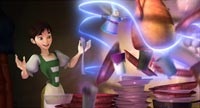
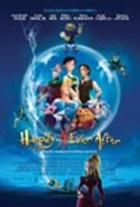
Ella (voice by Sarah Michelle Gellar) is looking for true love
In the 1990s, James Finn Garner's Politically Correct Bedtime Stories: Modern Tales for Our Life & Times gleefully satired the foibles of modern culture by holding them up alongside the traditional values of the fairy-tale canon. More subversively, Gregory Maguire reversed this experiment with his revisionist novels Wicked: The Life and Times of the Wicked Witch of the West and Confessions of an Ugly Step-Sister, undermining the traditional moral world of his fairy-tale source material.
That last work isn't the only feminist take on the Cinderella story. Other recent books and movies in that vein include Ever After: A Cinderella Story, Ella Enchanted, and Just Ella.
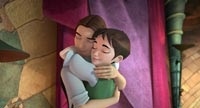
Happily N'Ever After offers yet another take on the Cinderella story. Like Maguire's novel, it displaces one of the traditional leading characters in favor of a less-noticed supporting figure—in this case, the Prince's disaffected servant, Rick (voiced by Freddy Prinze Jr.), who's secretly in love with the pixieish Ella (Sarah Michelle Gellar), though the latter is too overawed by the musclebound Prince's star status to see the gimlet-eyed servant in his shadow.
This is a pretty decent premise for a fractured fairy tale, and to its credit Happily N'Ever After plays it fairly straight, with less postmodern irony and pop-culture riffing than Shrek or Hoodwinked. Unfortunately, cheap-looking computer animation isn't the only lackluster aspect of the production from first-time director Paul J. Bolger. The characters are poorly conceived and no more interesting than they look, with their plasticine skin and molded hair; and the story runs out of steam less than halfway through.
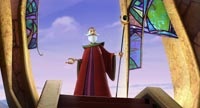
The Wizard (George Carlin) tries to balance good and evil
Take the Prince, whom Ella worships but Rick knows is a buffoon. Of course, no prince is a hero to his servant—but in this case Rick's contempt is thoroughly warranted.
Ella's so blindly devoted to the Prince, and so convinced that he's the one to save the day, that she seems just another swooning groupie rather than a worthy heroine. If she hasn't any more sense than that, what exactly does Rick see in her? What does that say about him?
Fortunately, Happily N'Ever After has at least one other good idea. It seems there's a reason stories in Fairy-Tale Land always end happily ever after. Watching over all the lives and stories of fairy-tale characters everywhere is a benevolent and powerful wizard (George Carlin), who administers the scales of justice, maintaining the "balance of good and evil."
As with the notion of "bringing balance to the Force" in the Star Wars prequels, this "balance of good and evil" seems to mean not a yin-yang equilibrium giving neither good nor bad the upper hand, but rather the ultimate triumph of good over evil. Like clockwork, the villains are vanquished while the heroes and heroines live happily ever after.
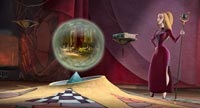
Evil stepmother Frieda (Sigourney Weaver) tries to make a mess of things
But then the wizard goes on vacation—leaving the scales of justice in the hands of a pair of comic sidekicks named Munk and Mambo (Wallace Shawn and Andy Dick). Before you can say "The Sorcerer's Apprentice," the balance of good and evil is in jeopardy. Restless Mambo is itching to "mix things up" a little, though conscientious Munk insists, "We are not tampering with the scales of justice for your amusement!"
Left to themselves, Munk and Mambo might not have made too bad a mess of things. But then another crank enters the works: Through the duo's bungling, one of the fairy-tale characters—Ella's imperious stepmother, Frieda (Sigourney Weaver)—gets a glimpse of what's going on behind the curtain.
First comes the nasty, eye-opening revelation that her stepdaughter, of all people, is destined to get the Prince every time. Then Frieda discovers that Fairy-Tale Land is bigger than just their story: There's also Little Red Riding Hood, Jack and the Beanstalk, Sleeping Beauty, Rapunzel, etc. And finally comes the realization that the whole ball of wax is controlled by the scales, along with an all-powerful wizard's staff.
Naturally, Frieda takes matters into her own hands. Like a malevolent version of Jack Skellington rallying the citizens of Halloweentown to seize Christmas for their own, the evil stepmother summons the villains of all the fairy tales to rise up and create their own Happily N'Ever After, with her own heavy hand on the scales of justice to seal the deal.
In this new fairy-tale world, when Prince Charming kisses Sleeping Beauty, instead of rousing her, the kiss puts him to sleep. Rapunzel's Prince fares no better. The Wolf and the Giant make short work of Red Riding Hood and Jack. Oh, and Rumplestiltskin finally steals the baby.
Article continues below
Rick (Freddie Prinze, Jr.) and Ella, all cute n' cuddly ever after
So far, so-so. As archvillainess, Frieda is at least more interesting than her opposite numbers, even if the most fanciful thing about her is her outrageous comic-book villainess figure. The script bounces along acceptably on decent throwaway gags and one-liners that will make kids laugh, and may get occasional chuckles from adults.
But the story stalls, and never recovers. For much of what follows—too much—Rick tries to persuade Ella that the man for the job at hand is not the Prince, but him. Granted, the Prince isn't the man for any job, anywhere, ever—but what makes Rick such a qualified hero? Why does he think he's so special?
Better yet, why does the movie think he's so special? Why is Rick the hero? Like Shrek 2, with its arrogant, Gaston-like Prince Charming, Happily N'Ever After proclaims that just being a prince doesn't make you a hero—and that a hero doesn't have to be a prince. Fine. But does just not being a prince make you a hero? Or is it Rick's cynical, ironic attitude that qualifies him?
Perhaps a hero doesn't have to be anyone special—perhaps he can be an ordinary guy, without extraordinary courage or skill in battle. Fine. Even so, shouldn't a hero at least be committed to the cause of good? When evil bad guys start taking over the world, starting with the castle you work at, does a hero just shrug and go to work for the new administration?
Even Rick's attitude toward the Prince is ultimately grating. Unlike Shrek 2's Prince Charming, this Prince isn't insufferable, merely helpless and clueless. A better film would have eventually humanized the Prince a bit, maybe even slightly redeemed him, and given Rick a chance to realize that he'd been unfair to him.
Not here. With characters this indifferent, what difference does it make whether Ella winds up with Rick or the Prince?
Talk About It
Discussion starters
What are your favorite fairy tales? Do they have happy endings? Do you have any least favorite fairy tales? How do they end?
In the original Cinderella story, Cinderella is set on the path to happiness by her fairy godmother, and rescued from her stepmother and stepsisters by the arrival of the prince (or his servant). What does this suggest about finding happiness? What problems might there be in this picture? Does this movie improve on the original fairy tale in this respect? Why or why not?
Article continues below
How does the comic behavior of the villains once they take over Fairy-Tale Land reflect on the nature of good and evil? What about the relationship of Rumplestiltskin and his kidnapped baby?
Romans 8:28 tells us that in all things God works together for good of those who love him. How is the movie's picture of the wizard watching over Fairy-Tale Land with his scales similar to that? How is it different?
Like Bruce Almighty and other movies and stories, Happily N'Ever After imagines godlike power falling into the hands of lesser beings. What, if anything, do such stories tell us?
The Family Corner
For parents to consider
Happily Never After is rated PG for some mild action and rude humor. Mildly subversive humor includes such gags as Jack getting squashed flat when the giant accidentally steps on him and the Wolf being served "Red Riding Hood ribs" and the like (though no characters are shown being prepared as meals). Frieda's appearance is exaggeratedly sexy.
compiled by Jeffrey Overstreet from Film Forum, 01/11/07
If you're considering taking the family to see Happily N'Ever After, think again. Film critics are urging moviegoers to "Just say never."
The movie looks primitive compared to most CGI animation, and worse, it packs in almost every cartoon-feature cliché, from the relentless pop culture references to the annoying, wisecracking sidekicks, to the fairy-tale revisionism of the Shrek series. It's hard to believe such a shoddy piece of work would draw the participation of talents like Sigourney Weaver and Sarah Michelle Gellar.
Steven D. Greydanus (Decent Films) says, "The script bounces along acceptably on decent throwaway gags and one-liners that will make kids laugh, and may get occasional chuckles from adults. But the story stalls, and never recovers." He adds, "Perhaps a hero doesn't have to be anyone special—perhaps he can be an ordinary guy, without extraordinary courage or skill in battle. Fine. Even so, shouldn't a hero at least be committed to the cause of good? When evil bad guys start taking over the world, starting with the castle you work at, does a hero just shrug and go to work for the new administration?"
Bob Hoose (Plugged In) says, "Happily N'Ever After tries to be more than just another twist on a story we've all seen in a thousand renditions. … Unfortunately, its creators don't do much to break the animated fairy tale mold. They barely live up to it. … And so, Happily N'Ever After ends up being much less than it aspired to be … and a touch more than a lot of families will care to handle."
Article continues below
Jenn Wright (Past the Popcorn) says, "Robert Moreland's writing is rather unremarkable, and perhaps made more so (meaning evenless remarkable) by its delivery. … I felt that the movie would have made a more appropriate TV special than a full-length cinematic release. While the funky little reworking of the fairy tale is kind of fun and light-hearted, the writing, the characterizations, and the animation simply don't stand up well in a theater setting."
Leader explains why the movement is seeing its biggest membership bump in 30 years and its mission for the years ahead.
Interview by James Thompson
Happily N'Ever After
1 of 4
Ella (voice by Sarah Michelle Gellar) is looking for true loveThe Wizard (George Carlin) tries to balance good and evilEvil stepmother Frieda (Sigourney Weaver) tries to make a mess of thingsRick (Freddie Prinze, Jr.) and Ella, all cute n' cuddly ever after













 While we pray for peace, we need moral clarity about this war.
 We’ve got little information on Jesus’ appearance and personality. But that’s the way God designed it.españolFrançais
 Leader explains why the movement is seeing its biggest membership bump in 30 years and its mission for the years ahead.