






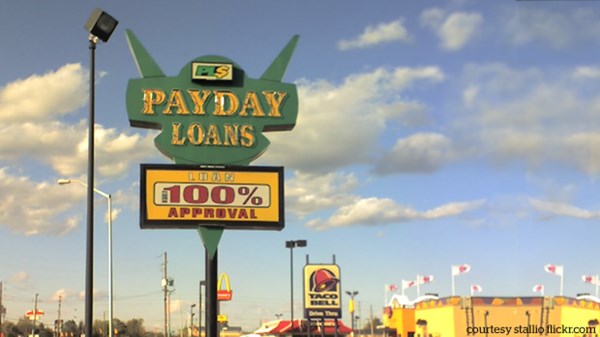
An Ichthus in a Sea of Loan Sharks

To a hardworking mom facing a cash crunch, a payday loan can seem like awfully good news—the chance to borrow some money in advance of a paycheck that is days or weeks away. But when that paycheck actually arrives, paying back the loan is often out of reach—the average payday loan customer renews their loan nine times, paying new fees each time. The Center for Responsible Lending has found that the average customer with a $300 payday loan will end up paying $500 in interest and fees, plus the original loan amount.
You would think a business like that, charging effective interest rates that can range north of 400 percent per year, would have trouble attracting customers. In fact, the market is huge—the United States hosts more payday lending stores than Starbucks and Burger Kings combined.
But a Pittsburgh-based organization wants to provide an alternative.
Dan Krebs and Tony Wiles first learned about the dubious practices of payday lenders in 2006, through a sermon preached by their pastor at Allegheny Center Alliance Church (ACAC). Krebs had been running the finance department at a local car dealership, and thought the church should be able to come up with a creative alternative. Wiles, an ex-cop who'd grown up in ACAC's struggling Northside neighborhood, had been "searching for something to do to give back, to do something in the community that could really make a difference." The two joined forces to launch Grace Period.
Grace Period is unusual, perhaps unique, in its faith-based approach to actually creating something better than the much-criticized payday lending industry. There's no shortage of protests against payday lending, and efforts to outlaw the practice are under way in several states. Indeed, for 10 years the state of Pennsylvania has strictly enforced old usury laws that prevented non-banks from charging more than 6 percent annual interest. It's illegal to offer a traditional payday loan in Pennsylvania—but that wasn't stopping offers from streaming in over the Internet, nor was it addressing the real financial needs that payday lenders promise to address.
Then Krebs and Wiles launched Grace Period. They were hoping to reach customers like Jameikka Drewery, a medical assistant and single mom with five children. In 2006, she had been burned by a payday lender called Advance America, which was circumventing Pennsylvania's usury laws until it was kicked out altogether by the attorney general in 2007. "It was a rip-off," Drewery says. "Every paycheck I had to go and pay them and then borrow back just to pay my bills. I did that for four months or so before things finally got better."
When Drewery needed a loan in 2008, she was stumped. "I was getting married and I needed a loan to pay for a [reception] hall," she explains. The place she wanted required a $250 deposit. An acquaintance recommended that she check out Grace Period.
When Drewery called the organization, she heard something different from the usual payday lending pitch. Wiles explained that Grace Period was a savings cooperative, one you join as you would a gym. Clients enroll as a member in the club for at least one year. Grace Period offers the new member an initial loan and establishes a workable repayment plan. Typically about $50 is deducted automatically each pay period from the member's paycheck to cover loan installments and modest club dues. These automatic payments continue for 12 months. During that time, the initial loan is repaid and additional funds accumulate as an emergency savings reserve for the member. At year's end, members can withdraw funds and close their accounts or remain members, earning interest on their savings.
"They look at how much you make and how much they believe you can pay back," Drewery says. "They tell you [that] you don't want to borrow more than what you can pay back every paycheck and still have enough to live on."
When Drewery cut back from working two jobs to "just a job and a half" so she could start nursing school, she walked a financial tightrope. Over the next few years, she borrowed several times from her Grace Period account to handle various challenges, such as her car breaking down. "The best thing about them was that when I needed them they were always there," she says. "They helped me save."
Largely through word-of-mouth endorsements, Grace Period's membership has increased 55 percent from 2010 to 2011, to nearly 4,000 members. It's on track to loan $1.73 million in 2011 through its partnership with Pittsburgh Central Federal Credit Union.
Grace Period wouldn't have gotten off the ground without support from Krebs's church. ACAC members raised $750,000 in new deposits at the credit union, providing initial capital for the new venture. "Everybody has got a couple hundred dollars sitting around for a rainy day," Krebs says. "We just asked people to put their rainy day money where it could help somebody else." Dan Moon, then CEO at Pittsburgh Central, was already inclined to do something new to service the Northside community. "We were taking a risk on a newly formed business," he admits. But when he visited ACAC and met the leadership and church members at an open house showcasing the Grace Period initiative, "We saw this whole church committed to this. They were ready to back up these loans."
Today, Grace Period's member dues system provides cash on hand to cover the operating expenses of the nonprofit. New club members are constantly being added into the loan pool; meanwhile, older customers pay off their loans but remain in the club. Their capital is then available to help out new members, turning previous debtors into creditors.
Close to Grace Period's modest storefront on E. Ohio Street, financial temptations abound: a Money Mart shop, two Rent-a-Center stores, and a Jackson Hewitt tax office offering "refund anticipation loans." To avoid these debt traps, Krebs says, "People need to have a systematic savings program—and that's what we offer."
Drewery recently stopped in to Grace Period to close her account. She and her family are moving to South Carolina to be closer to her ailing mother. She and Tony Wiles talked and prayed for a half hour, she says. She could hardly believe it when he reminded her that she'd saved $1,700.
"Who'd have thought that I could save $1,700?" Drewery exclaims. "I keep saying, 'If I can do it, anybody can do it.' "
Amy L. Sherman's newest book is Kingdom Calling: Vocational Stewardship for the Common Good (IVP, 2011). Small portions of this article were adapted from Sherman's essay "No Such Thing as a Free Loan," which appeared in the March/April 2011 issue of Prism.

Rethinking the $3,000 Missions Trip

Furniture Fit for the Kingdom

Faith in a Fallen Empire
 RSS
RSS
 TWITTER
 FACEBOOK
Comments Are Closed
No comments
See all comments