






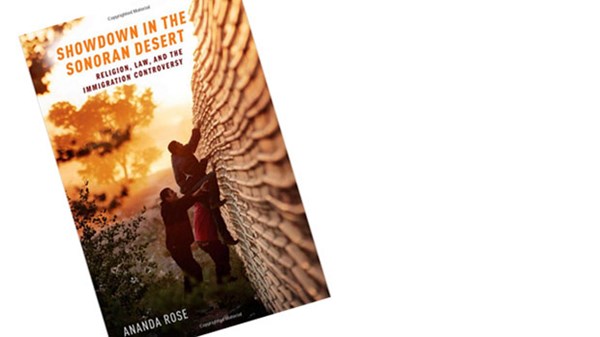
Doctrine in the Desert: How Religion Informs the Immigration Debates

If there's one truth all Christians can hold tight to amid the rancorous public debates about immigration, it's that the debate is ultimately about people. And nowhere is this reality starker than in the Arizona desert, where thousands of lives are lost each year as immigrants attempt to cross the foreboding terrain at the border.
Previous books, including Luis Alberto Urrea's The Devil's Highway and Kathryn Ferguson's Crossing with the Virgin, have documented migrants' trek across this wasteland. Showdown in the Sonoran Desert: Religion, Law, and the Immigration Controversy (Oxford University Press) is unique in that it includes the perspectives of those who oppose immigration. In Ananda Rose's work, the human face of immigration includes American citizens in Tucson on both sides of the issue—those who stand in solidarity with migrants, and those who defend the integrity of the border. The result is a wide range of emotions and opinions that reflects the complexity on the ground throughout Arizona.
What Do We Do with 'the Other'?
Part One, titled "God in the Desert: Migrant Deaths and the Rise of Border Ministries," comprises five chapters, each of which interacts with a particular group working to meet the physical needs of migrants. In contrast, the four chapters of Part Two, titled "Law in the Desert: Security, Sovereignty, and the Natural Rights of the State," engage those who are committed to stopping the flow across the Southern border. In both sections, Rose strives for objectivity and works to avoid taking sides. Her research is grounded in the pertinent literature but also includes interviews of key individuals on both sides of the border. While her sympathies seem to lie with the immigrants, she is willing to criticize the blind spots of pro-immigrant organizations.
In the opening chapter, Rose visits the border city of Nogales, Mexico, where she talks with three tireless nuns of the Sisters of the Eucharist who run El Comedor, a soup kitchen serving those attempting the trip north and others who have been removed from the United States and dropped off by border authorities. The second chapter turns to the New Sanctuary Movement, a ministry with roots in the Central American revolutions of the 1980s but reborn in early 2007 as a shelter for undocumented immigrants. The founders, pastor John Fife and Quaker leader Jim Corbett, among other activists, characterize their efforts as a "civil initiative" (not "civil disobedience," mind you), maintaining that they protect those whose human rights have been ignored or violated by the government.
The approach of Humane Borders, profiled in chapter three, is very different. The organization, started by pastor Robin Hoover, offers passive humanitarian assistance through water stations in the desert. Humane Borders tries to cooperate with the Border Patrol, a tactic not followed by No More Deaths (chapter four), which gives broader direct aid to migrants and is more confrontational with authorities. Several high-profile court cases have involved volunteers, and the group has published very critical reports of border enforcement. The final chapter of this section briefly presents the Samaritans, another group involved in emergency aid patrols.
Part Two begins with an analysis of arguments for and against the wall mandated by the Secure Fence Act of 2006. Chapter seven gives more details on civil patrol groups, such as the Patriots Coalition, Ranch Rescue, and the Minutemen Civil Defense Corps. For these organizations, upholding the rule of law is paramount. They justify their work on the twin convictions that unauthorized immigration presents a danger to the United States security, and that the federal government has been negligent in protecting the border. Others, such as the Center for Immigration Studies and the late Harvard professor Samuel Huntington, also stress the importance of patriotism and a commitment to cultural assimilation, both values they say that immigrants from Latin America lack. The discussion in chapter eight arises from the strict anti-immigrant Arizona Senate Bill 1070, which was passed in April 2010 (and was recently struck down, in part, by the U.S. Supreme Court). This chapter underscores the complications of the immigration quandary caused by, for example, the current visa system, verification of status, and the drug war.
This summary demonstrates one of the two primary contributions of Showdown in the Sonoran Desert. First, Rose's book serves as an introduction to some of the major voices and issues in the immigration debate; Rose writes well, and the mix of personal stories and commentary make for an attractive read. The second contribution is the space given to reflecting on deeper matters of motivation and vision. Groups turn to specific biblical mandates—New Sanctuary Movement, to Numbers 35:11; Humane Borders, to Isaiah 49:10—but the call to be hospitable to the stranger runs through all the groups who serve migrants. Other biblical justifications are found in the image of God, the command to love the neighbor (Lev. 19:18, 33), and the Parable of the Good Samaritan (Luke 10).
A Moral Project
Rose observes that different organizations appeal to diverse texts to base their commitments, and therefore, what matters is not "the full exegetical truth of a given passage's context" but rather "the effect those interpretations have on the larger public stage" (her emphasis). This stance seems to minimize a fundamental challenge among Christians on such matters: the need to evaluate appeals to Scripture on ethical matters. Additionally, Rose's most extensive deliberations on the Other are drawn from a Robert Frost poem, Freud, Sartre, William James, and Emmanuel Levinas—all quite removed from the biblical framework of those interviewed. So while these musings are interesting, there is a philosophical and religious disconnect with her interviewees and the border context. It would have seemed more constructive to explore other Christian theological resources on hospitality and the border, of which there are several of substance.
In Rose's penultimate chapter, she asks, "What would Jesus do?" At the very least, she says, he would call for a radical new vision of the problem and the solutions. In her conclusion, Rose asserts the border is a "moral project," one that needs "rational and patient debate." Thankfully, Showdown in the Sonoran Desert is an irenic, evenhanded work that gets the conversation going in the right direction.
M. Daniel Carroll R. (Rodas) is distinguished professor of Old Testament at Denver Seminary and author of Christians at the Border: Immigration, the Church, and the Bible (Baker Academic). He also is the National Spokesperson on Immigration for the National Hispanic Christian Leadership Conference.

Rethinking the $3,000 Missions Trip

Furniture Fit for the Kingdom

Faith in a Fallen Empire
 RSS
RSS
 TWITTER
 FACEBOOK
Comments Are Closed
Displaying 1–1 of 1 comments
See all comments
Jason Lee
Jack i thought that was the legal immigration process, where many who want to come to the US have to wait? But good idea about salary being allocated to social security and any other programs. Only question would be if we allow this, how many more "Illegal/Undocumented" individuals will come to this country?