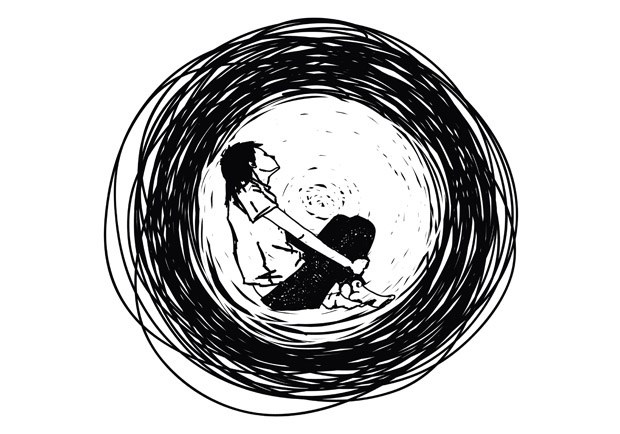
Somewhere between August and October of 2010, I stepped off the tracks of "normal, everyday life" into the no-man's land of chronic pain, then depression. At age 22, I started feeling a sharp, niggling pain in my left ankle every time I walked. After some months of unsuccessful treatment and fed by my own fears and anxieties, the pain gradually expanded into a black hole of existential despair that sucked away my hope and zest for life.
It sounds melodramatic. But anyone who has been in the throes of unrelenting physical pain knows the hard truth: Pain eats away at your personhood. Elaine Scarry, in her book The Body in Pain, lucidly explains that pain destroys language, because it has no reference to the outside world. Whereas other states of consciousness have an object – "love is love of x, fear is fear of y, ambivalence is ambivalence about z" – pain just is. Pain escapes our ability to explain in words and shrinks our world to the parameters of our body.
The language-destroying, meaning-escaping essence of pain perhaps terrified me the most. "What does it mean? Why is this happening to me?" I kept pleading to God. My fresh-out-of-college self was ready to take on life's unexpected adventures, but just not this one. Being sidelined by an insidious injury that didn't even result from some exciting feat like mountain climbing or salsa dancing was an anti-adventure. It lacked a plot line and forward momentum. Writing to a friend about my state, I told her I felt like I had fallen into an underground cave and was stuck there while people walked, danced, and skipped along overhead.
When people tried to comfort me by telling me that my experience was just part of life, that everyone suffers setbacks and losses, this scared me even more. I'd like to think that life is somewhat predictable, that if you exercise regularly and eat well, you won't come down with cancer or inexplicable joint pain. That God won't let people who love and trust him suffer without some word of explanation. But some health nuts do get cancer. And God does sometimes remain silent.
But even if God isn't speaking, humans cannot help trying to piece together a narrative. It's our nature. Viktor Frankl describes in Man's Search for Meaning how, even in the most dehumanizing conditions of a concentration camp, people still found meaning in their existence. I think there is a difference, however, between living out of the trust that there is a deeper meaning and putting words in God's mouth.
There were many instances when I and others around me fell toward the latter pole. Is God disciplining me for some reason? I wondered. Then I got angry because I felt the punishment was undeserved or at least unfair compared to the (seemingly) easy lives of my friends. Once, after receiving prayer for healing at a church we visited, the woman praying looked up and asked, "Are you harboring any unforgiveness?" While a legitimate question in the abstract, the link she drew between physical and spiritual well being put me off. From my own experience and those of many others, this is not a generalizable principle.
The language-destroying, meaning-escaping essence of pain perhaps terrified me the most.
Sometimes I abandoned spiritual explanations altogether and wandered off on scientific and medical rabbit trails: Perhaps I had a genetic disorder that caused my joints to injure more easily than normal. Perhaps it actually all started with my gut and the antibiotics I had taken when I was younger. Even if one of these explanations was the case, though, I was always left with the question, But why me?
About a year after the pain started, the burden of existential despair subsided. I'm not sure why. Partly, I was just tired of asking God questions that he wasn't answering. Also, I began to stop my thoughts from wandering too deep into the past and future and focused instead on the present. Today, over two years later, I still have some pain, but have improved greatly in mobility and pain level. Again, I'm not sure exactly why. Was I healed? Was it time? Was it the physical therapy? Was my body finally able to recover once I released my viselike anxiety over it? All of the above?
It is tempting to try to connect all the dots. I want to be able to look back and discern some cause and effect. I prayed, I trusted, then God answered. I surrendered my life, then God gave it back to me. Or, at least, I took these supplements for three months and followed this stretching regime religiously, and now I am better. Sometimes, this is the case. But the scores of dark, painful days, treatments with no seeming effect, and silence from God keep me from being too quick to assign meaning to anything.
I believe there is a meaning. I know God loves me and cares for me and won't in the long run let me down. That's what gives me the hope to get up another day and face life's unpredictability. But I can't presume to know precisely what that meaning is. At least not yet.
Article continues below
Perhaps the meaning of the pain in our lives is like the prophecies of old. Isaiah's beautiful foretelling about Israel's restoration may have been partially fulfilled in the immediate future, but won't be completely fulfilled until God binds up the book of time. Likewise, though I can glean some meaning from my ankle pain – it has made me more compassionate toward the sufferings of others, for example – I don't think I'll fully understand it in this life. This isn't a copout to avoid wrestling with pain and suffering or to not make wise and informed health decisions, but an acknowledgment of my limits. Even though I don't understand it now, it is enough to live with the trust that, in God's boundless love, there is meaning to my pain.
Liuan Huska is a freelance writer and part-time researcher. She has contributed to God's Politics, Loyola University's Center for Digital Ethics and Policy, and the G92 blog. She maintains a personal blog on embodiment and spirituality at bodyandbeing.wordpress.com.












 While we pray for peace, we need moral clarity about this war.
 A Christian reconciliation group in Israel and Palestine warned that war would come. Now the war threatens their relevance.العربيةFrançais
 The Grammy-winning artist was found dead at her home in Nashville at age 47.





