






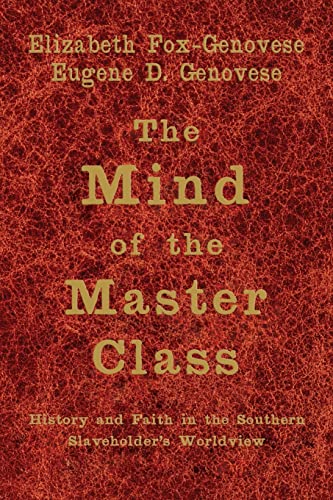
The Mind of the Master Class: History and Faith in the Southern Slaveholders' Worldview
Eugene D. Genovese; Elizabeth Fox-Genovese
Cambridge University Press, 2005
824 pp., 38.99

Harry S. Stout
Puritans, Planters, and American Intellectual History
The Mind of the Master Class is a masterpiece.In The Mind of the Master Class: History and Faith in the Southern Slaveholders' Worldview, Elizabeth Fox-Genovese and Eugene Genovese embark upon a task of rehabilitative intellectual history remarkably similar to that undertaken by the Harvard historian Perry Miller in the 1930s. Both have chosen a decidedly unfashionable subject for serious study. In the 1920s and '30s, the Puritans were the bete noires of serious American culture. When he began work on the two-volume opus that would become The New England Mind, Miller recalled in the foreword to the 1954 edition,
Oddly enough, I found myself driven to study the structure of the original Puritanism of New England in a time when the perverse tendencies of the American sensibility were most excited against my subject. All around me, in the 1920s, I was being shown by pundits and philosophers whom I respected, that "Puritanism" was the source of everything that had proved wrong, frustrating, inhibiting, crippling in American culture.
In his magisterial reassessment Miller came to the opposite conclusion. Far from being incidental or marginal to "serious" American intellectual history, the Puritans represented "one of the major expressions of the Western intellect" in American culture. Whatever feelings of personal revulsion or disagreement Miller harbored for his subjects (and as a self-confessed atheist they were certainly present), he recognized that an enormously significant component of America's cultural and intellectual legacy had been missed by his smugly superior intellectual peers.
In 21st-century America, antebellum Southern slaveholders are the new Puritans, who stand for everything that is repulsive in American history. Racist, violent, misogynist, willing to destroy the nation to preserve their "peculiar institution," slaveholders in post-civil rights movement America are about as politically incorrect a subject for sympathetic study as any scholar could choose to explore. "To modern sensibilities," the Genoveses recognize, "it is a preposterous idea that a slave system could engender admirable virtues. … In our own time it seems perverse, not to say impossible, to try to separate the horror of slavery from the positive features of an ordered and independent social system."
Yet, like Miller, the Genoveses have chosen to invest years of significant research into reconstructing the slaveholders' intellectual world and its place in the larger currents of Western thought. They do not come to their subject as fellow-believers caught up in some neo-Confederate madness, and in fact have written often and compassionately on the inhumanity of slavery. But still they persist in their intellectual project. In so doing, they disentangle the "horror" of slavery from the genuine virtues of a corporate social ethic that has virtually disappeared in modern industrial America. As well, they issue a powerful critique of northern conceits by showing how the defeat of the Confederacy meant not less racism, but more. Northern victory promoted a "new racism" that empowered the American white race "to rule the world, civilize the heathens of Asia, Africa, and Latin America, and rightfully put them to work for the master race."
The parallels between Miller's intellectual history and the Genoveses' go beyond engaging hostile intellectual cultures to encompass remarkably similarities in style, method, and argument. First, style. Both Miller and the Genoveses adopt a style of discourse and argumentation that might best be labeled bombastic. For both, ideas are not trivial matters for casual talk at cocktail parties but utterly serious pursuits worthy of being treated in life-and-death terms. Occasionally humor appears, but usually with the object of satire or reductio ad absurdum arguments. Neither are they shy to put forward their interpretation or belittle their opponents, both historical and contemporary. It is a style of discourse whose roots are ultimately medieval, grounded in what the Jesuit scholar Walter J. Ong termed "agonistic structures," in which words are weapons. In these embattled terms, the really critical question becomes, do they fight fair? And to this reviewer, the answer—in both cases—is yes.
In terms of methodology, the Genoveses, like Miller, are fanatical scholars and researchers. In a mark of characteristic hubris, Miller refused to footnote all of his sources, but when independently compiled years later, they confirmed that he had read virtually the entire canon of Puritan texts—mostly sermons—before the age of Evans micro-cards and photocopiers. A scholar's scholar, Miller ransacked the primary sources, achieving a depth of understanding and knowledge that no one else of his time—including Christian clergy and theologians—could begin to approach. Implicitly, Miller's prodigious archival research challenged the historical community to match his industry and consequent interpretation—or shut up.
Central to the "mind" that Miller elucidated was classical Western history and Protestant Christianity. By looking at Cambridge and Harvard, as well as Puritan literature, Miller described a culture of enormous philosophical erudition, well steeped in the Christian classics, the ancients, and the Renaissance and Reformation. One figure in particular loomed large over the intellectual enterprise: the French Protestant philosopher Peter Ramus whose new system of "logic" (really rhetoric) presented "reality" as it existed in the mind of God. That reality became the organizing device for Puritan preaching and social engineering.
The depth and range of the Genoveses' exploration of Planter intellectual culture and education is no less thorough and encyclopedic. Like Miller they probe deeply into the antebellum world of sermons and theology, and like Miller they also examine higher education and the authors read and studied by the slave-holding élites. In the Plantation South, no less than Puritan New England, public culture was defined by a learned mix of classical history and theology. Ancients were read widely in the South, and knowledge of Greek and Latin was a highly valued skill that any gentleman should possess. The medieval Schoolmen were read also with approval, despite their Roman Catholic context. (By war's end, some Southern intellectuals were actually wondering if the Reformation—with its individualistic ethos—was a good thing after all.) "Modern" philosophers from Hume to Locke were read, critiqued, and integrated into a distinctive Southern world view which privileged the corporate and hierarchical social ethic that upheld slavery as a positive good.
Theologically, Southern intellectuals tended to take their cues from Presbyterian theologians like James Henley Thornwell, Robert Dabney, Thomas Smyth, and Moses Hoge, who all defended slavery and the larger planter household it supported from carefully grounded Scriptural arguments and precedents. Indeed, in a fascinating—and certainly provocative—evaluation of Northern and Southern biblical arguments over slavery, the Genoveses argue that the South got the better of the argument if one stuck to the literal "Word" of the biblical text in contradistinction to some vague "Spirit" of Scripture based on abstract understandings of neighbor love or the Golden Rule: "To speak bluntly: The abolitionists did not make their case for slavery as sin—that is, as condemned in Scripture. The proslavery protagonists proved so strong in their appeal to Scripture as to make comprehensible the readiness with which southern whites satisfied themselves that God sanctioned slavery."
Of course, the notion of a "literal" understanding of Scripture is itself embedded in theological debates stretching from the patristic era to the present, and the Genoveses rightly concede that the slaveholders' hermeneutic would have relatively little bearing on 21st-century debates. (Even among self-identified fundamentalists you'd be hard pressed to find churchmen invoking St. Paul to defend present-day slavery in West Africa and Southeast Asia, where a conservatively estimated 12.5 million human beings—mostly women—suffer in bondage.) But in the antebellum South, clergy of all persuasions condemned Northern critiques of slavery as, in all cases, sinful, and some went so far as to think the institution would be continued in heaven.
If the worldview of antebellum Planters was remarkably similar to that of colonial Puritans (including the practice and acceptance of slavery), the Genoveses assert baldly that the same could not be said of the Puritans' Northern intellectual descendants. The reasons? Slavery and capitalism. While antebellum Planters remained strongly anchored in a hierarchical, patriarchal, and orthodox Protestant past, Northerners moved ever more in individualistic and "liberal" directions which, the Genoveses argue, were rendered necessary by the evolving market economy that undermined all sense of community (theological and practical). Antebellum Planters, like the Puritans before them, understood the extended family (including slaves) as a "Little Commonwealth"—the indivisible unit of society. Northern Protestants, steeped in Lockean epistemology, the egalitarian rhetoric of the Declaration of Independence, and a humanized Christ, bereft of all sense of sin and judgment, privileged the individual as the basic unit of society.
When one adds the Genoveses' interpretation of post-colonial Northern Protestant sell-outs to capitalism, the similarities in interpretation between Puritans and Planters become even stronger. Both Miller and the Genoveses tell a story that features what Miller termed a "jeremiad" for a "lapsed" America. In Miller's telling, "declension" began already by the second generation among children who could not measure up to the orthodox giants the Founders had been. In the Genoveses' account, Puritan orthodoxy in the North held at least through the hyper-Calvinism of Jonathan Edwards in the late 18th century, but then, sure enough, declension set in and formerly orthodox Calvinists capitulated to the sirens of rationalism, capitalism, and faulty biblical exegesis.
Both Miller and the Genoveses emphasize declension over and against persistence and continuity. Miller saw a flip side of declension: the boon of Americanization. Even as the Puritans declined in the 18th century, Miller argued, their democratic spirit lived on and informed the great national transition "from Puritan to Yankee." For the Genoveses, in contrast, there is no flip side: Northern declension led to unfettered capitalism and the loss of continuity with an organic past. In the "knotty theological debates" of 19th-century America, the Genoveses argue, divergent material realities and social constructions shaped divergent theologies in ways more significant than any surface similarities:
No simple dichotomy between Trinitarianism and social corporatism versus anti-Trinitarianism and individualism would bear examination, but a tendency toward correlation does exist and did exist in the minds of orthodox Southerners. Anti-Trinitarianism correlates nicely with the bourgeois individualism of modernism, whereas revolts of both the antibourgeois Left and Right have repeatedly fallen back on Trinitarian theology.
But as brilliant as Miller and the Genoveses are, one must ask if their jeremiads stand up to scrutiny. Miller's declension model never could explain Jonathan Edwards, whom in a later biography he portrayed as almost divine, nor could it account for the pervasive religiosity and orthodoxy that characterized Congregational churches down to the Revolution. Nor can the Genoveses' declension model explain the 19th-century Northern neo-Edwardseans, be they of the "New England Theology" or "Old School" Presbyterian orthodox represented by Charles Hodge at Princeton Theological Seminary.
To document the supposed lapse of 19th-century Northern Protestants into Unitarianism or proto-Unitarianism and "liberalism," the Genoveses rely less on the sort of exhaustive analyses of primary sources that accompany their analysis of the South than on the dated work of historical theologian Joseph Haroutunian, Piety Versus Moralism: The Passing of the New England Theology, which argued that Northern Protestantism "drenched its theology with humanism." Haroutunian's thesis was certainly provocative and appealed to a coterie of neo-orthodox theologians lamenting the rise of liberalism in their own generation. But it simply does not hold up under rigorous analysis. Many—perhaps most—Protestant clergy in the North did not embrace abolitionism but, like Hodge, argued that slavery was not a sin per se. As for their latent universalism and proto-Unitarianism, it simply did not exist. Recent and painstaking research by scholars such as Joseph Conforti, David Kling, and Douglas Sweeney reveal an amazingly consistent "Edwardsean" tradition. In sum, relying on Haroutunian to characterize 19th-century theology in the North is roughly analogous to invoking Ulrich B. Phillips on the subject of slavery and the plantation household over and against the more recent scholarship of Eugene Genovese and Elizabeth Fox-Genovese. It simply doesn't compute.
In discussing the South—the main theme of the book—the Genoveses are on much firmer ground. But even here, one yawning gap remains, namely the Civil War, or, as they call it, "the War for Southern Independence." References to "the War" recur in the book, to be sure, but with little amplification or analysis. Were the Genoveses to pursue more extensively the arguments rendered in the crucible of war, it would become apparent that the similarities between Northern and Southern Protestants were more significant than they assume.
Both adhered to a Christian orthodoxy grounded in Puritan notions of a "covenanted nation," a chosen people who, by virtue of their orthodoxy, could claim God was on their side. With that claim, both sides could enter into the bloody business of killing one another without any effective limits on the butchery. Since both sides read their Old Testament alongside their Puritans to arrive at an identical national jeremiad, they knew that defeats were only calls to reform and repentance—which, when properly pursued, would induce a covenant God to render victory to "His" people. Only when we recognize the profound similarities between Northern and Southern Protestantism does it become possible to understand the ferocity of the conflict. In fundamental ways, the Civil War represented a fratricidal war between two similarly grounded theologies struggling for the soul of the continent.
The originally Puritan idea of a covenanted Christian nation dominated Confederate discourse. Indeed, in a rare slip, the Genoveses assert that the Confederate clergy mounted an "unsuccessful campaign … to declare the Confederacy a 'Christian society.' " Sorry, but nothing could be further from the truth. Confederate pastors and moralists enjoyed an immense rhetorical advantage over the North because of their Christian Confederate Constitution. And they didn't hesitate to exploit it. Following the resounding Confederate victory at First Bull Run, the Rev. Edward Reed preached a thanksgiving sermon at Flat Rock, South Carolina and reiterated the stock Confederate truism that the Federal Constitution was fatally secular: "Whether through inadvertence, or, as is unfortunately more probable, from infidel practices imbibed in France by some members of the Convention … it contained no recognition of God. Our present Constitution opens with a confession of the existence and providence of the Almighty."
Much to their dismay, orthodox Northern Protestants found themselves forced to agree, and issued repeated calls for a constitutional amendment identifying America as a "Christian nation." So adamant were they in seeking to emulate the South with a constitutional amendment that a desperate Abraham Lincoln threw them a sop with piously phrased proclamations of fasting and thanksgiving and a new national motto, "In God We Trust." Ironically, when Lincoln determined that his new theocentric motto would be stamped on the nation's coinage, he inadvertently fashioned a telling symbol of the North's conflation of capitalism and Christianity.
Unfortunately, the Genoveses have relatively little to say on the actual war years except to romantically describe Confederate ministers as "prophetic" in their "brave efforts" to endorse a just but humane war. No doubt there were individual ministers who lived up to this description, but they were not representative. Far more typical was the case of Robert Dabney, whom the Genoveses frequently cite. Dabney, a famed preacher and theologian, served as Stonewall Jackson's aide-de-camp and chaplain. In matters theological he was rigorously orthodox, but in terms of war, he proved as bloodthirsty as any. Preaching at the funeral of a fallen comrade, Lieutenant Abram Carrington, Dabney singled out the young men in his congregation for a ringing affirmation of hatred and blood revenge:
Let me exhort the young men of this community to be "followers of him [Carrington] as he also was of Jesus Christ." And especially would I now commend by his example, the sacred and religious duty of defending the cause for which he died. … Surely [his] very blood should cry out again from the ground, if we permitted the soil which drank the precious libation, to be polluted with the despot's foot! Before God, I take you to witness this day, that its blood seals upon you the obligation to fill their places in your country's host, and "play the men for your people and the cities of your God," to complete the vindication of their rights.
With rhetoric like this, emanating from the Southern pulpit no less than the Northern, it becomes clearer how the war could continue until there were no more bodies to sacrifice on the altars of their nations. Calvin's God, after all, was on their side.
Whatever quibbles readers will have with The Mind of the Master Class, the book represents a stunning tribute to the power of the mind in American culture and the central role that religion has played in that mind, for better and for worse. Humanitarian and liberal wishes to the contrary notwithstanding, scholars of American cultural and intellectual history will now have to reckon with Planter ideology alongside Puritanism as major expressions of the Western intellect in American history. One can only hope that this powerful book will lead to a renaissance in constructive scholarship as far-reaching as that which flowed from Perry Miller's achievement seventy years earlier.
Harry S. Stout is Jonathan Edwards Professor of American Religious History at Yale University. He is the author most recently of Upon the Altar of the Nation: A Moral History of the American Civil War, forthcoming from Viking in 2006.
1. Joseph Haroutunian, Piety Versus Moralism: The Passing of the New England Theology (Harper & Row, 1932).
2. See Kenneth P. Minkema and Harry S. Stout, "The Edwardsean Tradition and the Antislavery Debate, 1740-1865," Journal of American History, Vol. 92 (2005), pp. 47-74; or Mark A. Noll, America's God: From Jonathan Edwards to Abraham Lincoln (Oxford Univ. Press, 2002), pp. 414-15.
3. See, e.g., Joseph A. Conforti, Samuel Hopkins and the New Divinity Movement: Calvinism, the Congregational Ministry, and Reform in new England between the Great Awakenings (Eerdmans, 1981); Douglas Sweeney, Nathaniel Taylor, New Haven Theology and the Legacy of Jonathan Edwards(Oxford Univ. Press, 2003); or David W. Kling, Field of Divine Wonders: The New Divinity and Village Revivals in Northwestern Connecticut, 1792-1822 (Penn State Univ. Press, 1993).
4. Edward Reed, A People Saved by the Lord (Charleston, 1861), p.9.
5. Dabney's sermon was reprinted in the [Richmond] Central Presbyterian, March 12, 1863.
Copyright © 2005 by the author or Christianity Today/Books & Culture magazine.
Click here for reprint information on Books & Culture.
 Email Newsletter
No comments
See all comments
*