







Cross on the Star of David: The Christian World in Israel's Foreign Policy, 1948-1967 (Indiana Series in Middle East Studies)
Uri Bialer
Indiana University Press, 2005
256 pp., 97.07


Paul Merkley
Was Israel a Mistake?
Three views (including former President Carter's).The literature which serves the historian of the relations between the churches and the State of Israel is sparse and for the most part lightweight. Most of the books that actually get read on this theme, those that are put out by publishers of religious literature and which are available in "Christian bookstores," are polemical, dedicated to either denigrating or exalting Israel's performance as the civil host of all the Christians who live and work in Israel.
Two things need to happen before serious scholarly histories of this story begin to appear. The first is that academic historians must come to recognize the centrality of this theme (the relations between the churches of the Holy Land and the Jewish State) in the overall story of the relations of State of Israel with the whole world. The second is that archives held by the principal participants in this story must be opened for disinterested investigation. The unwillingness of the Vatican to allow outsiders into its archives is well-known, but other Christian bodies—including the Orthodox churches, the Anglicans, the Lutherans, and still more who have played a part in the religious life of the Holy Land—have been every bit as reluctant to let strangers into their basement archives, and have accordingly paid the price of being mistrusted by scholars and misrepresented in the scholarly histories. So long as this state of affairs exists—so long as the materials necessary for writing honest history are unavailable—the amateurs and the partisans and the court-historians and the mindless polemicists are able to present their generalizations, their rumors, and their partisan prejudices as the story.
Uri Bialer's new book, Cross on the Star of David: The Christian World in Israel's Foreign Policy, 1948-1967, shows how serious historical research is done. This is the kind of research that historians wait for before they write their weighty books. It is (in other words) the kind of research that the popular historians flee from, when it exists. Bialer has been first in line at the archives of all the governmental bodies in the State of Israel—the Israel State Archives, the Central Zionist Archives, the Foreign Ministry and Ministry of Religion—as they have opened, in the last few years, files of the 1940s and 1950s. He has augmented these findings with research in the British Foreign Office and elsewhere. Apart from the occasional bit of supporting quotation from published books, everything that is told us in this book is documented by reference to these archives.
Among the themes which figured in early dealings between Israeli authorities and the churches were titles to property, missionary activities, the right to run schools and other facilities, and the right of representatives of the churches who are not citizens to travel in and out of Israel or to reside and to work in Israel. Of interest to historians of foreign policy are the connections that Israeli authorities made between settlement of these local issues and the behavior of parent church bodies in Europe as well as attitudes of nation-states which had among their citizens large numbers of members of certain churches which in the past had behaved as their protectors.
The recorded exchanges between the many parties to these negotiations make for colorful reading. Even more colorful are internal memoranda and diary entries which Bialer has located and quoted. We are shown a great deal that is not pretty. Here is Foreign Minister Sharett on his negotiations with Vatican principals (from the pope down) over the latter's refusal to recognize the State and its determination to wreck Israel's chances for survival by imposing "international status" upon Jerusalem: "[This is for them] a matter of retribution, the squaring of an account concerning something that happened here in Jerusalem, if I am not mistaken, 1,916 years ago when Jesus was crucified… . [They are saying] that the Jews need to know once and for all what they did to us and now there is an opportunity to let them feel it." Here is Cardinal Tardini, the Vatican's Secretary of State: "I have always been convinced that there was no real need to establish that state… . Its existence is a constant source of danger of war in the Middle East. Now that Israel exists, there is, of course, no possibility of destroying it, but every day we pay the price of this mistake." As for diplomacy: "There is no possibility of contact or negotiations with the killers of God." This is the kind of history that grownups like, because it requires us to make our own judgments about motives and meaning.
Apart from offering a few sensible observations on later developments (such as the Holy See's foot-dragging about recognition of the State of Israel, down to the year 1993), Bialer concludes his account with the year 1967. The context changed drastically after the Six-Day War, when the nominal headquarters of most of the major churches and large numbers of their properties as well as their adherents were transferred from Jordanian to Israeli jurisdiction. We must hope that Bialer will show the same zeal in pouncing upon all the documentation as it becomes available for these later chapters.
In Christian Zionism: Road-Map to Armageddon?, Stephen Sizer advances the fantasy, previously elaborated by a host of anti-Zionist polemicists, that the long and honorable history of defense by Christians of Israel's right to be Israel is merely an epiphenomenon of the history of a singular, off-center school of theology called premillennial dispensationalism. According to this thesis, all Christian Zionists are mindless acolytes of a Sanhedrin of pamphleteers which carries on the teachings of John Nelson Darby.
By my casual reckoning, about 80 percent of the book is devoted to a sedulous taxonomy of End Times speculation. The project began as a doctoral thesis for which Sizer bravely sifted through the mountain of English-language prophetic theology from the 17th to the end of the 20th century and disposed its components into categories: amillennialist, postmillennialist, and premillennialist—the latter further divided into covenantal and dispensationalist, and, in the latter section of the book, apocalyptic-dispensationalist and political dispensationalist. Do not despair: there are charts.
Early in the book, Sizer outlines a sequence of political figures who carried the message of premillennial dispensationalism forward into a plan of action for establishing a Jewish state. The list breaks off with Balfour, and thus Sizer spares himself having to explain the connection between dispensationalism and Woodrow Wilson, Franklin Roosevelt, Harry Truman, and their successors in the front ranks of political actors after 1918.
Among major misrepresentations of historical fact too numerous to list, let alone to deconstruct, I take the case of Arthur James Balfour, he of the Balfour Declaration, who stands in this book for the entire class of Christian Zionists. We learn that he was a man who was "brought up in an evangelical home and was sympathetic to Zionism because of the influence of dispensational teaching," hence naïve, uncultivated, weak-minded, his thinking processes dulled, like those of the rest of us Christian friends of Israel today, by low-brow pamphleteering and thus easily led by the Zionists. Balfour, dim bulb that he was, "regarded history as an instrument for carrying out a Divine Purpose." (Since when did this become a heresy?)
In truth, Lord Arthur James Balfour was a member of the most prominent political family of his day, noted for its achievements in science and the arts; he had a place at the very heart of British intellectual and artistic circles, was educated up to his ears, and was a widely published critical-academic philosopher, which earns him a long entry today in the Encylopedia of Philosophy. The quotient of dispensationalism in Balfour's intellectual makeup was zero.
In fact, of all the major Christian Zionists whom Sizer describes as standing at the end of the line whose head and fount is the dispensationalist Prophet, John Darby, only one, William Blackstone, was in fact a dispensationalist, or, for that matter, speculated at all about covenants and dispensations. (And how on earth did the notoriously agnostic Lord Palmerston get into this sequence of the mindless dupes of premillennial dispensationalism?)
Sizer's cartoon-Balfour stands for all the Christian Zionists jerked around by scheming Jews. Think of contemporary Christian Zionists, puppets of the Likud, cheering from the sidelines, never questioning, never doubting, as bulldozers destroy the vineyards and homes of Palestinians (as illustrated on the cover of the book), as illegal settlements are expanded towards the never-admitted but palpable goal of extending Israel's boundaries to include Damascus, Beirut, Amman, and Baghdad—perhaps, who knows, to China. Like the cartoon-Balfour, Christian visitors to Israel are swiftly taken captive by State-appointed tour-guides who drag everybody off to Yad Vashem (which exists "to represent Israel as a victim") and then to the Wailing Wall and Masada in order "to perpetuate a favorable image of Israel, stifle criticism and reinforce their claim to the land." Related to this red herring is the one about being in love with cosmic-death scenarios inspired by provocative passages in Daniel and Revelation. The debt which Sizer owes to the Chomsky-Finkelstein-Ateek school of the History of Israel is readily apparent.
Some of my best friends are premillennial dispensationalists, but we get along anyway. For a Christian Zionist of my ilk, a full and sufficient biblical mandate is in Genesis 12, with special reference to verse 3: "I will bless those who bless you, and I will curse him who curses you, and in you all the nations of the world shall be blessed"—a text which Sizer turns inside out on page 147.
It does not seem of any interest to Sizer to note that we stand today on historical ground very different from that of the age of the dispensationalist prophetic conferences. What we have to speculate about today is whether the being of Israel should be undone by human force. Christian Zionists are realists. They no longer attend conferences in which anyone proposes a theory about Israel's coming into existence. Their speculations about what is right and wrong, what should be done and not done, start from the premise that Israel is. Anti-Zionists, meanwhile, live in the same counterfactual world as do the Muslims who speculate about the legitimacy of Zion.
It is a common feature of anti-Christian Zionist literature that little interest is shown in the actual historical circumstances that brought the modern State of Israel into existence. In Sizer's book there is absolutely none, unless we count this oddity on page 148: "in 1948 the U.S. government was just as opposed to the founding of the State of Israel [as was] Britain." Is this revisionism, or what? It is Franklin Roosevelt attacking the Japanese fleet at Pearl Harbor. Did none of that long list of people who are thanked on the Acknowledgements page twig to this incriminating bit of confusion? Does InterVarsityPress not have fact-checkers? This is embarrassing. It is, however, all we have to indicate that Sizer knows that once there was no State of Israel but now there is—somehow.
With this book, says Colin Chapman in his back-cover appreciation, "Sizer has thrown down the gauntlet in a way that demands a response from those who support the state of Israel for theological reasons." Well, anytime, anywhere.
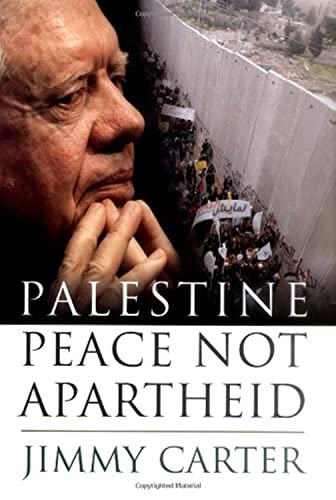
Even before Jimmy Carter's Palestine: Peace Not Apartheid had been published, and while reviewers were still reading the embargoed pre-publication text, the book was making news—and possibly even making some history.
Over the summer months, Carter's view of the Hezbollah war had been broadcast widely. That was, in brief, that the Olmert and Bush governments had been lying in wait to rain destruction upon innocent Lebanon and that an excuse was finally found when a few "militants" had slipped across the border and captured Israeli soldiers. Israel's goal, a Carthaginian peace, had only been prevented when all the nations of the world stood together at the un.
Carter insisted that in expressing these views, "I think I represent the vast majority of Democrats in this country." Then-House Minority Leader Nancy Pelosi, running for re-election, took a different slant: "With all due respect to former President Carter, he does not speak for the Democratic Party on Israel." Leaders of the Democratic Party took out an ad in the Jewish Daily Forward to proclaim that "For 58 years and counting Democrats stand with Israel." Included among pictures of several Democratic presidents was one of President Jimmy Carter standing with Prime Minister Menachem Begin at the time of the Camp David negotiations. The ad brought on angry letters making the counter-claim that Carter, since leaving office in 1980, has evolved into a sleepless enemy of Israel's peace.
Almost as though he were rising to prove this very point, Carter announced his new book, whose four-word title and subtitle, Palestine: Peace Not Apartheid, as everyone immediately saw, could run on the banner under which Israel's enemies worldwide have gathered since the Durban Conference of August, 2001.
Newspapers reported in October that Carter's book was to have been released on November 2, but that the publishers had responded to the panic of the politicians by holding off publication until November 16, a few days after the election. In any case, enough was leaked to make clear that the title of the book did not mislead: Carter had updated the line he has taken for a quarter-century now—that Israel is conducting "a system of oppression, apartheid, and sustained violence," that "Israel's continued control and colonization of Palestinian land have been the primary obstacles to a comprehensive peace in the Holy Land."
The irony is that Carter's book has probably drawn more attention and therefore been more of an issue than if the book had just gone out like other books on the date announced and been bought and wrapped for Christmas for Dad.
Carter is not an anti-Jewish ideologue. His views are not irrational, they are just unbalanced—driven by an unquenchable private need for vindication. He cannot let go of the fact that the only part of his Camp David Accords of 1978-1979 which has lasted (and that just barely) is the achievement of a Peace Treaty and exchange of diplomatic recognition between Israel and Egypt. He proclaimed at the time that the three parties (the United States, Egypt, and Israel) were committed under the Accords to persuade the Palestinians and all the Arab nations to resolve their quarrel with Israel along parallel lines. Because Israeli and American opinion can be affected by the disquisitions of former presidents and because Arab opinion cannot, Carter has been working out his frustration regarding the failure of the larger hopes for "Middle East peace" against the former ever since, seeking to shame us all into setting things straight.
But Carter's Camp David formula was built on a fantasy: that the Arab world's complaint against Israel has to do with geography. The creation of the State of Israel is an intolerable reversal of the judgment of the Prophet Muhammad that, for their refusal to heed his voice, "humiliation and wretchedness were stamped upon them [the Jews] and they were visited with wrath from Allah" (Sura II: 61; cf., Sura III: 112). It is for this unforgivable assault on the credibility of Islam that Israel cannot be permitted to stand.
There is not a word about Islam in Carter's book, except in passing as a benign presence (like the Christian church, here and there) consoling lives lived in the shadow of Jewish oppression. Neither is there any developed attention to the dynamic of terror, except to note in passing that decent people don't do certain things—never naming the names of those who proudly claim "responsibility," thus leaving us with the impression that the failure of decency is evenly distributed. Indeed, it is the Palestinians who are the primary victims of terror, since Israel seizes upon "provocative acts by Arab militants" as excuses for "devastating military response." Admittedly, "Some Palestinians react by honoring suicide bombers as martyrs to be rewarded in heaven and consider the killing of Israelis as victories." Regrettable, but perfectly understandable.
This allusion to "provocative acts" just about uses up Carter's interest in discussing terrorism. What is more interesting to him is Israel's inexplicable practice of locking up "thousands of Palestinians" in its prisons. Indeed, "one of the vulnerabilities of Israel, and a potential cause of violence is the holding of prisoners … [including] the revered prisoner, Marwan Bargouti." (Bargouti is "revered," in case you didn't know, because he is directly responsible for the murder of several Israeli citizens. To Israel it makes sense that he should be a prisoner. To Carter, it does not.) In view of this policy of locking up thousands of people (inexplicable except in terms of some kind of congenital sadism), we are invited to admire the tactical genius which motivates the kidnapping of Israeli soldiers—namely, the reckoning that in the past Israel has exchanged "1,150 Palestinians for three Israelis in 1985; 123 Lebanese for the remains of two Israeli soldiers in 1996," and so on. This passage, in my view, is the lowest point so far in Jimmy Carter's descent into total Chomskyism.
Carter's handle on the Gaza withdrawal of 2005 is consistent with his commitment to never admitting an honorable motive to any Israeli action. The Israelis may have thought that hauling off the Israeli residents, and leaving Gaza to the Gazans, would register with the world as an exercise to reduce the extent of her "occupation." But Jimmy Carter shares Mahmoud Abbas' logic: "Israel is constantly bringing more land under her occupation"—ergo, withdrawing is really a cunning way of expanding. As for the Gazans, Israel intends to "strangle" them.
Carter does not mention those philanthropic Jews who put up millions of dollars in early 2005 in order to meet the needs of a population said to be suffering because of Israeli oppression, transferring ownership and custody of the scientifically advanced, productive greenhouses and orchards—the most advanced facilities of their kind in the world—cost-free, to the local Arabs. The Arab response was to trash everything, carry off all the pipes and equipment and hoses and sprinklers, and then to plant in the garbage dump that remained beds for the missiles which rain down terror over the Negev today. (According to Carter, that Gaza today has no greenhouses and no commerce sufficient to justify opening up the ports for traffic abroad is attributable to Israel's "system of oppression, apartheid, and sustained violence.")
Near the end of the book, Carter pauses to reflect:
It must be noted that by following policies of confrontation and inflexibility, Palestinians have alienated many moderate leaders in Israel and America and have not regained any of their territory or other basic rights. The fate of all Palestinians depends on whether those in the occupied territories choose to pursue their goals by peaceful means or by continued bloodshed.
This is well said. Alas, whatever better angel (or passing whim) inspired that gesture toward seeing the Israeli point of view, it is gone and utterly forgotten when we get to the last page:
The bottom line is this: Peace will come to Israel and the Middle East only when the Israeli government is willing to comply with international law, with the Roadmap for Peace, with American official policy, with the wishes of a majority of its own citizens – and honor its own previous commitments – by accepting its legal borders. All Arab neighbors must pledge to honor Israel's right to live in peace under these conditions.
But this is not the frame of mind of the people who so recently elected Hamas to be their government, and who consistently tell the pollsters, by whacking great margins, that there will never be peace until Israel ceases to exist. The Palestinians are never going to embrace this healthy attitude so long as international voices with the prestige of Jimmy Carter keep up their unrelenting assault on Israel's right to life.
Paul Charles Merkley is the author of Christian Attitudes Towards the State of Israel (Mc-Gill-Queen's Univ. Press) and American Presidents, Religion, and Israel (Praeger).
Copyright © 2007 by the author or Christianity Today/Books & Culture magazine.
Click here for reprint information on Books & Culture.
 Email Newsletter
No comments
See all comments
*