







John H. McWhorter
Cue the Violin
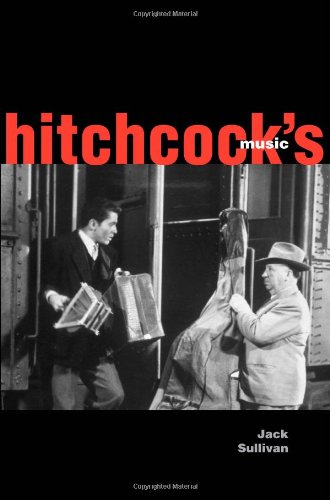
Was Hitchcock a master in his use of music?It's no surprise that Jack Sullivan's Hitchcock's Music, has gotten so much press. The title alone gets anyone thinking about the most searingly memorable wedding of image and music ever filmed. Do I need to specify? The violin shrieks as Janet Leigh is knifed to death in the shower in Psycho.
However, one could reasonably ask what Sullivan was going to fill out the pages of his book with besides that scene. Hitchcock fans may think of the eerie theremin on the soundtrack in Spellbound; then the creeping triplet figure under the opening credits of Vertigo seems to have made a certain impression. But Sullivan is interested in more than these easy scores, as it were. Hitchcock's Music argues that Alfred Hitchcock was especially sensitive to music for a director, and that throughout his oeuvre, Hitchcock applied music in so studious a way as to render it a kind of character in itself.
Despite having always enjoyed Hitchcock, I had never been aware of this as a defining trait of his, and so I took Sullivan's book as an occasion to watch no fewer than 30 of Hitchcock's 50-odd films—that is, all of his films considered to have passed the test of time. (With the exception of The 39 Steps and The Lady Vanishes, I left out the twenty-and-change films he made in England before coming to America, most of which were forgettable programmers, with rather sparse music due to budgetary constraints, as Sullivan acknowledges.) And after approximately 72 hours—no, not continuous!—of soaking in Hitchcock's fusions of story and sound, I judge Sullivan's thesis to succeed only partly.
His argument reminds me of the historiography of Broadway musicals, in which a guiding theme is the emergence of the "integrated" musical: the songs propel the plot instead of stopping it short with snappy but narratively irrelevant "acts." Often, the biographer of a Broadway composer or composer/lyricist team labors under the notion that his subject was uniquely committed to this trend toward dramatic integration: the Gershwin brothers with Strike Up the Band and Of Thee I Sing, Rodgers and Hart with early efforts like Chee-Chee, or later ones like On Your Toes with its narratively pertinent "Slaughter on Tenth Avenue" ballet, Jerome Kern and his collaborators with the Princess Theatre shows and Show Boat, and so on. Yet the truth is that between the wars, various composers converged upon the integrated musical idea, to such an extent that it became the default mode by the early Forties. Theatergoers during this period did not experience any one production as unprecedentedly integrated, regardless of modern chroniclers designating their favorite artists' shows as transformational keystones.
In this vein, Sullivan's descriptions of Hitchcock's music often imply something uniquely insightful on Hitchcock's part in techniques that were standard industry-wide. The techniques of timing, limning the ambiguity of characters' inner thoughts, interweaving themes, and so on that Sullivan describes were less conceptions driven by Hitchcock than the results of a communal development of the art of cinematic music from a period when at first there was none.
Yes, none. In early talkies, there was a conventional sense that music had to be realistic within the bounds of the narrative, such that if a sentimental tone was required for a scene, someone would turn on a radio, or an orchestra playing at a nightclub would suddenly fall into a pretty ballad. The idea of disembodied music just playing in the background seemed odd at first—and it still is, if you think about it. One can imagine an alternate universe in which music in American films was still sparse and "literal," just as in Europe, there never arose a tradition of animated film shorts featuring talking animals wearing gloves.
The Psycho scene is, to be sure, a quintessential culmination of the art of film music as it has become. Seeing it without music, as one can in a Bonus Features segment on the DVD, points this up exquisitely. But over the whole span of Hitchcock's career, the music in his films, while always and utterly professional, would hardly have motivated a book-length study on its own merits.
Make no mistake, there are wonderful musical touches throughout Hitchcock's output. The music for the titles of The Wrong Man is, on the surface, an anodyne bossa nova—but with a quiet touch of discord in one recurring stretch that tells you glum things are in store. In North By Northwest, the trenchant chords that stab the soundtrack whenever one of the pursued looks at Mount Rushmore, knowing that he or she can escape death only by rapelling down, are a perfect musical summation of acrophobia. In Suspicion, the "real" waltz music of an orchestra at a party propels Joan Fontaine and Cary Grant outside, gradually transforming into "abstract" ominous musings—certainly not what the orchestra inside is playing—as the characters come into conflict. Much of the soundtrack music for Marnie is plangently lush, which contrasts quizzically and, ultimately, bracingly with Tippi Hedren's contained, icy protagonist. Similarly in Frenzy, set in London, the music for the opening and for many early exterior shots is stately Elgaresque promenade, which clashes ironically with the grubby low-class goings on that the film will depict, and thus becomes in its way a mocking narrator.
As it happens, three of those five examples, which I chose at random, turn out to be from scores that Bernard Herrmann wrote. What truly motivates a study of "Hitchcock's music" is Herrmann's work, which struck me half of my life ago when I first saw about a dozen of the films, despite being unaware of Herrmann's reputation. Psycho, then, is natually Herrmann; another useful exercise is to watch, on DVD, the opening of Torn Curtain with Herrmann's scoring, and then with the music of John Addison, who replaced Herrmann after he and Hitchcock had a permanent falling out. With Herrmann's music you know you're in good hands: for Torn Curtain he had a clutch of twelve flutes twittering fiercely in dense, ominous harmonies over an orchestra that included eight double basses and nine trombones. With Addison's syrupy score—when Paul Newman lets Julie Andrews know that he is not, as she supposed, a traitor to the United States, the orchestra points this up with purple surges from the string section—we might as well be watching Magnificent Obsession.
But Herrmann actually only wrote seven scores for Hitchcock, all in the late Fifties and early Sixties. That leaves a lot of films, and one problem Sullivan has to dance around is that, however professional or even artistic the scores of many of the earlier American ones were, Hitchcock himself often found them too schmaltzy. Rebecca was an example: the obsessive producer David Selznick insisted on almost wall-to-wall music, including rising strings to signify passion and so on. Hitchcock's Forties scores are full of this kind of thing: as a kindly blind old man does a sentimental solilioquy in Saboteur, the orchestra creeps in with noble-sounding music; the strings surge and shimmer as Ingrid Bergman and Gregory Peck embrace in Spellbound. Such scoring was par for the course at the time, and hence no blot on Hitchcock's genius, but neither can these films be adduced as meaningful evidence of a distinctive gift for marrying music to story.
Sullivan, one senses, intends an argument that, even if bounded by limitations of fashion, Hitchcock was especially masterful in getting the most out of the scores for his films. But this is persuasive only if we willfully forget what the state of the art was for film scoring when Sullivan discusses a particular film. From Sullivan's presentation one might almost forget that Max Steiner and Erich Korngold existed, for example. It is also unclear to me that composers who worked with Hitchcock came up with scores distinctly more artful than their normal standard. For example, is Alfred Newman's work on All About Eve really small potatoes compared to his work on Hitchcock's also-ran Foreign Correspondent?
Another questionable argument is that the singing and playing of music had an unusual pride of place in Hitchcock's films. Okay, Hitchcock was clearly a more musical soul than John Ford. But in an era before high fidelity recordings, more people played instruments and sang, period. And what about Frank Capra: Jimmy Stewart and Donna Reed singing "Buffalo Girls" in It's a Wonderful Life, Essie dancing to Ed's xylophone in You Can't Take It With You, Frank Sinatra doing "High Hopes" in A Hole in the Head (despite it not being a musical)?
Ultimately, Sullivan is driven into forced argumentation by his format, which is to describe the scoring in every single Hitchcock film year-by-year. The truth is that more than a few of the films— the wan screwballer Mr. and Mrs. North, for example—simply do not merit musical discussion; The Birds has no music at all, while Rope only has music under the opening credits and one character playing that theme on the piano now and then. Yes, the scores that Hitchcock got out of Bernard Herrmann are indeed art for the ages. And some Hitchcock fans may well enjoy listening to the Late Romantic chocolate-box scores of Rebecca, Spellbound, and Notorious. Still, as to whether all of Hitchcock's scores taken together are a cut above normal Hollywood scoring, my verdict was neatly illustrated at a bookstore appearance by Sullivan that I attended.
Someone in the back asked Sullivan to discuss the score of Bell, Book and Candle, and had to be gently reminded that Hitchcock didn't direct the film. (The confusion was understandable: Bell, Book and Candle starred Jimmy Stewart and Kim Novak, the very same year they starred in Vertigo.) Next question.
Meanwhile, however, I was thinking about how much I'd always enjoyed the scoring in Bell, Book and Candle: sneaky, jazzy but contained, revolving around a neat, Pink Panther-like motif, pointing up the action without overwhelming it, and at times nicely interlaced with "literal" music by a jazz combo. One could pen a perfectly legitimate chapter analyzing the artistry of the score's composer.
Who was, get ready, one George Duning, a house composer for the meat-and-potatoes Columbia studio, whose status in the composer firmament is indicated by the fact that while the celebrated Franz Waxman scored the classic Mister Roberts, it was left to Duning to do the honors for the unmemorable sequel Ensign Pulver. Yet workaday, unsung Duning managed the utterly deft and amiable score for Bell, Book and Candle. Often, what Sullivan praises Hitchcock for in lengthy detail was otherwise known as professional competence.
Especially having made my way through 30 Hitchcock films in six weeks, I salute Sullivan's having viewed all 50-plus multiple times. It must also be mentioned that Sullivan makes ample reference to original score materials and the story behind the composition of each score, which often essentially means a description of the making of the film, material that is in itself almost always interesting.
I will value Hitchcock's Music as a neat reference book on each and every Hitchcock score. Yet it will continue to be the seven scores by Herrmann—who conveyed Henry Fonda's terror of imprisonment in The Wrong Man by putting a mike on someone plucking on the lowest strings of a grand piano—that draw my rapt attention. In that very selective preference, I suspect, I have plenty of company.
John H. McWhorter is a senior fellow at the Manhattan Institute. He is the author most recently of Winning the Race: Beyond the Crisis in Black America (Gotham Books). Among his other books is Defining Creole(Oxford Univ. Press).
Copyright © 2007 by the author or Christianity Today/Books & Culture magazine.
Click here for reprint information on Books & Culture.
 Email Newsletter
No comments
See all comments
*