






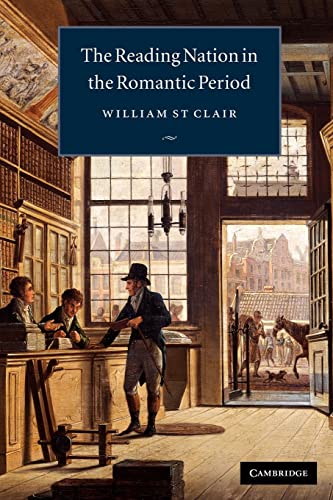
The Reading Nation in the Romantic Period
William St Clair
Cambridge University Press, 2007
796 pp., 62.99


The Intellectual Life of the British Working Classes
Jonathan Rose
Yale University Press, 2003
544 pp., 25.00
Timothy Larsen
Reading Habits
Ah, to have been a reader two centuries ago, in a golden age of English literature. Or so we think. But the thrust of William St. Clair's The Reading Nation in the Romantic Period is quite different. St. Clair has done prodigious research to drive home his thesis that in this "golden age," books were largely inaccessible to ordinary people. Moreover, the real enemy of the common reader was the book trade. One bitter author from the early 19th century told the story of God endeavoring to find a London publisher for the Bible. The first one the Almighty approached "disliked the mangers and carpenters, wanted the characters to be made aristocratic, and asked for the story of King Herod and Salome to be expanded." The next one offered to print it on a vanity publishing basis.
In the Romantic period, St. Clair explains, the English book trade was committed to positioning new literary texts on the costliest end of the spectrum, thus restricting sales to a tiny élite. A typical new book would have cost a maid six weeks' income. This strategy reached its zenith with William Wordsworth's The Excursion (1814). For the price of that book (48.5 shillings), a person could buy one hundred fat pigs. One man bought his own printing press and thereby set himself up in business for the same amount as this single volume of contemporary poetry!
Such an arrangement was no gift to authors, who, not surprisingly, generally wanted to reach a large audience. At such a price, Wordsworth's book did not sell out its first edition for fifteen years, thereby holding back a cheaper version that might have reached the reading nation. Not a single copy of Wordsworth's book was sold in his own home county of Cumberland. Even an aristocrat such as Lord Dudley felt he could not afford first editions. Publishers often destroyed copies that they could not sell at the list price rather than risk destabilizing the high-price atmosphere by discounting them.
The result of such machinations by the London book trade was that the canonical Romantic authors did not reach nearly as wide a public as we would suppose. And the price of their books wasn't the only barrier. Publishers were extremely conservative about what they accepted. Both Lord Byron and Jane Austen, for example, suffered rejection by publishers before they achieved fame. Mary Shelley's Frankenstein was turned down by all the major firms. Still, she was a success compared to her husband, the great poet Percy Bysshe Shelley, who was reduced to vanity publishing.
Authors now enshrined in the Norton Anthology were undervalued by their contemporaries in other ways as well. As a national depository, Cambridge University Library was entitled to a copy of every book published. Nevertheless, it disdained to collect items deemed beneath its dignity, and thereby refused books by Austen, Byron, Shelley, and Wordsworth. In a lifetime of writing and lecturing on contemporary literature, William Hazlitt never found a reason to mention any of the novels of Jane Austen. In one of numerous delightful asides, St. Clair observes that under British law at that time a man could have been hung for stealing a copy of Wordsworth's The Excursion, "although there is no record of anyone taking the risk."
Occasionally the high-minded publishers' stranglehold on copyrights was broken. The courts declared that a copyright could not be enforced on immoral literature. This act of censure had the ironic effort of releasing these texts to the masses in endless cheap editions from downmarket publishers. While Shelley's mature work languished in overpriced volumes with minuscule print runs, his youthful indiscretion Queen Mab was by far his most read work. Byron's Don Juan became a wildfire bestseller in the same manner. This bifurcation was so stark that whole lives of Byron produced by the "respectable" publishers of the day "omit all mention of the fact that he had written the most widely read long poem of the century." (These risqué offerings prompted the poet laureate, Robert Southey, to pontificate that Byron and Shelley represented the "Satanic School of poetry." The devil, however, has an urbane wit: Byron prophesied that Southey's Joan of Arc, An Epic Poem would be read "when Homer and Virgil are forgotten, but—not till then.")
At least in the Romantic period the reading nation had access to out-of-copyright material. In the high monopoly period from 1710 to 1774, everything was under copyright. The first publisher to print a text, however long ago it had been composed, held the copyright in perpetuity. A publisher would suddenly secure exclusive rights to a medieval Christmas carol such as "The Holly and the Ivy." Shakespeare's plays were taken away from the people and hoarded for the few who could afford pricey editions. St. Clair combines these two illustrations in order to offer his own intriguing contribution to Shakespearean studies. He suggests that in the original texts of the plays, whole popular songs were often included, but, as these lyrics were now under copyright, the practice developed of giving only a brief fragment of the song in the printed versions of the plays.
Reading therefore actually declined during the so-called Enlightenment. Again and again, St. Clair calls us to see that economic realities were behind trends that we often attempt to analyze as if they merely reflected the intellectual or literary interests of society at that time. So, for example, we might assume that when the vise-grip of the London book cartel was loosed in 1774, the moment had finally come to produce canon-forming edited volumes. Unfortunately, at this historic juncture, the interests and vagaries of the publishers trumped critical assessment. The most important canon-forming collection of the era, Samuel Johnson's The English Poets (1779), was not the result of the discerning choices of its eminent ostensible editor, but rather a publisher's ragbag.
So what literature did the reading nation actually have access to during the Romantic age? The evangelical tracts of Hannah More were widely disseminated. With the entrepreneurial spirit characteristic of the movement, More co-opted the chapbook (cheap book) network of traveling booksellers who sold inexpensive publications to the poor. We have on record the testimonies of many who were inspired by these edifying tales. On the other hand, free paper was a useful resource in its own right: "The chapmens' insistence from the start that the tracts should be printed on soft paper, rather than the smoother book paper favoured by the promoters, suggests that they were all well aware of the ignoble fate to which they would soon be consigned."
Above all, readers in the Romantic period devoured Sir Walter Scott, as did their Victorian successors. Scott circulated faster than office gossip. Even leaving aside the novels, more of Scott's poems sold in a normal afternoon than those of Shelley, John Keats, or William Blake during their entire lifetimes. Another quirk caused by market realities was that, as America and Britain did not have a copyright agreement, the common reader in America was a generation ahead of the English public in discovering England's romantic poets. (Likewise, as Jonathan Rose observes, plebeian readers in Britain were discovering the great American novelists faster than England's professional literary critics.) But both countries had Sir Walter Scott as the staple of their reading diets. Leslie Stephen, the Victorian intellectual who edited the Dictionary of National Biography and fathered the novelist Virginia Woolf, read aloud to his family all 32 volumes of Scott's Waverley novels—and then started over again.
St. Clair argues that such a diet was bad for a nation's health. He wishes that the book trade would have allowed a more varied fare to be on offer. When the Romantic poets came out of copyright in the late Victorian period and became ubiquitous, it still meant that the populace-at-large was being sustained on stale bread rather than manna for their day. Scott's works and the popular narratives of writers such as Byron, St. Clair avers, were perfectly suited to foster a culture that glorified war, admired conquest, and aspired to chivalric militarism and honor. Following Mark Twain, St. Clair posits that such reading nurtured the mentality that led to the American Civil War. In Britain, the result was World War I. His case is vigorously asserted but persuasive only with so many qualifications as to render it nugatory. Still, the historical detective work St. Clair has done stands on its own as a magnificent achievement.
Jonathan Rose extols the virtues of the old canon. It is my earnest wish that everyone would find some book somewhere out of which they would derive as much pleasure as I have done in reading The Intellectual Life of the British Working Classes. While St. Clair skillfully exposes how powerful forces have conspired against the common reader, Rose celebrates those working-class autodidacts who found their way to knowledge and culture despite substantial obstacles.
It is easy to forget what a struggle mere access once was. There were no state schools in Britain until 1870. Thirty years on, in 1900, the majority of state schools still did not have a library. No, manual laborers and their families could not look to the government to educate them; they needed to gather resources on their own. Many of them did just that. Rose brilliantly evokes a rich working-class culture of self-education. One needs to read every detail presented in this example-filled study to appreciate the depth and breadth of this achievement.
Welsh coalminers, for example, created a formidable intellectual culture among themselves. The Tredegar Workmen's Institute built up a circulating library of 100,000 volumes. When an economic downturn led to massive layoffs during the 1920s, out-of-work miners in Ynyshir were reading, on average, 86 books annually. Likewise, during the labor shortage created by World War I, companies would entice and retain workers by providing educational and cultural lectures for their employees. John Edwards found that his real education began down in the pit, where he learned from other miners about the ideas of Herbert Spencer, Charles Darwin, and Karl Marx. When he first heard of some poetry by George Meredith, he went to the miner's library to check out the volume, only to discover that there were already twelve people on a waiting list for it.
A middle-class visitor was stunned to overhear two miners discussing Einstein's theory of relativity. Another recalled a worker who would cheer himself up after losing a game of billiards by rehearsing the philosophical theories of George Berkeley. The man who spent a portion of his weekend year after year systematically collecting fossils from the mine's rubble heaps exemplifies a multitude of ordinary people thirsty for knowledge. Ironworkers would sing opera choruses together while on the job. Striking miners would give vent to their feelings by declaiming lyrics from Handel. Laborers would name their children after their favorite classical composers: "in one family there was a Handel, Haydn, Elgar, Verdi, Joseph Parry, Caradog, Mendy (short for Mendelssohn) and an unforgettable Billy Bach, together with an only daughter Rossini (called Rosie for short)."
Certainly there were limits to their reading. Typically the only time they read about sex was in the performance of their religious duties. One man finally got his hands on an illicit volume famed for its raciness when he served as a soldier abroad, only to discover that "it did not come within shouting distance of certain passages in the Old Testament, once you got the hang of Biblical language." For family devotions, specially expunged Bibles were devised: "if Mrs. Potiphar did not disappear entirely, her agenda was left unclear."
But Rose has no patience for the charge—exemplified by Matthew Arnold's patronizing remarks during the Victorian age and echoed by many commentators up to the present day—that the culture of Welsh chapelgoers was narrow and stifling. The Scriptures opened up lush and beautiful terrains; the Bible was great literature that inculcated habits of appreciation for great literature. As one working-class man eloquently recalled: "It is true that our fathers, in Wales, taught us religion of cast-iron dogma, which, according to all the theories, should have made us obscurantists, inhabiting a very small world.But it did not. In some mysterious way we became freemen of a spacious world … . I defy any child of ordinary intelligence to read the Bible constantly (in the Authorized Version) without acquiring a genuine literary taste."
If the book trade is the common person's foe in St. Clair's telling, Rose excoriates modernists such as the Bloomsbury Group, who flattered themselves by sneering at plebeian efforts to gain knowledge and culture. In a memorable image, T. S. Eliot depicted the clerks who commuted across London Bridge as the living dead, perhaps projecting his own state of mind on "the masses." By contrast, Rose gives us a glimpse of Edwardian clerks who were profoundly alive intellectually. Neville Cardus, a junior clerk for a marine insurance agent, recalled how he and his workmates would stay up afterwards eagerly discussing their frequent forays into London's cultural scene: "We never went straight home after a new play by Shaw, after Gerontius, after the A flat symphony, after Kreisler had played the Elgar violin concerto for the first time, after Tristan, after Strauss's Salome with Aino Akté in it." One office boy raised in poverty poetically expressed his own delight in learning:
For me has Homer sung of wars,
Aeschylus wrote and Plato thought
Has Dante loved and Darwin wrought,
And Galileo watched the stars.
The pretensions of modernists led them to make obsolete the learning of working-class autodidacts. So you are familiar with all the novels of Dickens? Well then, his works must not matter. What working-class people had tenaciously learned on the margins of their days was dismissed as the wrong kind of learning. Working-class readers were knocked to the floor by Hardy's Jude the Obscure and E. M. Forster's Howard's End, novels which brutally asserted that their efforts to better themselves were not only futile but also self-destructive. The fate of Forster's character, Leonard Bast, was a kind of grotesque wish-fulfillment for Bloomsbury snobs, who wanted to put plebeian autodidacts in their place. In Forster's none-too-subtle scenario, Bast is literally crushed to death by books.
So too the modernists' self-consciously "difficult" art kept the masses at bay: stream-of-consciousness novels, experimental music, and the like. Rose's work crescendos toward a passionate indictment and lament: now there is always a self-anointed intellectual élite (made up largely of climbing academics) determined to replace the old canon with a new one of their own devising, while the common people keep doggedly in pursuit. Eliot and Forster mocked the clerks of their day and befuddled them with modernist offerings, but today's clerk "assumes that a modern painting ought to look like a Jackson Pollock." Virginia Woolf gets blithely assigned to high school students, and so now a new canon must be conceived—or the old one filtered through some impenetrable theory: "When modernism became mass culture, the avant-garde had to move on to something more modern still—postmodernism, which strove to recapture the opacity and difficulty that once cloaked modernism."
In a particularly cruel irony, the intelligentsia now asserts its status by reveling in popular culture and championing marginalized groups, all the while excluding the lower classes more thoroughly than ever. Only 3 percent of those who attended the Institute for Contemporary Arts in the 1980s, Rose reports, were from the working classes. Theory-laden academics have spread the disinformation that the classic canon is "bourgeois" and thereby "rendered the common reader illiterate once again."
The culture that Rose celebrates has largely disappeared. Some individual workers still drink from deep wells, but it is not likely that their workmates will be able to finish a speech from Shakespeare they have begun to declaim or join in when they strike up a refrain from Puccini. To be sure, this state of affairs is not entirely the fault of trendy academics. Still, it is worth lamenting, and workers who remember the old days are captured in this volume doing just that. One of them complains that while people read trash in his youth as well, as least back then they knew it was trash. It is as if they are saying: Eliot, if you only knew what a real wasteland looks like.
Timothy Larsen is McManis Professor of Christian Thought at Wheaton College. He is the author most recently of Crisis of Doubt: Honest Faith in Nineteenth Century England (Oxford Univ. Press), and he is at work on a book about the Bible in the 19th century.
Copyright © 2008 by the author or Christianity Today/Books & Culture magazine.
Click here for reprint information on Books & Culture.
 Email Newsletter
No comments
See all comments
*