






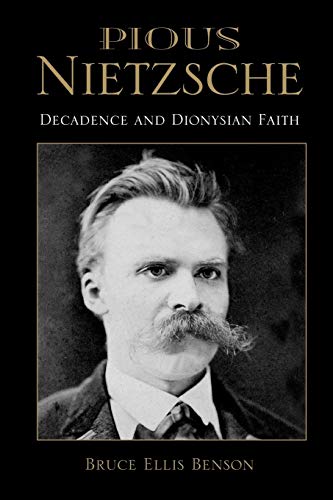
Pious Nietzsche: Decadence and Dionysian Faith (Philosophy of Religion)
Bruce Ellis Benson
Indiana University Press, 2007
296 pp., 24.95

Stephen N. Williams
Was Nietzsche Pious?
Dionysian faith.Nietzsche again?" Nietzsche professionally studied chorus in Greek tragedy, but never heard a wail quite like this. If the question does not sound forth in choral harmony, it is certainly uttered by a multitude of voices. The phenomenon of "Nietzsche again" gives rise to bewilderment, consternation, and exasperation on the part of the many who see his name everywhere and do not know why. In (dulcet or otherwise) antiphonal response, we may warble that the justification for attending to Nietzsche lies in his sheer influence, regardless of our judgment on the quality of his thought or on various particulars of Nietzsche interpretation. If we do not find him intellectually momentous, at least we might call him a momentous event in intellectual culture.
It is true that attending to him primarily on account of his influence tends to inflate or, at least, perpetuate interest and to reinforce, and not simply to acknowledge, the status quo in Nietzshean investigations. Be that as it may, Nietzsche remains big business. We might expect anything to emerge from it, but presumably there yet remain innocent souls in our world who will be surprised to find a pious Nietzsche amongst its products. Still, Bruce Ellis Benson has produced him in Pious Nietzsche: Decadence and Dionysian Faith . That is tendentiously put, for Benson aspires not to forge an image of his subject in the furnace of intellectual construction but rather to describe the authentic Nietzsche. How does he do it?
The argument in this volume is that Nietzsche retained his native Pietism. He was brought up in a Pietist home and broke away from the beliefs which it housed, but he did not thereby cease to be religious or pious. He aspired to become a disciple of Dionysus, a devotee of Life, of which Dionysus is the symbol. This determination to pursue a way of life is rightly called "piety" when we observe the continuities between Nietzsche's background Pietism and his later quest. His Pietism was a way of life rather than a set of doctrines. The form remains where the content changes. In pursuit of what changes, Nietzsche sought out a musical askesis. Benson explores this carefully. Askesis is a form of spiritual exercise in self-transformation. It is not identical with asceticism, which carries connotations of bodily denial. It is affirmative of bodily life as well as negative toward spiritual sickness and the enemy of decadence, also carefully explored by the author, which Nietzsche self-consciously fought in himself. Music was a vital and central force in Nietzsche's life, but for those Greeks whom Nietzsche so loved and to whom he was so indebted, it was a far more basic force than we tend to imagine when we hear the word "music." For Nietzsche, music forms the soul; it effects a profound spiritual formation. As far as he was concerned, once he had shrugged off the baleful influence of Wagner, music assumed its proper office of fostering spiritual health and cheerfulness, which is to say, a form of life. Pietism was a heartfelt way of life. In sum: Nietzsche sought to know, follow, pray to Dionysus, god of Life, through a musical askesis, and, in doing so, he transplanted a form of Pietism onto the soil of Dionysus or, better, cultivated the apparently alien form of Dionysus on the soil of native Pietism. He may not have succeeded in overcoming his childhood Pietism. But it is what Nietzsche was about, even if he did not fully know it.
Benson's volume is interestingly written and clearly argued. Both very broadly and on many points of detail, the thesis is cogently delivered. It is tempting to suppose that it is only a slight exaggeration to say that no two readers of Nietzsche are likely to be agreed about very much in Nietzsche interpretation. However, this reviewer, like the author, is impressed by Lou Salomé's insistence on the religious force that drove Nietzsche's thought.[1] Whether by deliberate design or by virtue of the cumulative force of his study, Benson conveys the pathos of Nietzsche's mental collapse in the light of what he interprets as his religious quest, even if he is bound to be, as he admits, speculative and suggestive at this point.
It seems to me that this work is also problematic on at least two different and significant counts. The first difficulty lies in the argument that Nietzsche experienced some kinship with Paul. In general, Benson argues plausibly the prima facie case that, if Nietzsche opposed particularly fiercely those with whom he felt some sort of affinity, and if this clearly seems to apply to Socrates and Wagner, then it is likely to apply to Paul. But he is unable to show successfully how it does apply to Paul. We need far more analysis to show that there is mileage in the contrast between Nietzsche's attack on Paul's distortion of the gospel and an attack on Paul's theological belief in a context where we are also told that Nietzsche holds Paul responsible for inventing Christianity by coming up with his peculiar interpretation of the death of Christ. Discussion of Nietzsche's interpretation of Paul shades into the author's own theological remarks on law (drawing on Slavoj Zižek), a topic at the heart of Nietzsche's engagement with Paul:
While it seems far too much to say that God's strategy is to "seduce Adam and Eve into the fall, in order to save them," Zižek's point that the law has almost a kind of perversity to it seems hard to escape. The logic of forbidding is that of creating a temptation.
But this is mistaken. For one thing, in the context of Benson's argument, it conflates law in the form of a prohibition in Eden with a dispensation of law originating at Sinai. However, suppose the argument is refined to allow for differences. Zižek's claim, to which Benson is in a measure sympathetic, misses the theological point. There is no perversity involved in instructing the child not to put his or her hand in the fire. That is surely a major component of the logic of prohibition in the garden. To be created human was, ipso facto, to be placed in a position of choice; God did not superimpose on the human scene an extraneous law. James (1:13-14) succinctly states a theology of temptation, a small-scale hermeneutic of Eden. There is no need to suppose that Paul would have taken issue with the theology of law implied here. In this connection, and more generally, I confess that I am surprised when readers of Nietzsche occasionally find impressive, even if mistaken, his reading of Paul.[2]
The second difficulty is that a question goes unanswered: what difference does it make whether or not we regard Nietzsche as pious in Benson's sense or religious in any sense? It surely strains language beyond what is permissible to describe the mature Nietzsche as a kind of theist, but I shall not pause here to quarrel over language or, for that matter, to analyze types of Pietism and therefore the language of "piety." Nietzsche is called pious in this volume because of certain structural similarities between his Dionysian faith and Pietism, abstractly considered (the latter is shorn of its Christian content). Possibly Nietzsche was "pious" in a sense arrived at by (relative) abstraction; possibly Nietzsche should be called "religious" in some non-trivial sense of that word. But what does it matter? What exactly do we forfeit if we refuse to call him "religious" or "pious"? Benson may well be able to argue that it matters a great deal. One can surmise how he might. However, he does not do so. So we are left wondering what the exact significance is of his discovery of a pious Nietzsche. Is it principally (or merely) a historical-interpretative thesis, a proposal that we should do well to think of Nietzsche under the rubric of "piety"? Or is it more, a kind of (broadly) theological thesis, a hint that, if a superficial atheism turns out to be an ersatz religion, it matters a lot that we see, describe, and call it as such?
Nonetheless, this is a rewarding study. Nietzsche was in many ways his own man, a distinctive individual. Yet so much seems either to coalesce in him or to coexist in him precisely without coalescing, in terms of forces that make for contemporary intellectual culture, with all their swirling cross-currents, that he is worth trying to understand. Karl Jaspers observed that "in the end one cannot help but ask how a man who is by no means representative can still become as overwhelmingly significant as though he spoke for humanity itself."[3] Perhaps this remark puts us on the trail of answering the question of why our discovery of a pious Nietzsche might matter. If so, Bruce Benson will prove to be a helpful guide along that trail.
Stephen N. Williams is professor of systematic theology at Union Theological College in Belfast. He is the author of The Shadow of the Antichrist: Nietzsche's Critique of Christianity (BakerAcademic).
1. This rather remarkable woman's account is found in Nietzsche (Univ. of Illinois Press, 2001).
2. Benson refers to "an interpretative move" by Nietzsche which "is brilliant," though he makes clear that he regards it as wrong-headed. Morgan Rempel is particularly prone to this in Nietzsche, Psychohistory, and the Birth of Christianity (Greenwood Press, 2002). See Stephen N. Williams in New Nietzsche Studies, Vol. 7, Nos. 3&4 (Fall 2007 & Winter 2008), pp. 171—73.
3. Karl Jaspers, Nietzsche: An Introduction to the Understanding of His Philosophical Activity (Univ. of Arizona Press, 1965), p. 16.
Copyright © 2009 by the author or Christianity Today/Books & Culture magazine.
Click here for reprint information on Books & Culture.
 Email Newsletter
No comments
See all comments
*