






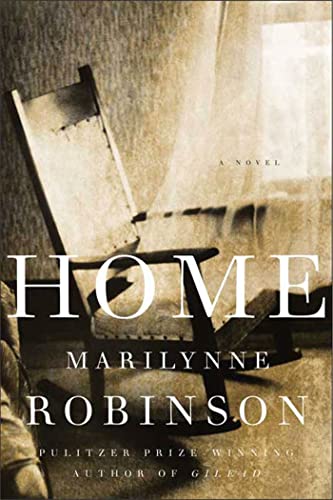

Reviewed by Linda McCullough Moore
Marilynne Robinson at Large Again
A sequel—or a companion—to Gilead, a very different book and just as astonishing.What do you give a woman whose treatise on the plutonium content of the Irish Sea can put your family off eating fish in Wales for life? A woman who makes you feel you're missing something if you don't read John Calvin every morning before breakfast, or rethink Darwin, or sleep with your shoes on and maybe hop the occasional freight train, perhaps compose a 250-page letter to your small son.
I say give that woman pen and paper. Then stand back. Or better yet, approach, but with some caution. She will lull and woo you, and before you know it you are out in the middle of the night with your oddest aunt shivering in a leaky boat in very scary water, and not long after, setting fire to the curtains in the parlor, the last word in housekeeping. Housekeeping, Marilynne Robinson's first novel, a book that warned us not to be surprised if one day she wrote books like Gilead and now her latest, Home. To read Marilynne Robinson is to enter into an agreement. I say be careful what you sign. Read the small print. Her characters can move into your living room, take up residence in silences and shadows, their triumphs and discomforts come unbidden at the oddest times. Her thoughts can make camp in your mind.
Pastor Tim Keller says you need a God you can disagree with. I think we need writers we can disagree with. Writers with positions and attitudes—yea, attitude—and dare, I say it, beliefs (oh dear!). And if Robinson's beliefs are not always my own, they help me to consider just what mine might be and why, and give a free home demonstration of definition playing out across a lifetime, blessing its bearer and the souls life brings to him.
For all of her conviction, Robinson is not a desperate writer. She doesn't over-describe or explain or try to convince you of anything. Gertrude Stein said she wrote for herself and for strangers. I think Marilynne Robinson writes for herself. Every worthy writer does, write for that self, that stranger, familiarly strange. She tells her story—it's all any writer has to tell—but because it's true, there is a place inside of it for us. A story about everybody is a story about no one. She makes you think that, happy or not, every family is different. And so, every family is just like yours.
But you'll be wanting now to know about the plot of this new novel. A man, Jack Boughton, comes home—yes, to Gilead—to his father and his sister, Glory, after twenty silent years away. He gardens, fixes the car, visits the neighbors, and goes to church a couple times. Then goes away again.
And if this Jack Boughton is the Prodigal, he's one whose father slaughters not the fattened calf, but any hope of lasting ease. The Prodigal whose older brother traveled six times to St Louis to search the sorry streets for him. But Robinson would have Jack be more Lazarus than Prodigal, Lazarus "with the memory of cerements about him," no matter he is washed and shaved, his hair slicked down, dressed up in a suit he has dry-cleaned with dabs of gasoline. Lazarus who wishes they'd all stop studying him, stop falling silent when he walks into the room. He's Lazarus, not Saul or Paul, not Simon Peter, not even Thomas. His story isn't from the Gospels or the Book of Acts so much as it is from an older testament.
He's Abraham—he's told—abandoning his Ishmael; he's Caleb and Joshua still thinking things possible even after forty years of wandering in the desert. He is David, his sin ever before him, still, man after God's own heart, rehearsing questions about the sins of the fathers being visited on sons. Jack is Jonah telling God: I fled because I feared your mercy; he's Moses, stuttering: God, Please! Pick somebody else. He is Joseph, father-favorite, given a coat of many colors woven out of expectations—that he be happy, happier perhaps than his father ever managed to be. If there is a balm in Gilead, the relationship of this brother Jack with this sister Glory, and in the end with Reverend Ames, would suggest the balm to be a thing as rarefied and fine as friendly feeling,that friend-love that does not need you to be successful, or remarkable, or particularly serene. His sister: young Miriam. His godfather: Elijah, telling Elisha it's God who runs the blessing department.
It's all been told before. But that's the point. The story's old. All stories are. We do not read for that. We read to know just what we are to make of the stories we already know. We read to ask how are we, knowing what we know, expected to get out of bed tomorrow morning. To stay alive till then. Some days to flourish.
Robinson can be a gentle writer, soothing even, but always in the service of an enterprise that in another hand might have us in the stock and pillory. She's come to talk of things that matter, let us not pretend. Mercy, grace. Truth and wisdom. And sorrow for our sin. Sin, perhaps defined as our intention to believe our substitutes will see us through. And yet, and yet, I show you a better way. In this writer's hands, good people can be good with fear of neither masquerade nor tedium. Her saints are kind as they are intelligent. A dying father says his anticipation of the prayers of gratitude and rejoicing he would pray on the day his prodigal came home gave him joy for twenty years. Robinson's men—yes, men—refuse ironic immolation with a soft-spoken, pleasing ease. (I want to use the word old-fashioned, though I know full well that goodness never was in vogue. True courtesy, hard to abide.) And here, rogues and villains practice righteousness, refuse to lie. Robinson writes of a redemption that redeems our dogged compromise, our tawdry imitations.
There's no fit way to encapsulate the beauty of Robinson's language, the lyricism born and bred in earnestness, the brilliance of her understanding. Choppy quotes are clunky. Not that that will stop my trying.
Robinson would have us know things. Have us know forgiveness precedes not follows understanding. Forgive, she says, and "you will be ready to understand, and that is the posture of grace." She paints with tiny brush strokes, showing "Sympathy [that] would corrupt something wonderful, which secrecy and a kind of shame kept safe." She tells us of a God who "lets us wander so we will know what it means to come home."
She'd have us laugh out loud, with the preacher's treating salvation as if it were "a problem that had been sorted out between the Druids and the centurions at about the time of Hadrian," adding that "The doctrine of total depravity had served him well." And later, she has his children studying "deracination … angst and anomie," done "with the earnest suspension of doubt that afflicts the highly educable."
Robinson knows and does not fear to tell us what a thing a family can be, with the burden of "their endless, relentless loyalty." The parents with the hope their son would not be lost to them. "The one hope I couldn't put aside." says the father who doesn't ask for much, only everything, only wanting every day forever "the childish happiness they'd offered to their father's hopes."
This writer knows old age. The joke seeming to be that once very young, now very old, having been the same day after day, people at the end are somehow so utterly changed. Looking back on being young, the old man says, "it's like remembering that I used to be the sun and the wind." Now, his hair "brushed into a soft white cloud, like harmless aspiration, like a mist given off by the endless work of dreaming," he sleeps on. And finally he knows something like peacefulness with the "extinction of that last hope, like a perfect humility undistracted by the possible." And always memory. Standing in the sunlight "the wind hushing in the dusty lilacs of their childhood, laundry swaying on the lines where school clothes used to hang."
But it is Jack whose story breaks our hearts, as it surely should. We are made to understand the stark lunacy it is to think that he would one day get to know his family, come for Christmas, as though parents and siblings were only people. We see Jack with his sister "whiling away perdition together," reading to his sleeping father, his voice "courteous to the page he read from." Jack, laying out his alternatives to a slight by the Revered Ames as either confronting him, leaving town in a huff, or else "the only undamaging choice left to me. Which might also have the look of virtue, I believe." To forgive. As he prepares to go away again, he has "fallen back on estrangement, his oldest habit," the injury to him that "all of them were native to their life as he could never be." He experiences "none of the trust that sustained the most ordinary conversation."
What is the soul? his sister Glory asks. "It's what you can't get rid of." His reply. When she would assuage his pain, he tells her, "Let me get used to things the way they are. That's the biggest favor you can do me." Finally, the last morning, he seems to be "withdrawing into utter resignation, as if the old incandescence had consumed him before it flickered out."
Marilynne Robinson is in a category by herself, and that category is both fully staffed and up to any project. I hope this is gratuitous, but if you haven't read the essays in The Death of Adam, neither sleep nor eat till you have remedied the oversight. Her first novel Housekeeping is what I think a book should be. And now writing in Home of the same people in the same time and place as in her Pulitzer Prize-winning novel Gilead, everything is different. These two books could not be less alike. And just because she can and perhaps must, Robinson has pages and pages of dialogue about theology here, people sitting on the porch as evening falls, discussing and dissecting the particulars. The reader slows his pace, he doesn't want to miss a word. Theology as conversation. She's pulled off the impossible. (I know whereof I speak.)
In all her work we have the writer as magician. She's making a concoction of her own invention, and if she doesn't know if it will turn the one who drinks it into a fairy princess or blow the place to smithereens, well, those are risks she is prepared to take on our behalf. Perhaps that hints at her distinctive. She has been the sort of reader in her life who knows the possibility of writing. She takes nothing lightly, but there is lilt and charm for all of that. She can be light precisely because she knows the stakes are high, because she has cared enough to take the measure of the thing. And, she has the requisite humility to say, "There are things worth believing."
So then. How to end a tribute so deserved? Why, the only way that makes any sense at all. To copy out the final sentence from this book, to speak aloud the words and hope to live in what they mean. Her last word:
The Lord is wonderful.
Linda McCullough Moore lives and writes in Northampton, Massachusetts, once home to Marilynne Robinson.
Copyright © 2008 Books & Culture.Click for reprint information.
 Email Newsletter
No comments
See all comments
*