






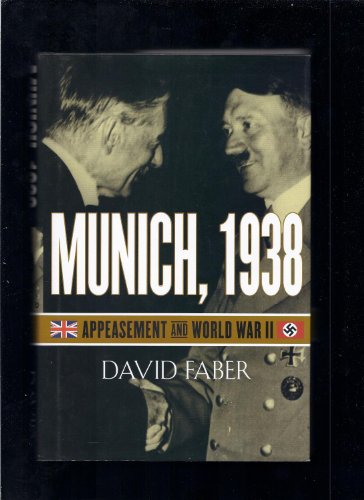

Reviewed by Joseph Loconte
"A New Era of Friendship and Prosperity"
How "compromise" with Hitler was achieved—and at what cost.On August 26, 1938, British Prime Minister Neville Chamberlain dispatched a letter to every member of his Cabinet, most of whom were on holiday, summoning them to Downing Street to discuss "recent developments in the international situation, with particular reference to Czechoslovakia." The recent developments were relentlessly grim. Nazi Party operatives were stirring up violence in the Sudetenland, the ethnically German area of Czechoslovakia, as a prelude to annexing the region. Czech leaders were becoming increasingly embittered by British diplomatic pressure to submit to the effectual conversion of the Sudetenland into an independent Nazi state. Hitler's military preparations were reportedly in full swing. The Treaty of Versailles, which had imposed strict limits on Germany's military and territorial claims because of its role in the Great War, was beginning to unravel.
The Conservative Prime Minister was determined to quash any mood of militarism that might arise within his Cabinet. "No State, certainly no Democratic State, ought to make a threat of war unless it was both ready to carry it out and prepared to do so," he told them. Britain was grotesquely unprepared for war. Nevertheless, Duff Cooper, First Lord of the Admiralty, asked for a partial mobilization of the fleet. Chamberlain rebuffed him: "It was very important not to exacerbate feeling in Berlin against us."
After a three-hour meeting, that supreme objective was achieved—momentarily. "There was to be no change in policy, no new diplomatic initiative, and no warning sent to Berlin," writes David Faber in Munich, 1938: Appeasement and World War II . "No decision had even been taken as to what Britain's response should be if Germany did indeed attack Czechoslovakia." Yet Chamberlain got exactly what he wanted—Cabinet support for a scheme to avert war at any cost. Thus Europe's tortuous descent into a policy of appeasement was complete: a diplomatic delusion that triumphantly delivered Czechoslovakia into Nazi hands, setting the stage for Hitler's lightning assault on Europe.
Faber, a former Conservative MP, recounts the details of Britain's capitulation to Hitler with an extensive use of diaries and notes from political leaders, diplomats, and their inner circles. The crucial weeks leading up to the Munich Pact—in which Britain, France, and Italy traded the territorial integrity of Czechoslovakia for a German promise of peace in Europe—are familiar territory. Hitler pledges that "this is the last territorial claim I have to make in Europe." France, which had signed a treaty of mutual assistance with Czechoslovakia, insists that its obligations "are sacred, and cannot be evaded." Chamberlain returns to London waving his paper agreement with Hitler and declaring "peace for our time." Yet although we know the outcome all too well, Faber's account is far from superfluous. His richly detailed and tightly paced narrative sheds light on how the betrayal of a democratic ally in the cause of peace, despite all evidence to the contrary, became thinkable.
One of the fascinating subplots of Faber's retelling is how the British press abdicated its role as watchdog and slavishly supported government policy. When Anthony Eden, one of the few hawks in government, resigned his post as Foreign Secretary, most of the press sighed in relief. The Daily Mail praised Chamberlain's "realism and sound common sense" against his detractors. Winston Churchill, Eden's ally and a Conservative backbencher, was distraught: "There seemed one strong young figure standing up against long, dismal, drawling tides of drift and surrender, of wrong measurements and feeble impulses," he wrote. "Now he was gone." With few exceptions, the national papers continually sought to downplay Hitler's growing belligerence, or excused it by faulting the punitive Treaty of Versailles. The Times even extolled the "advantages to Czechoslovakia of becoming a homogenous State"—that is, becoming dismembered by German occupation. Faber's work suggests that we need a fuller account of the British media's ideological collusion with pacifists and political powerbrokers.
Faber's description of the euphoria that followed Chamberlain's diplomatic initiative still rattles the senses. King George VI praised "the magnificent efforts of the Prime Minister" and expressed hope that "a new era of friendship and prosperity may be dawning among the peoples of the world." The Pope sent Chamberlain a cross. President Roosevelt's message was brief but congratulatory: "Good man." The press was almost universally uncritical, especially The Times: "No conqueror returning from a victory on the battlefield has come home adorned with nobler laurels than Mr. Chamberlain from Munich yesterday." In the days following, Chamberlain received over 20,000 letters and telegrams from a thankful nation and equally grateful allies. The House of Commons, after cheers and sustained applause, approved the government's policy by a vote of 366 to 144.
Not even Faber's meticulous narrative can fully explain the dissolution of moral and political will in Britain in the prelude to Munich. His story would be strengthened by a brief summary of the pacifist mood that infected the democracies after the Great War. In 1928, fifty-nine nations signed the Pact of Paris, pledging to abandon war regardless of the threats to international security. In 1933, the year Hitler became chancellor, students at the Oxford Union passed a resolution declaring "that this House will in no circumstances fight for its King and Country." Franklin Roosevelt, who gladly signed into law America's "Neutrality Acts," sounded roughly the same theme in a 1936 speech: "We shun political commitments which might entangle us in foreign war. … We seek to isolate ourselves completely from war." It was, in the words of W.H. Auden, "a low, dishonest decade." The idea of degenerate democracies took hold and informed the architects of terror.
Perhaps the most satisfying aspect of Munich, 1938 is how it weaves into its story bright reminders of those few individuals who, without the benefit of hindsight, nevertheless judged correctly the monstrosity of Munich. Most of them were reluctant hawks; all could easily remember the devastation of the World War I. Faber rightfully draws attention to these dissenters—including Anthony Eden, Duff Cooper, Leo Amery, Harold Macmillan, Sir Robert Vansittart, and, of course, Winston Churchill. "We have suffered a total and unmitigated defeat," Churchill told the House of Commons days after the Munich Pact. "And do not suppose that this is the end. This is only the beginning of the reckoning. This is only the first sip, the first foretaste of a bitter cup which will be proffered to us year by year unless … we arise again and take our stand for freedom as in the olden time."
Britain would take its stand for freedom. But it did so only after the shock of Hitler's absorption of what remained of Czechoslovakia, six months after Munich, in March 1939. The Czech foreign minister, Frantisek Chvalkovsky, had flown to Berlin to try to stave off a German invasion. Hitler warned him that it was "useless to cherish any hopes" of help from Britain or France. Neither government gave the Czech leader any reason to believe otherwise. "There was no resistance," writes Faber, "and, for the Wehrmacht, the occupation of the rump of Czechoslovakia represented little more than a routine training exercise." A statement from the Czechoslovak government put the matter squarely: "We had no other choice, because we were left alone." The betrayal of Czechoslovakia, instead of averting war, had made a prolonged and global conflagration virtually inevitable.
The transcendent tragedy of Munich is that it all might have been averted. The Czech frontier defenses were considerable, but once the country's borders were redrawn they were taken over by the Germans. The French Army, with a promise of help from Great Britain, might have held off the German advance. Hitler's generals, in fact, feared this outcome. Thus, when Roosevelt asked Churchill what the new conflict should be called, he replied immediately: "the unnecessary war."
Faber is content as an historian to chronicle the disaster of Munich, not to speculate about its implications in the post-9/11 era. Others, though, will wonder whether the world has learned the lessons of Europe's "catalogue of surrenders" to tyranny and terror. There are uncomfortable echoes of dictators who warn democracies not to "meddle" in their internal affairs. There is the ascendancy, and moral ruin, of realpolitik. The performance of the British press seventy years ago should give pause to contemporary media élites.
The central lesson of Faber's chronicle, the truth neglected today by many liberals and conservatives alike, is especially pertinent: that a political regime can become irretrievably wicked, and that accommodating such a regime only feeds its rapacious and murderous ambitions. "Our enemies are small worms," Hitler told his generals in the summer of 1939. "I saw them at Munich."
Joseph Loconte is a senior research fellow at The King's College in New York City and the editor of The End of Illusions: Religious Leaders Confront Hitler's Gathering Storm.
Copyright © 2009 by the author or Christianity Today/Books & Culture magazine.
Click here for reprint information on Books & Culture.
 Email Newsletter
No comments
See all comments
*