







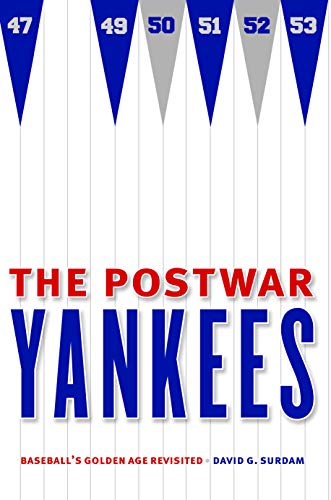
The Postwar Yankees: Baseball's Golden Age Revisited
David George Surdam
University of Nebraska Press, 2008
438 pp., 49.99

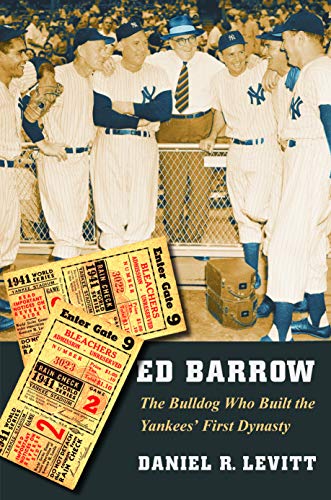
Ed Barrow: The Bulldog Who Built the Yankees' First Dynasty
Daniel R. Levitt
University of Nebraska Press, 2008
456 pp., 29.95
Michael R. Stevens
Kingdoms Rise and Kingdoms Fall
Baseball preview, 2009 edition.As I write, the last days of spring training are upon us, and I wish I had a better reason for waiting until the eve of Opening Day than mere procrastination. Perhaps it was the World Baseball Classic that held me in its grip, except that I barely know what happened, other than the Netherlands making a move on the rest of the baseball world with a drubbing of the conflicted Dominican team. Or maybe my delays this spring were rooted in the distractions of following my local teams in the newspaper, and that would smack of at least a half-truth. I have read daily cryptic statements in the Grand Rapids Press from Tigers manager Jim Leyland about the woes of his physically and psychologically brittle pitching staff and, more recently, of his dismay at the release of veteran slugger Gary Sheffield, with whom Leyland has carried on a close mentorship over the years. Can baseball manager spring training quotes get any better than Leyland's rumination about his troubled night before breaking the news to Shef? "It's not good when you light up two Marlboros at 3 a.m. You know you've got something on your mind." Furthermore, my beloved local minor league team, the West Michigan Whitecaps (low-level A ball in Tigers system) have made national news with the unveiling of a massive, 4,800 calorie, $20, "meant for a family of four but if you eat one yourself you get a T-shirt" ballpark burger, to be served at the home park this summer. My 11-year-old son already has sought approval for the purchase and consumption of one—do tweens ever undergo bypass surgery? Bill Veeck and all the baseball showman-entrepeneurs of yore would be proud; the shtick of baseball is alive and well, if only in the minor leagues.
Alas, to glance at the major leagues these days is to see a more somber landscape, and perhaps that's at the root of my dawdling. I've become anxious that this grandest of all games has a damaged heart, of a sort and severity comparable to what a steady diet of four-pound cheeseburgers could do to a person's cardiac health. The heart disease of baseball is a loss of respect for the game—its history, its scrappy brand of battling, its demands and grudging rewards. And steroid injections and growth hormone creams and amphetamine-boosted coffee urns and astronomical salaries and interstellar-style distances between fans and players are all part of this problem, but none is the root of the problem. There's a worldview crisis even deeper down. But how does one locate this dark force? It is somewhere in the tension, the bifurcation, the duality of baseball as sport nonpareil, but also as economic and business construct ad nauseum. And, as much as I hate to admit it, the most obvious place to ponder this tension is in a place very close to my own heart—in the history and character of my team, the New York Yankees.
For years, I've figured that John Wilson allowed me to do this preview each season in spite of the fact that I was a self-professed Yankees fan. But this year, he seemed to be offering me a genial favor by asking me to review not one, not two, but three books about the Yankees, all at once, an embarrassment of riches! Alas, the experience has been far from exhilarating for me; indeed, it has been troubling, stirring up forebodings rooted in baseball's past and lurking in the present and future. Even if we could set aside A-Rod's apparent wooing of Madonna, about which I will withhold all comment (except Why????!!!), and his inexplicable willingness to allow a cousin from the Dominican to inject into his buttocks a mysterious island concoction called boli—even if we could forget that circus, the Yankees would still be under a particular spotlight this spring, because of the publication of The Yankee Years, a quirky book by former manager Joe Torre, now with the Dodgers, and Tom Verducci of Sports Illustrated. I approached this text with the proverbial mixture of horror and fascination that any tell-all book invites, but the shape of it took me by surprise. Oddly written not as an autobiography but with Torre referred to in the third person, the text feels very historical, a document of a team's rise and fall, and of the travails of baseball as a whole.
And the first hundred pages are, to the Yankee fan, elegiac indeed—anecdotes of the grind-it-out championship teams of '96, '98, '99, and '00 provide the paradigm by which Torre and his first wave of players succeeded: "A desperation to win." Paul O'Neill 's throwing of bats when he left men on base, Derek Jeter refusing to get X-rays or take a day off with a broken hand, David Cone pitching best at the end of the season, beat up and worn down and fearless—these are the players that Torre learned to trust and love, his warriors. Indeed, "trust" is crucial in the Torre vocabulary, just as "warrior" and "fighter" and "grinder" are his highest words of praise. Of O'Neill, Torre says, "he was a great soldier." Cone makes Torre think of "fire and brimstone, the stuff that kept their furnace burning at peak capacity." Speaking collectively of those core players who brought home the four world championships, Torre says, "They were good and they knew it and they worked at it. They worked at it. They were a bunch of grinders." The occasional bad apple, like the slovenly leftie David Wells, could be tolerated in such a context, could even be challenged to achieve, precisely because the ethos of the team created an undergirding for fragile egos. Even Torre's dealing with the infamous Boss, Yankees owner George Steinbrenner, is cast in a surprisingly sentimental light, and not just in the years of World Series glory. Whether because of Torre's candor or his unflappability, he seems to have forged with this most demanding and fickle of employers an odd measure of mutual respect and, yes, trust. Only in recounting the later years, the period of Steinbrenner's declining health and the oligarchic rule of his sons and sons in law, does Torre wearily acknowledge an utter breach of trust, enacted in spite of the Boss than because of him.
This latter phase of Torre's career with the Yankees, which takes up the lion's share of this book, makes for a story as disheartening as the first part is inspiring. Verducci offers a lengthy transition section on the explosion, first under the radar and then in ugly exposure, of the Steroid Era. Of course, figures such as Roger Clemens and his personal assistant (and hence Yankee employee) Brian McNamee played a huge role in this scandal. I've pondered why this section of the book depressed me so sharply. It's not just the rampant performance enhancement (we've all know about that for awhile) but also the disingenuous naivete offered up by so many players in the midst of this bastardization of the game. Verducci captures well the implications for us as fans, and does so with Torre's key phrase in mind, when he notes that "The Steroid Era was baseball's Watergate, a colossal breach of trust for which the institution is forever tainted." Seeing the truth there, feeling the weight of the analogy, I want to resist and resurrect the baseball of yore, the integrity of Roy Campanella and Phil Rizutto and Preacher Roe. But the stain won't go away.
Despite all the scandal and censure of the performance enhancers, that alone didn't take the shine off of Yankee baseball in the second half of Torre's run in New York. Deeper issues, having to do with increasingly fragile player psyches, increasingly selfish player behavior, increasingly rationalistic and statistical GM work—all of these forces chewed away at the legacy Torre helped to foster, until he himself was chewed up and all but spit out in the process.
The tragedy played out in the bulk of this book is against the backdrop of that early trust and those early grinders and warriors. The parity in the league brought about by the "think-tank culture" of high-tech, sabermetric baseball executives like the A's Billy Beane and the Red Sox Theo Epstein (and eventually the Yankees own Brian Cashman) is cast as a dehumanizing, even despiritualizing force in the game. Sure, Epstein helped construct a Red Sox team that finally tore down the Yankee mystique, but he did so with a good measure of imitation thrown in—he picked up a foundering David Ortiz and made him an everyday grinder, and found in Curt Schilling the warrior ace who could own a post-season. Ironically, Cashman's decision to increasingly imitate the statistically savvy modes of Beane and Epstein led to the dissolution of his tight and fruitful relationship to Torre.
The jettisoning of Bernie Williams, one of Torre's original warriors and a cog in all four Yankee championship teams, finds Torre playing Plato to Cashman's Aristotle: " 'Cash, listen,' Torre said. 'I don't know how long we're going to be together. But do yourself a favor: never forget there is a hearbeat to this game.' " The heartbeat—yet another heart allusion, and it won't be the last!—pinpoints the emotional, intuitive, simple but not simplistic style of baseball which Torre embodies throughout the book, in his earthy rebukes of players, his bluntness with Steinbrenner, his fierce trust and loyalty. By contrast, the new wave of Yankee free-agent acquisitions after the final World Series win in 2000 reveals a set of players who, amidst their many technical and interpersonal flaws, suffer from an endemic lack of heart. Torre makes this clear especially with the pitchers who become his bane. Of the talented, tantrum-prone Kevin Brown, a high-paid bust: "He never was a fighter. He never wanted to fight you. Neither was Randy Johnson, for that matter." Johnson gets a further, more nuanced critique from Torre late in the book: "He never took the ball and said, 'All right, guys. Follow me.' You never had the feeling that was what you were going to get" (330). Of Carl Pavano, he of the four-year, $40 million contract that produced exactly 26 starts, Torre could barely mask contempt: " 'The players all hated him,' Torre said. 'It was no secret.' " Mike Mussina, who pitched for the Yankees through this same era, and who comes across as pleasantly candid in the book, says that the term "the 15 Day Pavano" had come to replace "the 15 day disabled list" in Yankees parlance! Not all problematic players receive such censure from Torre; for instance, he says of Gary Sheffield, with whom he clashed many times, "He was a team player. He finished a couple of games at third base for me, when we had to take guys out and move people around. He was willing to do anything. He'd even catch. 'I'll do anything,' he told me. He came in one day and brought in a VHS tape of when he caught in Little League. He was a great teammate. He was just inconsistent with his moods."
The archetype would thus be the grinder with the even keel, the warrior with the zen persona, and Torre had two such players (who incidentally brought along Hall of Fame talent) in Derek Jeter and Mariano Rivera, players who bridged the two halves of Torre's run, both the feast and the famine. Verducci sets the table when he says that "Jeter's talent and confidence helped make him a great player right out of the box. It was his humility and desire to win above all else that made him a great teammate and a manager's dream." Indeed, Torre found in Jeter many of the central virtues by which the heart of the warrior might be measured: " 'Jeter was such a big part of what we established,' Torre said. 'I filled him in on what we needed to have done. He would literally commit to it. I wouldn't say buy in. He would commit to do something. He trusted me to the point where he knew what was important." What emerges in Torre's encomium to Jeter is a sketch of the inner quality of the warrior-player, the deep moral quality, if you will. If this is augmented by tremendous ability, it is a unique confluence, but ability alone can never mimic it. Hence, Alex Rodriguez's confusion, mentioned many times in the book, about why Jeter is revered more highly when he, A-Rod, has the superior talent, statistics, and even work-ethic. Torre pinpoints A-Rod's myopia with characteristic bluntness: " 'His goal was to be the best player in baseball,' Torre said. 'He was very much aware of what was going on elsewhere in baseball. He seemed cluttered up with these things." In the hierarchy, such motivational clutter is clearly better than self-serving absenteeism or moody dysfunction, but it can never be enough to make one a warrior, and ultimately a champion. It can never replace heart.
If I've skipped over some of the details of Torre's contract disputes with the Steinbrenner entourage, it is only to avoid tediousness, since there, too, the variations are all on the theme of trust. The same Joe Torre appears to have been at work in all 12 seasons with the Yankees, his approach rooted in a mingling of respect and professional accountability and trust among his players and coaches and with the organizational administrators. The turning of comedy into tragedy would indicate that the offer of trust is not enough—it must be embraced and reciprocated, by the right sort of players, the right sort of owner (yes, even the Boss!), in the right sort of sublimation of parts to the whole, of individual wills to the collective will to win. If the Yankees of the Torre era are a test-case, then we might have to grudgingly and grievingly admit that all of baseball suffers from a breach of trust that will be long-lived and hard to heal. Grinders of the world unite, or at least sign up for tee-ball and Little League—we need you!
By way of clarification, some of the forces that Torre and Verducci identify in their diagnosis of the diseases afflicting baseball are not of recent invention. True, HGH kits in the lockers and $10 million signing bonuses and 24/7 media coverage weren't part of the fabric of the game half a century ago, but David G. Surdam's The Postwar Yankees: Baseball's Golden Age Revisited reveals disconcerting trends afoot five and six decades ago, with ramifications reaching right into the contemporary game. If Torre's narrative of the recent Yankee juggernaut is a roller-coaster of laudatory praise and sharp rebuke, Surdam (a professor of economics at Northern Iowa) offers a sharp downward gaze at the supposed Golden Age of baseball (1946-1964), and the deleterious role of the Yankees in that illusory world. Like A.N. Wilson's deconstruction of the seemingly cohesive Victorian Age in God's Funeral, Surdam's revisionist account reveals in occasionally murky economist's prose that baseball was troubled in its structures and business habits even in the midst of its supposed finest hour. This book is not for the faint of heart; the writing is thick with statistics and particulars, culled in spheres as obscure as average concession incomes at the various stadiums through the era (this and other charts grace the massive statistical appendices). It is a quirky narrative, but the connections between the issues facing baseball now and those of a half century ago are startlingly clear. Surdam outlines the challenges at mid-century, such as competition with the rising NFL for fans, aging stadiums with inadequate parking, the mixed blessings of revenue sharing, the controversy and covetousness involved in franchise relocation, the crap shoot known as the amateur draft, and the cartel philosophy by which baseball owners ruled their unique and politically protected business interests. Not much seems to have changed. Not only have baseball's economic riddles not been solved, but they've escalated and proliferated. One strand of Surdam's copious research that took me—a supposed devotee of baseball history!—totally from the blindside was his account of the attempts by Branch Rickey and William Shea (both of estimable National League fame, before and after this cabal) in the late 1950's to form a "Continental League" as a third wheel on the major league machine, taking advantage of a prospering cities passed over by the tight MLB clique. Though the league never formed (and was indeed blocked by Congressional hearings and MLB harping about a dearth of playing talent), its aspirations to move into cities like St. Paul, Dallas, Houston, Denver, Miami, San Diego, and Toronto proved prescient. The shrewd MLB owners began their expansion into such markets , and managed to find the players whose absence they had lamented in derailing the new league. (Sadly for all Upstate New Yorkers—I am one by birth and upbringing—Buffalo remains to this day among those cities named oft and anon as bridesmaids, never to become the bride of a Major League Baseball franchise.)
Surdam's final sections ponder why the Yankees declined so steeply after the 1964 World Series, and I couldn't help comparing his observations with the second half of the Torre book—did these Yankee falls from glory have any similarities? Yes and no. In both cases, it seems, the tremendous success of the Yankees spoiled the competitive edge to which up-and-coming teams cling. The public perception of a cold and impersonal machine seems to have plagued the Yankees in both eras, and a lack of innovation (represented in the late Fifties by the failure to sign black players, and in the last decade by the failure, until recently, to groom young, homegrown players) allowed other teams to catch up. What is Surdam's final observation, then, in his deconstruction of the Golden Age and his case study in the Yankees incipient decline? His conclusion would likely get a world-weary nod from Joe Torre: "The Yankees may continue to win a disproportionate share of titles, but past experience suggests that it may not be in their interest to overdo it."
One other book to mention, stepping back yet another generation in the annals of Yankees lore, is Daniel R. Levitt's Ed Barrow: The Bulldog Who Built the Yankees' First Dynasty. Like Surdam's book, this is a product of that devoted source of all-things-baseball, the University of Nebraska Press. Raised in the Wild West context of late 19th-century baseball, Barrow was more like P. T. Barnum than like Billy Beane for the first half of his career, as he ran diverse and sundry independent league teams. (Anticipating Bill Veeck, Barrow once featured a female pitcher, and heavyweight champ John L. Sullivan served as a guest umpire in several 1898 Atlantic League games.) With characteristic verve, Barrow ended his run with the 1902 Toronto Baseball Maple Leafs by dealing a faulty umpire (not the heavyweight champ, thankfully!) "a thump on the jaw and a solar plexus blow," after which "the fans surged onto the field."
From these this rough-and-tumble forays at borders of the baseball establishment, extending to the ill-fated Federal League of the World War I era, Barrow emerged as the somewhat over-the-hill manager of the powerful 1918 Boston Red Sox, featuring a 23-year-old pitching ace named Babe Ruth. It was Barrow who began Ruth's transition to an everyday position player, in order to maximize his obvious skill with the bat. But it was only after he followed Ruth to the Yankees that he reached his true calling, creating our modern conception of that crucial baseball role, the general manager.
Torre's warnings to his own GM—"don't forget that this game has a heartbeat"—echoed in my mind as I read Barrow's story. If you get below the surface of the pre-Golden-Age-Golden Age of the Twenties and Thirties, you start to feel that Machiavelli might have fit in as a GM, perhaps working for the Faustian Connie Mack with the Athletics. We hear of Barrow that, "To pressure players into signing, [he] worked his newspaper contacts to portray holdouts to the club's advantage." He wasn't alone in the shady stuff, as we find out that "A possible rival for the Yankees' financial and on-field dominance in the 1920s and 1930s, the New York Giants were forestalled by the legal troubles of New York Giants owner Charles Stoneham, a backroom operator who today would almost surely be in jail." But were these tactics any different from the hectoring by Brian Cashman and the Steinbrenner entourage that Torre laments? Could it be that there has always been a tension in baseball between the business side and the game side, between the head and the heart, between money and meaning? For Ed Barrow, the man who developed Babe Ruth into an everyday player, who signed Gehrig and DiMaggio and Casey Stengel and a host of Yankee legends, perhaps the heartbeat still sounded, albeit dimly in the GM's, then the team president's, office. If Branch Rickey could say of him, "That fellow sitting across the table is the smartest man who ever was in baseball … . He knows what a club needs to achieve balance, what a club needs to become a pennant winner. I, perhaps, can judge the part, but Mr. Barrow can judge the whole," well, it's hard to argue with the Mahatma. Yet, one would perhaps prefer the "inferior" Branch Rickey—the man who dared defy all the logic and pressure of the cartel to sign Jackie Robinson and change the very heart of baseball and of America—to the great Ed Barrow, architect of a dozen world champion teams.
But my quarrel with the game must end for now, at least at the philosophical level, because I need to turn to the pragmatic realm, and predict the outcome of the 2009 season. At this moment, at the cusp of the new year on the greensward diamonds of thirtyodd cities, anything is possible. The Phillies are the reigning champions, for crying out loud! And the lowly Devil Rays still own the American League pennant for a few months more. I have been singularly unsuccessful in my picks the past few years, but we must not give up hope. Instead, I will move away from logic in my choices, and allow my baseball heart to lead me. So, starting in the NL West, I cannot help but pick the Joe Torre-led Dodgers, and hope that somehow, someway my longtime nemesis Manny Ramirez becomes the grinder and warrior he was always meant to be. San Francisco will lose 90 games, and still the aged New Yorkers who rushed across the Polo Grounds in anguish in 1958 will not be assuaged. San Diego and Colorado will just have to be happy that their cities were once part of the Continental League master plan. As for the Diamondbacks, it's time for a pendular downswing. Let's talk NL Central—my heart, formed in the crucible of love for the 1970s Yankees, says follow Lou Pinella and his Cubs all the way to the Promised Land, even though Lou refused to look up in the stands when my big brother's Little League team visited the Stadium 35 years ago and shouted to him incessantly. Wait, my heart says that will cost the Cubs in a tight race—and hence I like the Reds here, if they end up signing an aging warrior who will enjoy a surprising comeback. If you say Houston Astros to me, or St. Louis Cardinals, or Milwaukee Brewers, well, my heart isn't leaping (though I wouldn't mind seeing Rick Ankiel, the Cardinals version of Babe Ruth in his power-hitting outfielder converted from pitcher role, hit 59 dingers and drive in 171 runs, as Ruth did in 1921). I follow the Pirates only to find out how their young center fielder/grinder Nate McLouth, a local boy from Grand Rapids, is doing. Out NL East way, I say the Phillies have another run in them, and hence the Dodgers/Reds/Phillies thing makes it seem like the mid-Seventies in the National League again, which has the hue of boyhood and baseball idealism for me. My heart feels no twitter for the Washington or for Florida. The Mets, where Gary Sheffield landed—well, my wife's heart leaps for them, or at least used to, when, in her Long Island girlhood, she once wrote a love letter to Ron Darling—but I digress. Well, for Linda's sake, I'll give the Mets the wildcard. The Dodgers will tilt with the Mets in the divisional round, in a redux of the wild 1988 playoff series, and again the Dodgers will prevail. We'll call the Phillies-Reds series the Pete Rose-Joe Morgan reunion tour, with the Reds stunning everyone by a sweep, both here and against the Dodgers in the NLCS.
The American League is my psychic dwelling place, but I find it hard to care about the AL West. I like none of the teams out there, and a quick heart-check tells me Seattle, Oakland, and Anaheim raise not a single jolt of excitement. The Angels are dangerous—Vladimir Guerrero isn't finished—and they had a great spring. On the other hand, they've lost K-Rod and their glue player, Garrett Anderson. I guess that leaves the Rangers, so … I'll go with Angels to take the division. In the AL Central, I'd love to go with my adopted home team, the Tigers, but I know too much about their struggles to put a starting rotation together (though watch 20-year-old Rick Porcello, who's made the team as the fifth starter—there's nothing like a young gun to fire up a staff). The White Sox are good, the Twins are good, the Indians are really good. But I'm registering nothing toward them in the heart category, even with a stethoscope. So, I'll go with Kansas City, the little guy, the scrapper, the city abandoned by the diabolical Charlie Finley, the team with a batch of young speedsters and slap hitters, who can torment opponents, but alas, without solid pitching, can't win much. This year, the pitching solidifies and they win 90 games. The Tigers get a best-case-scenario from their pitchers, and take the wildcard. Now, out in the AL East, a big ugliness is brewing. The Yankees need a year or two more of rest and recovery (as per Surdam's final advice in his book), and the Devil Rays will find the grind of another long race too taxing on the young roster. Somehow, Theo Epstein's reign of Benthamite empiricist terror will implode in Boston, but his indie-rock band will flourish and Epstein will remain in the public eye. Toronto—again, wasn't the Continental League mention enough? That leaves Baltimore, a city once mocked by White Sox demagogue Charlie Comiskey—"Baltimore is a minor league city and not a hell of a good one at that"—but a sanctuary for the fugitive St. Louis Browns in one of the most successful relocations in major league history. It's the St. Louis Browns my heart leaps for, the lowly Browns, the team that the Yankees used as a glorified farm squad during the Golden Age. The Baltimore Orioles have had their successes in each of the past four decades, but it will be the Browns this year who are the ultimate victors. Orioles management, if you're reading this, follow my advice and immediately create St. Louis Browns throw-back uniforms to work into your seasonal attire! The Orioles/Browns will survive a brutal challenge from the Tigers in the divisional round, then take on the Royals, who will have squeaked out 3 one-run wins against the Angels. And here the Brownie magic dies out, as the Royals grind out a six-game ALCS victory.
The Royals, like last year's Devil Rays, will confound baseball analysts and anyone who has a stake in large market teams succeeding, but who cares. It will be Royals-Reds, the World Series that should have been back in the mid-Seventies, if the Royals hadn't lost several pennants in a row at the hands of the Yankees. Reds vs. Royals, a Fox TV revenue nightmare, a series with literally no household names, with George Brett and George Foster getting more recognition in the luxury boxes than the players on the field. But we will get to see some grinders in action, some young warriors on the field, low-budget players, castaways, rookies, journeymen. With the absence of stars and "stories," we'll get to concentrate on baseball being played with urgency, with desperation, with a heartbeat—and that's why we still love the flawed and finicky game. And, oh yeah, the Royals in seven. When logic is suspended, anything can happen!
Michael R. Stevens is associate professor of English at Cornerstone University in Grand Rapids, Michigan. With his Cornerstone colleague J. Matthew Bonzo (assistant professor of philosophy), Stevens is the the author of Wendell Berry and the Cultivation of Life: A Reader's Guide, recently published by Brazos Press.
Copyright © 2009 by the author or Christianity Today/Books & Culture magazine.
Click here for reprint information on Books & Culture.
 Email Newsletter
No comments
See all comments
*