





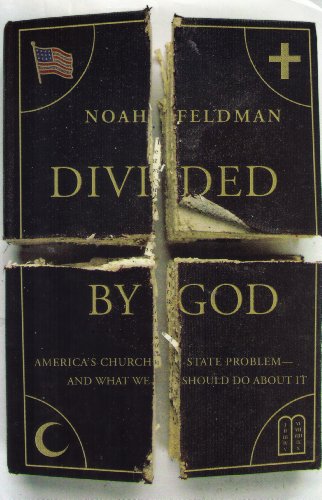
Divided by God: America's Church-State Problem--and What We Should Do About It
Noah Feldman
Farrar, Straus and Giroux, 2005
320 pp., 25.25

Reviewed by Thomas C. Berg
How Wide the Divide?
A proposal for compromise between "value evangelicals" and "legal secularists" on church-state issues.This past summer's split Supreme Court decisions on Ten Commandments displays, and the public reaction they provoked, shows that the nation remains deeply divided over the proper relation of religion and government. Noah Feldman, a New York University law professor, insightfully traces the divide between religious traditionalists (whom he calls "values evangelicals") and "legal secularists."
In Feldman's terms, values evangelicals (who include many Catholics, Jews, and Muslims) contend that public policies in America must be guided by the values—especially the shared values—of our leading religious traditions. Secularists, on the other hand, see religion as a private matter, which if allowed to intrude on the sphere of government will divide rather than unite us.
Legal secularists enlisted the Supreme Court in the 1970s, as the justices banned official prayers and Ten Commandments displays from the public schools and simultaneously forbade the government to aid parents who sent their children to religious schools. But these developments galvanized values evangelicals, whose political efforts indirectly helped appoint new justices less committed to "court-mandated secularism" (Feldman's terms). The 1990s Court more and more allowed the inclusion of religious schools in voucher and other government aid programs.
But values evangelicals have not fully succeeded, for the above cases hang by a single vote—that of the now-departing Justice O'Connor—and the Court has actually strengthened its ban on religious speech and symbolism by government, as in the recent Ten Commandments case from Kentucky. Feldman argues that neither side can fully prevail in the battle over religion in public life. Unity cannot be achieved entirely by religious values—which are too frequently not shared—or by the secularist exclusion of religious values, which simply excludes Americans of serious faith.
Feldman proposes a compromise designed to reduce America's religious divisions: "offer greater latitude for religious speech and symbols in public debate, but also impose a stricter ban on state financing of religious institutions and activities." His approach, the opposite of the Court's recent direction, would recognize religious values through symbolic means, thereby appealing to values evangelicals, but discourage state support for separate religious schools, thereby appealing to legal secularists.
Feldman's diagnosis is insightful and convincing; his prescription, more questionable. First, his overriding concern to manage religious division—understandable for someone who has worked on Iraq's new constitution—overlooks other central concerns of our church-state tradition. Founding-era leaders such as James Madison and Baptist preacher Isaac Backus emphasized maintaining the integrity and vigor of religion by keeping it separate from government. They thought that religion would thrive—and affect society more deeply—if it reflected free choices by individuals rather than promotion and favoritism by government officials.
Feldman's proposal to reinstate bans on funding would arguably lead us away from the ideal of religious choice. Parents would once again be denied assistance because they chose religious schools, a discrimination that discourages that choice, especially for low-income parents. Vouchers covering a wide range of religious and secular schools increase individual choice (although one may legitimately be concerned about the regulations that accompany voucher aid).
Conversely, government prayers and religious displays, which Feldman would allow, raise significant concerns about the integrity of independent religious institutions and ideas. The government selects one or two religious messages or symbols it favors, usually watered-down versions based on majority sentiment. Official prayers are reduced to vague commonalities between differing faiths; municipal crèches are surrounded by plastic reindeer and are used to further the commercialization of Christmas.
Feldman's compromise might also fail in its own goal of reducing religious controversy. Voucher programs do potentially create disputes—for example, is a school's teaching so anti-social that it should be ineligible?—but banning religious-school funding pushes everyone (except the wealthy!) into a single set of institutions, the public schools, where people then seek to impose their (inconsistent and incompatible) values. The results are emotional disputes over prayers, Christmas carols, intelligent design, sex education, and countless other issues. By contrast, school choice programs allow families to send their children to schools that more closely reflect their varying views.
To fellow Christians, I would argue that issues such as Ten Commandments displays in the courthouse and prayers at football games should not receive near the emphasis they do today. We do far more to preserve the vigor and independence of faith-based activity by fighting for strong rights under the First Amendment's Free Exercise Clause—an issue Feldman's book sidesteps—and by assuring that the state does not discourage families from the choice of a religious school by denying them otherwise-available education assistance.
Thomas C. Berg is professor of law at the University of St. Thomas School of Law in Minnesota. He is the author of Religion and the Constitution (with Michael McConnell and John Garvey, Aspen Publishers, 2d ed., forthcoming 2006); The State and Religion in a Nutshell (West Publishing, 2d ed., 2004); and more than 50 journal articles on religion, law, and society, as well as nearly 30 briefs in religious freedom cases in the Supreme Court and lower courts. In 1996 he received the Religious Liberty Defender of the Year award from the Christian Legal Society. A longer version of this review will appear in a forthcoming issue of the Christian Lawyer magazine, published by the Christian Legal Society.
Copyright © 2005 Christianity Today. Click for reprint information.
Related Elsewhere:
Divided by God: America's Church-State Problem—And What We Should Do About It is available from Amazon.com and other book retailers.
More information is available from Farrar, Straus, and Giroux.
More about author Noah Feldman is available from his page at New York University School of Law.
More CT articles on church/state issues are available from our Politics & Law page as well as our Ten Commandments page.
For book lovers, our 2005 CT book awards are available online, along with our book awards for 2004, 2003, 2002, 2001, 2000, 1999, 1998, and 1997, as well as our Books of the Twentieth Century. For other coverage or reviews, see our Books archive and the weekly Books & Culture Corner.
Books & Culture Corner and Books & Culture's Book of the Week, from Christianity Today sister publication Books & Culture: A Christian Review (want a free trial issue?), appears regularly on Tuesdays at Christianity Today. Earlier editions include:
Poet with Three Heads Talks with King Solomon | Conversation touches on Hebrew parallelism, marriage, and the making of many books. (Aug. 30, 2005)
With God on Our Side | David McCullough's account of the pivotal year 1776 has resonance for Americans in 2005. (July 19, 2005)
The Rich Are Different—and Not So Different—from Us | Think you're burned out on memoirs? Read this book. (June 28, 2005)
A Grief Observed | Exploring the valley of the shadow in two literary lives. (June 13, 2005)
The Mind and Soul of Combat | Perhaps war really is hell. (June 07, 2005)
The Universal Language | If Latin died in our mouths, we'd just stop talking. (May 24, 2005)
At Home in the Dark | The first new book of poems in almost twenty years from Rod Jellema. (May 17, 2005)
"Taken Up in Glory" | The Ascension has been forgotten in many Protestant churches, jettisoning an essential part of the Christian story. (May 10, 2005)
Making Believe | Bedtime stories for grown-ups. (May 03, 2005)
Looking for God on the Holy Mountain | A journey to Mount Athos. (Apr. 25, 2005)
The Words of the Word | Two sharply contrasting perspectives on Bible translation. (April 19, 2005)
 Email Newsletter
No comments
See all comments
*