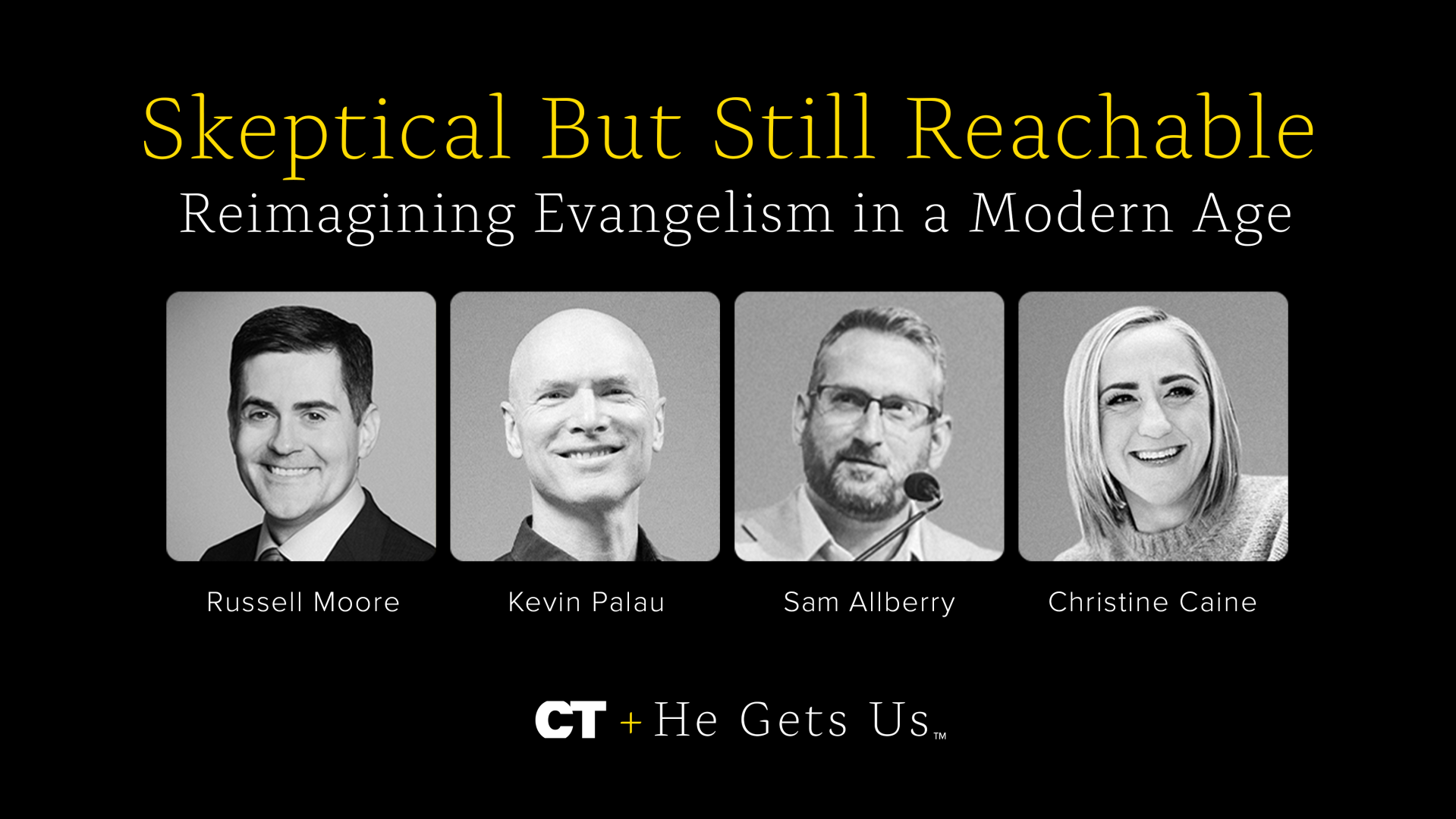
From the time of gospel tracts and door-to-door canvassing, evangelism has radically changed in the last 20 years. Join our host, Russell Moore, as we take a look at how today’s church can connect with those who are skeptical about faith. Panelists Kevin Palau, Sam Allberry, and Christine Caine will share the most rewarding and challenging parts of these relationships while offering tips and resources for engaging those with doubts and questions.
Jesus draws near to those who ask questions, so we can too.
Our Panelists
 He was a tiny man, frame so small he appeared almost fragile. But the passion with which he spoke revealed a forcefulness that contradicted both his frame and fragility. He was pleading with me, a Christian college president, to send some of our young people to his African nation as missionaries.“Is there really a place for white missionaries in black Africa today?” I asked.His answer was an affirmative—but with a qualification: “There is a great need for the right kind of white missionaries.”“And what kind is the right kind?” I queried.“Those who believe the Bible. If they don’t believe the Bible, we don’t need them.”“And why should that make such a difference?” I asked knowingly.“When the white men first came,” he said, “they brought with them a book, the Bible. They taught some of us to read it, and we found there was only one God, the Creator of all. We read of Christ and his passion. And it dawned on us that his blood was shed for black men just as it was for white. God had paid the same price for all.“For the first time,” my friend continued, “we knew the universal equality of all men—our universal brotherhood and sisterhood. We discovered our eternal worth!“If you wanted to enslave us, you should never have brought us that Book.”More quietly now, he brought our conversation to an end. “Yes,” he said, “there is still a place for white missionaries in black Africa—but only ones who really believe the Bible.”It has been ten years since that conversation, but I recall the passion still. It deepened a conviction in me that has intensified over the intervening years: That wherever twentieth-century thought is genuinely revolutionary, it has been in touch with the Bible.It does not matter whether the agenda is political, economic, social, or religious. Nor does its packaging matter: Ideologies that promote genuine justice and equality find their roots in Scripture.Consequently, when missionaries take the gospel to beleaguered nations, they are taking not only a personal message of salvation, but introducing values that may clash with those of the surrounding culture. Once man views his personhood in the light of God’s love, he can no longer be content with the dehumanization of poverty, oppression, racism, and tyrrany.Lesslie Newbigin alluded to this in the sixties, a period the United Nations declared the Development Decade. He pointed out that development to the UN meant promoting new values in developing nations. And such values (which Newbigin said ultimately stem from the Bible) would inevitably lead these nations to revolutionize their understanding of right relationships between other races and nationalities.All of which takes us back to my African friend. Do you suppose the whites who took the Bible to his people (or, for that matter, the blacks who received it) understood the inevitable political and social impact of their act? Probably not.A friend just returned from the World Methodist Council in Nairobi; Bishop Desmond Tutu was there. He told me how the bishop recounted the story of the whites going to South Africa. The blacks had the land, Tutu said, and the whites had the Bible.Then, said Tutu, the whites wanted to teach the blacks to pray. “When they opened their eyes,” Bishop Tutu continued, “the whites had the land and the blacks had the Bible.”The bishop raised his Bible and tenderly kissed it. “We will see,” he said, “who got the better deal.”If the Bible is wholly understood, there can be little doubt about the answer.
Russell Moore (moderator)
Russell Moore is public theologian at Christianity Today and director of Christianity Today’s Public Theology Project. Dr. Moore is the author of several books, including The Courage to Stand: Facing Your Fear Without Losing Your Soul, Onward: Engaging the Culture without Losing the Gospel, and The Storm-Tossed Family: How the Cross Reshapes the Home. A native Mississippian, he and his wife Maria are the parents of five sons.

Christine Caine
Christine Caine is a sought-after international speaker, author, and activist. Together with her husband, Nick, she founded the anti-human trafficking organization, The A21 Campaign—a recipient of the Mother Theresa Memorial Award for their work combating human trafficking among refugees. Christine and Nick make their home in Southern California with their daughters, Catherine and Sophia. Her most recent book, How Did I Get Here?, is available now.

Kevin Palau
Kevin Palau is president and CEO of the Luis Palau Association. Under his leadership, LPA has united tens of thousands of churches in hundreds of cities to love and serve their communities and clearly share the Good News of Jesus. Kevin helps lead TogetherPDX, a sustainable, united movement of churches in Portland, Oregon. His book, Unlikely: Setting Aside Our Differences to Live Out the Gospel, describes the ongoing impact of the movement.
 He was a tiny man, frame so small he appeared almost fragile. But the passion with which he spoke revealed a forcefulness that contradicted both his frame and fragility. He was pleading with me, a Christian college president, to send some of our young people to his African nation as missionaries.“Is there really a place for white missionaries in black Africa today?” I asked.His answer was an affirmative—but with a qualification: “There is a great need for the right kind of white missionaries.”“And what kind is the right kind?” I queried.“Those who believe the Bible. If they don’t believe the Bible, we don’t need them.”“And why should that make such a difference?” I asked knowingly.“When the white men first came,” he said, “they brought with them a book, the Bible. They taught some of us to read it, and we found there was only one God, the Creator of all. We read of Christ and his passion. And it dawned on us that his blood was shed for black men just as it was for white. God had paid the same price for all.“For the first time,” my friend continued, “we knew the universal equality of all men—our universal brotherhood and sisterhood. We discovered our eternal worth!“If you wanted to enslave us, you should never have brought us that Book.”More quietly now, he brought our conversation to an end. “Yes,” he said, “there is still a place for white missionaries in black Africa—but only ones who really believe the Bible.”It has been ten years since that conversation, but I recall the passion still. It deepened a conviction in me that has intensified over the intervening years: That wherever twentieth-century thought is genuinely revolutionary, it has been in touch with the Bible.It does not matter whether the agenda is political, economic, social, or religious. Nor does its packaging matter: Ideologies that promote genuine justice and equality find their roots in Scripture.Consequently, when missionaries take the gospel to beleaguered nations, they are taking not only a personal message of salvation, but introducing values that may clash with those of the surrounding culture. Once man views his personhood in the light of God’s love, he can no longer be content with the dehumanization of poverty, oppression, racism, and tyrrany.Lesslie Newbigin alluded to this in the sixties, a period the United Nations declared the Development Decade. He pointed out that development to the UN meant promoting new values in developing nations. And such values (which Newbigin said ultimately stem from the Bible) would inevitably lead these nations to revolutionize their understanding of right relationships between other races and nationalities.All of which takes us back to my African friend. Do you suppose the whites who took the Bible to his people (or, for that matter, the blacks who received it) understood the inevitable political and social impact of their act? Probably not.A friend just returned from the World Methodist Council in Nairobi; Bishop Desmond Tutu was there. He told me how the bishop recounted the story of the whites going to South Africa. The blacks had the land, Tutu said, and the whites had the Bible.Then, said Tutu, the whites wanted to teach the blacks to pray. “When they opened their eyes,” Bishop Tutu continued, “the whites had the land and the blacks had the Bible.”The bishop raised his Bible and tenderly kissed it. “We will see,” he said, “who got the better deal.”If the Bible is wholly understood, there can be little doubt about the answer.
Sam Allberry
Sam Allberry is a pastor, apologist, and speaker. He is the author of a number of books, including Is God Anti-Gay?, Why Bother with Church?, 7 Myths about Singleness, and What God Has To Say About Our Bodies.
Posted