Until recently, churches responded to growing attendance by building larger facilities. But the faltering economy makes raising large sums for building projects harder to accomplish. And combined with the aversion of younger churchgoers to the bigger-is-better ministry philosophy, these tight-money days are demanding imaginative alternatives. For some churches, the question has become, “Should we build at all?”
 The final curtain fell on the longest-running show in Broadway history after 13,981 performances. Alan Lampel has been there for roughly 13,000 of them. Mr. Lampel has done the same job in the same place for the same production from the very beginning of its existence. He takes a seat in a rolling chair at his desk in the back of the orchestra section of the Majestic Theater and plays the most important role that nobody should notice: He is the head electrician for The Phantom of the Opera.
“I’ve seen the show more than anybody on earth,” Mr. Lampel says. In fact, nobody has seen any show as many times as he sat through Phantom, which has sold 20 million tickets and earned .3 billion during a run that made other Broadway productions look more like high-school musicals. There was one guy keeping the lights on the whole time. And the success of any business is every bit as much about the electrician operating behind the scenes as the people taking a bow on stage.
Mr. Lampel was there at the start on January 26, 1988, and he was there at the end on April 16, 2023. That kind of longevity on Broadway is not just unprecedented. It’s unimaginable. There were colleagues he loved and bosses he didn’t. His responsibilities evolved with technology.
Others in the theater have no reason to pay attention to Mr. Lampel. But it’s those who understand Phantom the best who appreciate his contributions the most. Andrew Lloyd Webber, the show’s composer said, “Phantom has shone brighter on Broadway for 35 years because of the work of Alan Lampel.’”
Possible Preaching Angle:
In life, usually the author, the speaker, and the star of the show gets the praise. But quite often, just as much praise, if not more, is due the person who quietly and faithfully works behind the scenes. This is especially true in the church, where a faithful group of people often work unnoticed to set up chairs, staff the nursery, work with the youth, using their less “spectacular” spiritual gifts who also do the work of God.
“We have told many clients in the last couple years, ‘You’re not ready to build, because you aren’t sure what your ministry is,'” said Ed Bahler of the Aspen Group, a church design firm. “So what once took a few weeks has become a six- to twelve-month process: determining what their vision is and what they really need to do that ministry.” The firm now focuses on guiding church leaders through the vision process.
“People ask us what ministry will look like in ten years—with the impact of technology and the desire to attract younger people driving many of the choices they make today,” Bahler said.
“For some of these churches, the answer is not a new building. They can’t afford it, and it won’t accomplish their true purpose. It may be renovation of older sanctuaries, or holding services on multiple sites and venues.”
And for those who do build, it may be a very different building.
Instead of a larger worship center, one church built an additional, smaller worship space complete with stained glass, as an additional venue. Their study before building showed the Catholic backgrounds of many potential attenders created a desire for a church that feels like “church.”
That’s also a common desire among younger people, partly in reaction to the big-box multi-purpose warehouse-church decades.
Does this mean goodbye to the cafegymitorium? Perhaps. And perhaps, too, to the giant fundraising thermometer-tote board in the lobby.
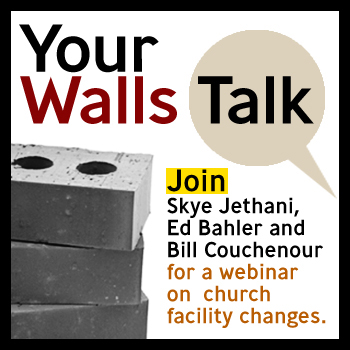
Ed Bahler and Bill Couchenour, presidents of two independent church design and construction companies and co-founders of the Cornerstone Knowledge Network, have decades of hands-on experience when it comes to creating effective ministry space. Skye Jethani will be interviewing Bahler and Couchenour about what church leaders should do before they decide to build or renovate their facilities.Sign up for the live webinar on November 17th.
The final curtain fell on the longest-running show in Broadway history after 13,981 performances. Alan Lampel has been there for roughly 13,000 of them. Mr. Lampel has done the same job in the same place for the same production from the very beginning of its existence. He takes a seat in a rolling chair at his desk in the back of the orchestra section of the Majestic Theater and plays the most important role that nobody should notice: He is the head electrician for The Phantom of the Opera.
“I’ve seen the show more than anybody on earth,” Mr. Lampel says. In fact, nobody has seen any show as many times as he sat through Phantom, which has sold 20 million tickets and earned .3 billion during a run that made other Broadway productions look more like high-school musicals. There was one guy keeping the lights on the whole time. And the success of any business is every bit as much about the electrician operating behind the scenes as the people taking a bow on stage.
Mr. Lampel was there at the start on January 26, 1988, and he was there at the end on April 16, 2023. That kind of longevity on Broadway is not just unprecedented. It’s unimaginable. There were colleagues he loved and bosses he didn’t. His responsibilities evolved with technology.
Others in the theater have no reason to pay attention to Mr. Lampel. But it’s those who understand Phantom the best who appreciate his contributions the most. Andrew Lloyd Webber, the show’s composer said, “Phantom has shone brighter on Broadway for 35 years because of the work of Alan Lampel.’”
Possible Preaching Angle:
In life, usually the author, the speaker, and the star of the show gets the praise. But quite often, just as much praise, if not more, is due the person who quietly and faithfully works behind the scenes. This is especially true in the church, where a faithful group of people often work unnoticed to set up chairs, staff the nursery, work with the youth, using their less “spectacular” spiritual gifts who also do the work of God.