



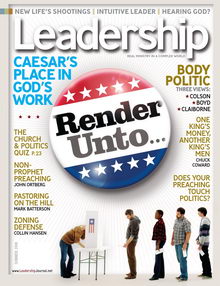
Most Christians agree that their faith affects how they approach politics, but disagreements arise over the political role of the church. A common source of confusion is the phrase "separation of church and state." Although the U.S. Constitution does not include these specific words, the phrase is part of the American lexicon and one that evokes strong reactions. Some associate the phrase with strident secularists who want to remove all vestiges of religion from the public square, forgetting entire traditions of Christian belief, such as Anabaptists, that uphold separation out of their religious convictions. Others assume that theological traditions affirming the integration of faith into all realms of life, including government, aim for nothing less than creating a theocracy.
These tensions, particularly in an election year, can cause confusion within a congregation. This quiz, created by our editors with input from political scientists, is intended to be a self-assessment tool for approximating where you stand on issues of church and state. The survey's goal is to stimulate healthy discussion and deeper thinking. Clearly, these relationships are far more complex than this simple tool can fully diagnose, but these questions are meant to provoke deeper reflection about the assumptions we carry and why we carry them.
On a scale of 1-5, mark the answer that best fits your perspective. (If, for example, you fall between response 1 and response 3, give yourself a 2.)
Take the Church & Politics Quiz

How did you score?
Total score for Part One _____ Total score for Part Two _____ Plot your total score for part 1 on the vertical axis and for part 2 on the horizontal axis. The intersections of the two marks on the graph will determine which of the four quadrants best describes your political/ religious perspective.
Your score, our findings
The vertical axis represents the role of the church in society and the extent to which you believe political engagement is part of the church's mission. People scoring on the upper half of the chart likely believe that the gospel has a social dimension, and therefore political activity by the church is a natural outgrowth of faith. These people are more comfortable with politically charged issues being addressed in the church. Those scoring on the lower half of the chart may see politics as important, but they do not link it to the gospel or mission of the church. In fact, they may see political activity as a distraction from the church's central task.
The horizontal axis represents the institutional role of the church in relation to the government— "the separation of church and state." People scoring on the left half believe the church should have a prophetic posture, staking a place outside the system in order to challenge those in power and call them to account. Those on the right half of the chart are generally supportive of the government and see the church offering guidance from within the system.
Combining the two axis scores will place a person in one of the four political quadrants. Radical Reformers see a strong prophetic role for the church and combine this with a robust call for political engagement to seek social and political change. In contrast, Quiet Critics steer away from a direct role for the church in politics, instead emphasizing the church's purity by maintaining a separation from the state. From this perspective, the church best shares the gospel by being an alternative community that models Christian love.
Those who emphasize the link between God and nation are generally more supportive of the system and want to foster connections between church and state. As a result, Thumpin' Theocrats sound the call for renewing a Christian America by recapturing its godly heritage. Private Patriots also connect religious practice with support of the nation, but their application of faith to politics is as an outgrowth of personal piety rather than church involvement.
Books for Radial Reformers | |
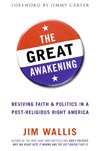 |
|
Books for Quiet Critics | |
 |
|
Books for Thumpin' Theocrats | |
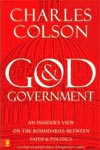 |
|
Books for Private Patriots | |
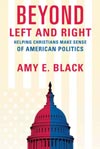 |
|
Amy E. Black is a political science professor at Wheaton College and author of Beyond Left and Right.
Copyright © 2008 by the author or Christianity Today/Leadership Journal.Click here for reprint information on Leadership Journal.