



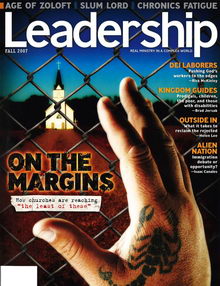
Your skin color can make you marginal in some settings. Your level of income or education can do it in others. Your worship style or theological persuasion or political party can put you at or beyond the fringe in still others. Being, thinking, looking, or acting different from the majority can push you to the margins.
I’d like to speak up on behalf of a group of people in our churches who feel different pretty often, and therefore feel marginalized pretty often. Dan Taylor, in The Myth of Certainty (IVP, 2000), calls them “reflective Christians.” Less sympathetic people call them doubters.
As nearly all Protestants know, in the 16th century, the Roman Catholic Church was excited about issuing indulgences—ways of reducing people’s time in purgatory through religious actions, especially giving money to the church.
Despite the church’s enthusiasm for it, a number of people couldn’t help but question the “indulgence program.” They doubted what the institution held with such certainty.
Something about it didn’t make sense to these reflective Christians. If they remained silent, they would feel dishonest and frustrated, but if they raised their questions, they would be seen with suspicion—not “team players,” you know? Some, like Martin Luther, spoke up (in the form of 95 theses) and found that reflective Christians of his sort didn’t have a future in the church at that time.
About a hundred years later, Galileo looked through a telescope one night and saw moons positioned like dancers orbiting Jupiter. He realized the church was wrong in upholding the traditional worldview it had inherited from Aristotle and Ptolemy.
Unfortunately, when he became a doubter of the party line, he discovered what Martin Luther did: reflective Christians weren’t welcome in the church at that time.
A similar story could be told about John Wesley, who doubted what everyone “knew”: sacred duties (like preaching) needed to occur in sacred spaces (like pulpits).
Or we could talk about reflective Christians like Phineas Bresee (founder of the Nazarenes) who doubted that poor people should be avoided by respectable Christians, or Menno Simons (leader among the Anabaptists) who doubted that Christians should kill other Christians in Christ’s name, or Martin Luther King and Desmond Tutu who doubted that race should be a factor in fellowship, or Bill Hybels or Rick Warren or maybe you.
The heroes we study in church history began as reflective Christians who doubted what everyone else took for granted, and as a result, were in almost every case marginalized.
When communities habitually marginalize or exclude their most reflective members—who ask tough questions about things that are completely normative for the majority—of course those who are stigmatized are wounded.
But so is the community that excludes, because in so doing, it cuts off resources of growth and renewal. It builds resistance to exactly what it will soon need.
Which raises an urgent question: Who are the reflective Christians in your sphere who may feel they’re already on thin ice at the margins, who may be close to being edged out completely?
What would it take to tell them they are wanted, needed, respected—that their differentness isn’t a problem to be solved by pressuring them to conform, but that their questioning is a resource?
Here’s a suggestion: listen to them. Try to understand their questions, frustrations, and fresh ideas. You don’t need to agree with them. Just be attentive, give them space to be who they are, even if they think differently from the majority. At times you may need to stand between them and their most vocal critics, to defend them from the forces of boundary maintenance and exclusion.
These forces can be brutal for reflective Christians, but a kind heart and a listening ear can keep our reflective Christians within the community, even if at the margins, not edged out. If every community eventually needs renewal, and if renewal comes from the margins—as it nearly always appears to do—then by amputating our margins, we do what the chief priests and scribes did when a needed voice showed up at the margins of their community. Are we listening?
Copyright © 2007 by the author or Christianity Today/Leadership Journal.Click here for reprint information on Leadership Journal.