



I worked my way through seminary as a night-shift copy editor with The Denver Post. Commuting from the numinous to the newsroom produced some unusual contrasts.
On weekends, when the football scores were coming into the sports desk, I often had to grin at the headlines on some of the parochial league games:
ST. JOSEPH WHIPS HOLY FAMILY. Or ST. FRANCIS CLOBBERS CARDINALS.
Not exactly what I’d been reading about those saints a few hours earlier.
As a divinity student (and son of a church historian) I saw even professional sports cities with different lenses. For me, San Diego, St. Louis, San Francisco, and San Antonio all testified as much to church history as sports history. Even today, when Dad and I talk, the conversation often mingles saints and superstars.
Ever since I first read Polycarp’s unflinching responses to the Roman proconsul who would sentence him to death, or the story of Loyola (his leg mangled by a cannon ball, he found a book on the life of Jesus and decided to become a soldier of Christ), I’ve been fascinated by the saints.
In his book All the Saints Adore Thee, Bruce Shelley (the aforementioned historian) puts this matter of sainthood in perspective: “Saints have always been part of the Roman Catholic and Eastern Orthodox experience. … Protestant piety seems dull by comparison. Baptists, Presbyterians, Lutherans, and other Protestants must cultivate their love for God somehow without the help of thousands of these colorful characters out of church history and folklore.
“A ‘saint’ came to mean one who has been ‘canonized,’ which means the person’s name was included in the Canon of the Mass. This list of recognized ‘saints’ was the original way the churches identified their heroes. The passing of the centuries, however, added so many names to the roll that it was not possible to mention them all in the Mass.
“In time, both Western and Eastern churches created a complicated process to determine their saints. For nearly a thousand years in the Roman Catholic Church, the apparatus for canonization required petitions from the dead candidate’s sponsors, a dossier of his or her good deeds, and a Devil’s Advocate whose function was to pick flaws in the case for the candidate. A ‘saint’ was one who passed the test.”
Because this revered status recognized the saint’s access to God, some believers would target their prayers through this individual.
“Protestants have their reasons, of course, for their rejection of ‘saints’ in this traditional sense. ‘Saints as miracle-workers and go-betweens,’ they say, ‘lead to an erroneous conclusion about the Christian faith. We don’t really need these saints. Jesus is all we need.’ “
Indeed, no human being, alive or dead, can replace Lord Christ in our worship. He, “the way, the truth, the life,” is absolutely unique.
Shelley continues: “Are we to draw from that fact, however, that no place remains for other ordinary Christians who have experienced the grace of God in an extraordinary way? Can’t we, in fact, see the Lord himself reflected in his servants and understand more readily what God can do with human nature?”
The Bible itself encourages us to ponder the lives of spiritual models. The “hall of faith” in Hebrews 11 offers a line-up of faithful men and women for us to consider.
Pastors, of course, find themselves in the unusual position of both looking for spiritual models and being looked at as models by others.
Not long ago, I was talking with a church leader who said, “I think the biggest danger to spiritual vitality is spiritual proficiency. My job pushes me to be smooth and professional while talking about faith. It’s easy to become proficient but hollow.”
Just because our spiritual models occasionally prove hollow (or we find ourselves feeling hollow), we need not give up the practice of learning from the lives of godly people.
I was encouraged by what W. E. Sangster wrote in his book The Pure in Heart: “The best way to approach the study of holiness is not first to seek a definition (which is doomed from the start to be inadequate), but to gaze steadily and long at those in whom, by general consent, this quality appears. …
“Let him gaze most of all at Jesus Christ. Let him examine the lives of the saints. Let him think on those obscure disciples he has met on the road of life who seemed always to have the breath of God about them. Let him be unhurried and teachable.
“And he will find that, far from holiness repelling him, it will fascinate and awe and subdue him. He will wonder at all God can do with human nature and sink to his knees in marvel and surprise. … and he will catch himself shaping the question: ‘Even me?’ “
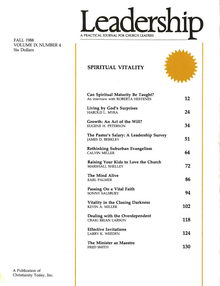
For church leaders who struggle to maintain spiritual vitality, this issue of LEADERSHIP offers a glimpse of some obscure disciples-none of them canonized, but saints nonetheless-who long for the breath of God and speak candidly about their experiences.
-Marshall Shelley is managing editor of LEADERSHIP
Copyright © 1988 by the author or Christianity Today/Leadership Journal. Click here for reprint information on Leadership Journal.