

Article

McBURNEY ON CONFLICT RESOLUTION

In trying to resolve conflict we usually take easy ways out.

First, we avoid it. Running from it, pouting about it, and pretending it’s not really happening seem initially more inviting than actually facing the conflict.

If avoidance doesn’t work we try intimidation. We threaten, cry, create power blocks, and quote Scripture .

Sometimes we can’t successfully intimidate, so we manipulate. This involves enticement, bribery, and withholding everything from sex to personal influence.

Our final solution is usually deflection. Instead of focusing on the real issue, we deflect off it to issues that are safer, more urgent, and more comfortable.

None of these work.

We should, instead, try to first establish a solid foundation for conflict resolution in each situation. Ask these questions: “Why do we need to resolve this? Do our mutual best interests require that we resolve this? Is resolving this a part of our Christian commitment, or a part of our marriage vows?” “I vowed in our marriage to love and be faithful to you. I want to resolve any conflict that comes between us based on that commitment.”

Then, identify the real issues. Are unfulfilled expectations causing the conflict? Is it a matter of who has the power or who’s going to have the last word? Is it a problem of trust?

Once you know the issue, identify feelings and share them. “You know, I’ve really felt neglected. I’ve been feeling angry. I’ve been feeling awfully lonely.” Because it’s difficult to share feelings, incorporate them with other experiences: “I feel like I did on our vacation when you went out without telling me, and I got very upset.”

Listen attentively to the other person. This requires practice because usually we’re busy preparing our defense instead of listening. If we’re not interested in hearing their side, we’re not interested in resolving the conflict; we merely want to prove we are right and they are wrong. We must learn to listen in a non-defensive way.

Be ready to concede. The other person is hurt by you. Even though you didn’t deliberately hurt him, you must accept that the person is experiencing pain that came from your side of the relationship. If you’re really concerned, you’ll be truly: sorry. Whether the cause of the conflict is moral failure or simply insensitivity, face up to it, confess it, and ask forgiveness.

Be forgiving. Often the reason we don’t want to forgive is because by withholding forgiveness, we feel a sense of superiority. This is pride and self-righteousness, and it can be cut away by forgiving.

Finally, learn how to compromise. By the time you’ve gone through the preceding steps, you should be ready to negotiate things that are important to you and the other person.

Copyright © 1980 by the author or Christianity Today/Leadership Journal. Click here for reprint information on Leadership Journal.

Posted April 1, 1980

Also in this issue

The Leadership Journal archives contain over 35 years of issues. These archives contain a trove of pastoral wisdom, leadership skills, and encouragement for your calling.

HOW ONE CHURCH

LEADERSHIP FORUM

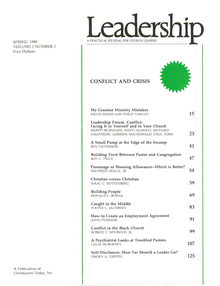
Conflict. Crisis. The corporate church often does not see its own power to make and destroy its servants.

How to Create an Employment Agreement

A youth pastor agreement as a model.

A Psychiatrist Looks at Troubled Pastors

An interview with Dr. Louis McBurney

IDEAS AT WORK

Preaching without notes next Sunday morning might become one of the most rewarding experiences of your life, according to Craig Skinner. Here are five tips that work for him.

My Greatest Ministry Mistakes

He watched his dreams crumble at Circle Church. Did that failure invalidate his ministry?

Conflict in the Black Church

The black church has often failed to manage conflict because it believes conflict is wrong.

A Message from the Publisher: April 01, 1980

Christian Versus Christian

Conflict is inevitable. When it comes, face it–and follow Jesus’ style of confrontational ministry.

Warning Signs: A Brief Guide for Pinpointing Breakdown between Pastor and Staff Members

TIPS, TRENDS & RESOURCES

A Parsonage or Housing Allowance-- Which is Better?

Manfred Holck, Jr., contrasts the viewpoints of pastors and congregations.

Comments from the Editor

Building People

Can people who are vastly different really learn to love one another? How can a caring fellowship be built upon such differences?

SELF DISCLOSURE: HOW FAR SHOULD A LEADER GO?

You’re told to be vulnerable–to disclose yourself honestly to those around you. But like most of us you’re painfully aware that honest self-disclosure can blow up in your face.

Problem Solving

Building Trust Between Pastor and Congregation

What can be done about the fact that in many churches a pastoral crisis occurs about every 18 months?

LETTERS

When the Alligators Are Snapping

Dealing with conflict that threatens to tear a small church apart.

Caught in the Middle

How can staff members be true to themselves and follow a leader with whom they disagree?

BOOK COMMENTARY

View issue


Our Latest

Apple PodcastsDown ArrowDown ArrowDown Arrowarrow_left_altLeft ArrowLeft ArrowRight ArrowRight ArrowRight Arrowarrow_up_altUp ArrowUp ArrowAvailable at Amazoncaret-downCloseCloseEmailEmailExpandExpandExternalExternalFacebookfacebook-squareGiftGiftGooglegoogleGoogle KeephamburgerInstagraminstagram-squareLinkLinklinkedin-squareListenListenListenChristianity TodayCT Creative Studio Logologo_orgMegaphoneMenuMenupausePinterestPlayPlayPocketPodcastRSSRSSSaveSaveSaveSearchSearchsearchSpotifyStitcherTelegramTable of ContentsTable of Contentstwitter-squareWhatsAppXYouTubeYouTube
Down ArrowbookCloseExpandExternalsearch